Swartwout Chronicles Chapter I, Pages 1-4 Frisian Ancestors, 1335-1641

Excerpts including origins of the family name, Swartwout…

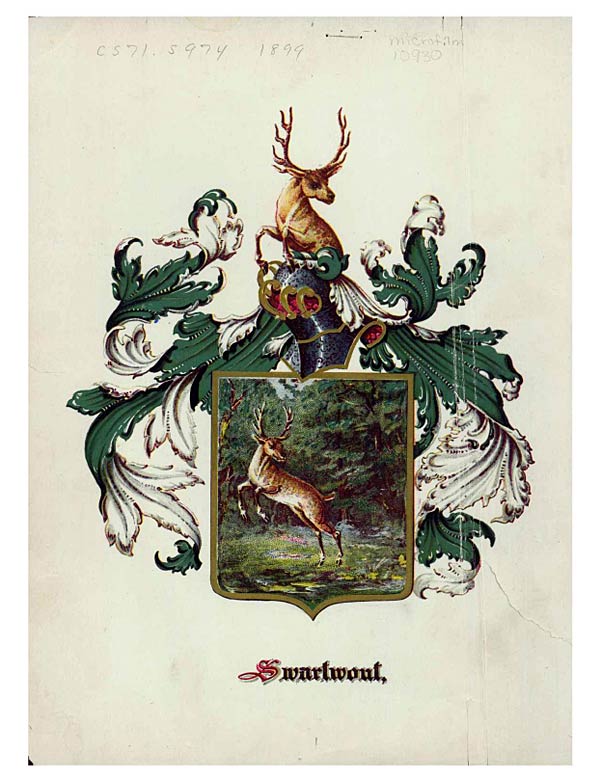
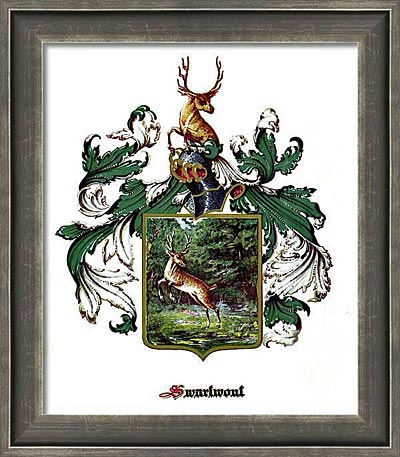
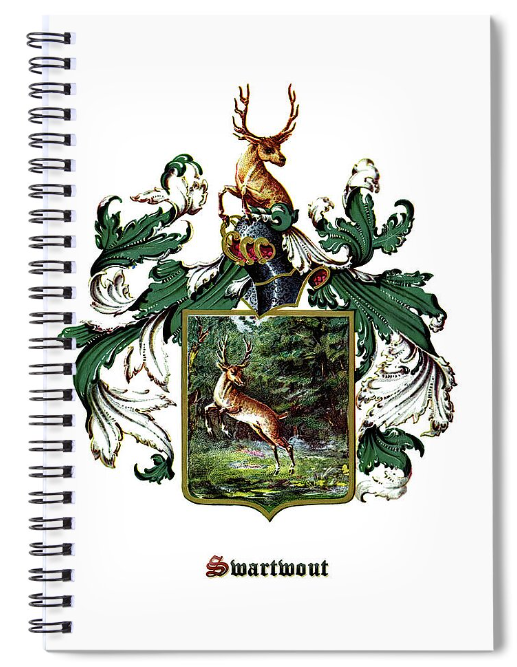
Swartwout Coat of Arms
(Available as prints and more.)

In the first ages of the world people were distinguished by names descriptive of their origin, appearance, traits of character, and by titles derived from imputed blessings of the Diety : Adam (red earth), Cain (gotten from the Lord), Laban (white), Esau (hairy), Jacob (supplanter), Solomon (peaceful), Jonathan (gift of Jehovah), Nehemiah (comfort of the Lord). Later such appellations were frequently bestowed without any consideration of their signification being accepted as denoting the individual’s derivation, features, disposition, or attributes.

Surnames are so called because they were originally written above those first designating mankind. They were then used to denote the vocations, localities of residence, rank, or kinship of the persons bearing them: Faber (Latin, smith), Zimmerman (German, carpenter), Clinton (Dano-Norman, promontory-town), Amherst (Saxon, woodland-village), Sigsby (Anglo-Saxon, town of victory), Prescott (English, priest’s cottage), Luther (German, renowned chief), Johnson (English, son of John). In England and France surnames became hereditary about the eleventh century. As family titles they have been perpetuated mainly by records of sale and purchase of property, by wills, and other instruments of writing.


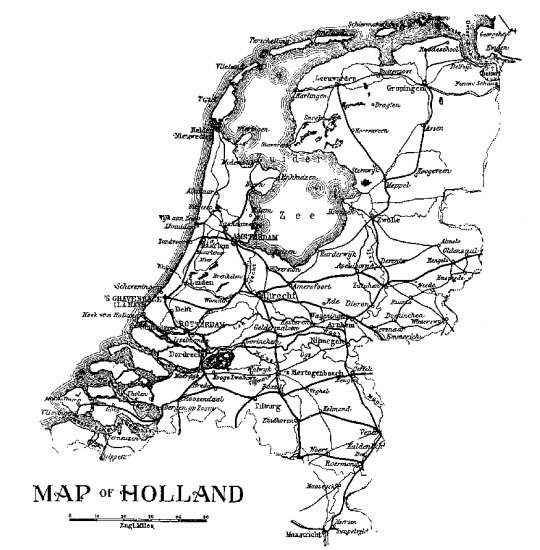
In the middle ages the names of the seats of ancestral estates began also to be used to designate the families possessing them. The appellation Black-wood, derived from a forest-covered demesne in Scotland, has long been the title of a well-known family living in that part of Great Britain. Six centuries ago the synonymous cognomen Swartwout (Blackwood) similarly originated from a densely-wooded manor lying in that part of Frisia or Northern Holland, now known as the district of Ferwerderadeel, in the province of Friesland. A primeval forest, figuratively styled by the inhabitants het Zwartewoude (the Black Forest), then stretched across that part of the Netherlands, north of the city of Leeuwardcn. Now only a few scattered groves diversify the level landscape where formerly the vast wood was imposingly conspicuous. The westward range of this dark forest is still indicated on maps of the province by its early geographical title, Zwartewoude.

Swartwout Chronicles, Chapter 01,  Page 02, Map of Holland
Map of Holland
Swartwout Chronicles, Chapter 01, Page 2

(n.b. Zwarte, also written swarte, a Dutch adjective, meaning black, and agreeing with the neuter substantive woude, also written wout, of the same language, signifying a wood or forest. There is also a Dutch noun, hout, expressing wood or timber as material. The Dutch words woud and hout are closely allied in meaning to the German terms wold or wald, and holt or holz.

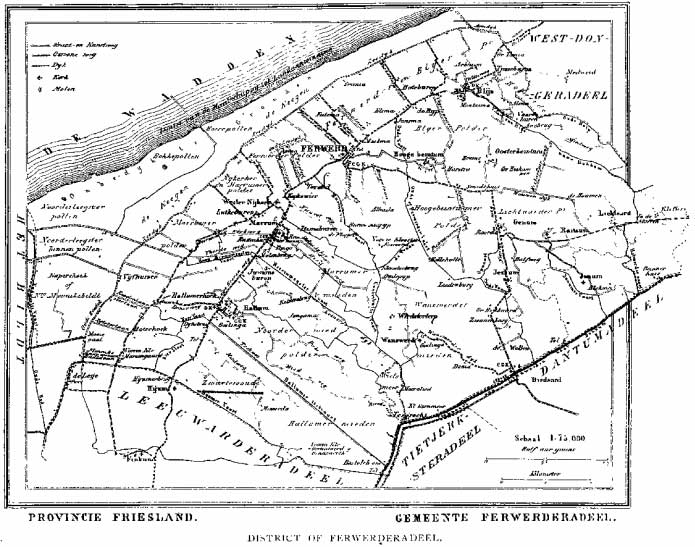
Zwartevoude or Zwartewold, the present tract of land bearing that name, is described as lying in the canton of Holwerd, arrondissement of Leeuwarden, districtof Ferwerderadeel, quarter of Oostergoo, in the province of Friesland, bordering northwest on the highway from Hallum to Hallum, northeast on the Hallum canal, southeast on the Hallum meadows, and southwest on the Hallum lake, and having an area of five English acres and certain fractions of an acre. (“Zwartewoude of Zwartewold, streek lands, prov. Friesland, kw. Oostergoo, griet. Ferwerderadeel, arr. Lceuwarden, kant. Holwerd; palende N. W. aan den rijweg van Hijum naar Hallum, N. O. aan dc Hallumervaart, Z. O. aan de Hallumermieden, en Z. W. aan het Hijumermeer, en eene oppervlakte beslaande van 5 bund. 65 v. r. 50 v. ell.”))

Swartwout Chronicles, Chapter 01, Page 04, Province Firesland
Province of Friesland, District of Ferwerderadeel
Swartwout Chronicles, Chapter 01, Page 03

The ensigns armorial or coat-of-arms of the Frisian Swartwouts emblematically represent not only the woody locality of the patrial manor, but also the political freedom which they originally enjoyed as possessors of the extensive estate of Zwartewoude. The right of emblazoning on their war-shields the proper figure of an alert deer bounding across a grassy glade of a dark forest was granted the male members of the family, by royal decree, in the thirteenth century. (n.b. Ecusson: un ccrf sauiant guardant dans line clairere d’une foret noire. Citnier: la tete d’un cerf guardant. Lambrequin: de sinople et d’argent . Vide: Frontispiece.) The inspiring augury, contained in an ancient statute-book of the country, that its inhabitants should be “free as long as the wind blows out of the clouds and the earth remains,” they intrepidly sought to verify by the might of their weighty swords in frequent engagements with foreign invaders, who again and again attempted to put them under subjection.

The Frisians, originally a Germanic race, were already occupying the northern territory of Belgic Gaul when Julius Caesar, in the year 57 8.C., invaded it. They were then far advanced in successful methods of agriculture, and so rich in cattle that they were required by the Romans to pay a heavy tribute in hides and horns. Their fair complexions, bright blue eyes, heavy locks of auburn hair, great stature, and physical vigor, constantly commanded the admiration of the Latin invaders. The men, clad in plainly -made woolen tunics and loosely-fitting breeches, and the women, as simply attired, were so grand in character that they quickly won the respect of the Roman soldiery.

The people of Frisia recognized the existence of God, in whose divine fatherhood they discovered care and guidance, and whom they worshipped in consecrated forests on appointed days. They had no priests and offered no sacrifices. They hallowed marriage; each man exclusively honoring with his affection and fortune the woman chosen for his wife.

The frequent incursions of foreign forces, led by ambitious and depraved commanders seeking to dispossess the inhabitants of Frisia of their property and independence, gradually distempered their minds and morally debased their offspring. It happened in the year 728 that Archbishop Wolfram, of Sens, in Gaul, under the sanction of Charles Martel, or Charles the Hammer, undertook the conversion of the people of Friesland to Christianity. Among those who were willing to be baptized in evidence of their acceptance of the religious teachings of the zealous dignitary was Radbod, a dethroned Frisian king. While waiting to receive the outward sign confirmatory of his faith, his thoughts reverted to his deceased pagan ancestors. “Are they in heaven or hell?” he asked. “In hell,” the pious prelate answered. “Then I would rather dwell hereafter with my kindred there than with a few strange Christians in heaven,” he frankly declared, and forthwith strode away from the surprised archbishop.

Poppo, the son of Radbod, who succeeded him in governing Friesland, was killed in 750 in a battle with Charles the Hammer, who established at Utrecht the famous episcopate of which Saint Willebrordus was the first…

CONTINUED: Chapter 01 pp 5-8 Frisian Ancestors

Preface to the Swartwout Chronicles

This Preface to The Swartwout Chronicles – as copied and transcribed from a file obtained from the Library of Congress – written by Arthur James Weise in 1899 – provides a synopsis of what is found, in much greater detail, within the body of the entire manuscript.

WHEN the author of these chronicles began searching for information relating to the ancestors of the Swartwout Family, none of its members had any knowledge of the place or places of residence in the Netherlands of the one who settled in New Netherland in the sixth decade of the seventeenth century. Accepting certain hearsays as true, some of his American offspring believed that they were respectively the descendants of two or more brothers who had come in that century from Holland with their households to occupy and cultivate tracts of bush-land bordering the river explored, in 1609, by Henry Hudson. An ensnaring fiction later induced others to receive the coat-of-arms of the Edinburgh Blackwoods as that of the Swartwout Family.

The descent of the members of the different American branches of the family, now writing the cognomen Swartwout, Swarthout, Swartout, and Swartwood, is distinctly traceable to Tomys Swartwout, who, in 1655, was appointed a schepen (magistrate) of the court of Midwout (Flatbush), on Long Island.

The object of Major William Merrill Swartwout in having these chronicles published in the attractive form in which they appear – there being only one hundred copies of them printed – is assuredly noteworthy. Believing that a memorial history of the Swartwout Family in Holland and America would more advantageously perpetuate a knowledge of the public services of its members than any other monument, he considerately leaves with the readers of this work the determination of the judiciousness of his choice of the means to accomplish that purpose.

In a sojourn of three months in the Netherlands, the author found many rare and valuable records in different depositories of church registers, municipal documents and state papers containing important information relating to the ancestors of the family. A visit to the site of “hct Zwartewoud” (the Black Wood), originally diversifying the northern part of the Low Countries known first as Frisia, and later called Friesland, afforded him an enjoyable view of the extent of land once the manor from which the family derived its topographic name. There and in the vicinage of the Black Wood, the emblematic bearings of the Swartwout escutcheon were early seen on shields and standards conspicuous in the battles in which the valorous Frisians repeatedly discomfited the forces of foreign invaders, for, since the time of the Latin historian Tacitus, that ancient stalwart race of Germans has had renown for its love of independence.

The political eminence of the Frisians in the Middle Ages is remarkably substantiated by the fact of their adjudicating differences arising between the inhabitants of one part of the country and those of another by the agency of arbitration commissioners. The constitution of the arbitration commission, of which, in 1338, Otto Swartewold of Drenthe was a member, is historically described as having been honored with the singing of “a great number of triumphal songs” by assemblages of gratified people. The ennobling character of the state-craft adopting this laudable method of settling sectional disagreements was signally heightened by the moral excellence and superior intelligence of the commissioners. The scroll of parchment on which the awards of the commission were engrossed, on June 30th, that year, in Latin, is preserved in the Imperial Archives of the province of Groningen, and of which a photo-engraved copy is displayed on two pages of the first chapter of the Swartwout Chronicles.

The protective manner in which officers were selected to administer the affairs of the city of Groningen was manifestly conducive to the maintenance of good government. A body of well-born and upright men, called as early as 1324 the Wisdom of the City (de Wijsheid der Stadt), and a century later the Sworn Commons (de Gezworene Meente), possessed the exclusive right to determine the eligibility of citizens to be municipal officers. In 1580, Johan Swartwolt was a member of this college of local sages, as he was afterward, and also as was Herman Swartwolt.

In the long war with Spain, the Frisians heroically perpetuated their native invincibility on many fields of battle. In 1580, when the enemy besieged Steenwijk, the daring achievement of Arent Swartwolt in extinguishing the flames enveloping the palisades protecting a gateway of the walled town, which the foe had surreptitiously set on fire on a dark night and had then guardedly covered with the guns of a concealed body of sharp-shooters, is still admiringly recounted by Dutch historians.

Tomys Swartwout and his brothers Wybrandt and Herman were the first of the Frisian Swartwolts to write the surname conformable to modern Dutch orthography. They were evidently the first Hollanders to engage in the wholesale business of buying and selling in the Netherlands tobacco cultivated by colonists in Virginia and New Netherland. The fact of their dealing, in 1629,

in Amsterdam, in tobacco grown and cured on the island of Manhattan, or three years after the purchase of the island by the Dutch West-India Company from the Indian proprietors, is well established.

It is no less important to mention here that Tomys Swartwout was one of the nineteen courageous representatives of the settlers of New Netherland, who, in convention, in the city-hall, in New Amsterdam, on December 11, 1653, dared to remonstrate against a continuance of the maladministration of the affairs of the province by the arrogant directorate of the West-India Company, and to claim for the taxed colonists a right of voice in the government of it. The aggressive action of this first landdag of the oppressed inhabitants of New Netherland, although contemptuously ignored and regarded by the despotic guild of avaricious merchants as meriting severe punishment, so that other colonists might be deterred from “deliberating on affairs of state,” had, nevertheless, in the fulness of time, a glorious consummation in the declaration of independence of the thirteen united American colonies.

As a strenuous upholder of the rights of the colonists, Roeloff Swartwout was as fearless as his father in the utterance of his political convictions. When the choice of delegates to the provincial convention, held in New York city, in 1690, was about to be made, he boldly advised that “it ought to be a free election for all classes.” By birth and education the equal of most, if not all, of those who pompously “deemed themselves favorites of royalty” and politically isolated from “the common people,” he was not troubled by any apprehensions of losing prestige and preferment in becoming a partisan of Jacob Leisler, whose military experience, wealth, and excellence of character commended him to the Committee of Safety which deputed him “to exercise and use the power and authority of a commander-in-chief” of the province “until such time as orders should come from their most sacred majesties, William and Mary, king and queen of England.” The iniquitous and precipitate execution of Leisler and his son-in-law, brought about by a few ambitious and revengeful men, was an event strikingly horrifying and pitiful.

The participation of Lieutenant Abraham Swartwout in the siege of Havana and in the storming of Morro Castle and other Cuban strongholds, by the English, in the summer of 1762, gives prominence to the fact that the valor of the members of the Swartwout Family in America, in the colonial period, was not only notable in engagements with the French and their allies at places near the homes of the vigilant frontier settlers, but also along the distant borders of Canada and the more remote island in the West Indies.

The patriotism of the family was also brilliantly exhibited in the war of the Revolution by the services of twenty-nine of its members ; one having the rank of brigadier-general, three that of captain, three of lieutenant, and four of ensign, two of whom were institution-members of the Society of the Cincinnati.

The appellation Swartwout designated, in September, 1776, a temporary fort, constructed at that time near Spuiten Duivil Kill,for the defence of the city of New York.

The voluntary contribution, at Fort Schuyler, on August 3, 1777, by Captain Abraham Swartwout, who, as a lieutenant of volunteers, had served, in 1762, in the successful campaign of the English forces in Cuba, of his valuable blue cloth cloak to form the field of the first United States flag that was made conformable to the style of the national standard established, on June 14, 1777, by the American Congress, is an historical fact inseparable from the genesis of the star-constellated banner of “the Land of the Brave.” The testimony of an order of the Pennsylvania Navy-Board, written on May 29, 1777, to pay Elizabeth Ross “fourteen pounds twelve shillings and two pence for making ships’ colours, etc.,” in no way substantiates the claim that she fabricated a United States flag “prior to the Declaration of Independence,” nor does it verify in any manner the assertion that the American Congress “issued an order on the treasury” to pay her a similar sum for making a flag or flags of the design set forth in the resolution of June 14, 1777.

The bold statesmanship of General Jacobus Swartwout, one of the original law-makers of the state of New York, who for eighteen successive years served six as an assemblyman and twelve as a senator, added no little lustre to his prompt and early service in the war of the Revolution.

The arena of party politics in the state of New York, at the beginning of the current century, presented scenes and characters peculiar to that time. The eager gatherings of the different leaders’ forces, their violent onsets at the polls, and the loudness of their voicings of victory were as remarkable as the characteristics of the spirited men who outlined the plans of the successive campaigns, named the candidates, and marshalled the electors. The illustrious prestige of the federalists and the vivid vigor of the republican-democrats gave more than ordinary distinction to the two antagonizing parties. Hamilton’s early discovery of the growing popularity of Aaron Burr made him the more ambitious to lessen it, which consequently stimulated the zeal of the young democrats to increase it. The factionary alliances of the Livingstons, the Clintons, and the Schuylers not infrequently changed the preponderance of public favor from the candidates of the one party to those of the other. The strong individuality of John Swartwout made him a distinguished favorite of his party, and, inasmuch as his frankness and integrity invalidated many of the unjust animadversions of his opponents, he was thrice elected to a seat in the state legislature. The duel which he so resolutely fought with DeWitt Clinton was evidently to him the only honorable means by which he could disprove the intemperate and unfounded expressions of his reckless and sclf-opinioned traducer.

The clandestine and perilous methods adopted by General James Wilkinson to conceal his disloyal machinations and treasonable acts from the knowledge of the national government and the people of the United States during the time he was engaged in the attempt to place Spain in possession of the territory of Louisiana, and to persuade the people of Kentucky to secede from the Union and acknowledge the supremacy of that foreign country’s power, and thereby obtain for himself compensatory riches and titular distinction, exemplify an art of traitorous diplomacy truly astounding. Wilkinson’s faithlessness to Aaron Burr, whom he knavishly used and artfully vilified in order to keep the public ignorant of the fact that he himself was the concocter of the plots which made his enthusiastic and incautious servitor a conspirator and a filibuster, reveals in liveliest colors Wilkinson’s nefarious selfishness and personal turpitude. The temporary perplexity of General Wilkinson in determining the character of his treatment of Samuel Swartwout, to whom Burr had entrusted the delivery of the famous cipher-letter to Wilkinson, was undoubtedly due to Wilkinson’s belief that the young man would not belie Burr’s description: “a man of inviolable honor and perfect discretion; formed to execute rather than project; capable of relating facts with fidelity, and incapable of relating them otherwise.” This truthful characterization evidently made Wilkinson unwilling to place full faith in the frankness and candor of the disinterested bearer of the cipher-letter. When acquitted of the charge of treason brought against him by Wilkinson, Samuel Swartwout, in publicly proclaiming him guilty of treason, forgery, and perjury, did not use words inapplicable to the numerous and now more clearly established offenses of the execrable impostor.

The outbreak of hostilities between the United States and Great Britain, in 1812, again quickened the martial spirit and valorous proclivities inherited by the members of the Swartwout Family. Midshipman Augustus Swartwout, although seriously wounded, persistently superintended the firing of a gun on the flagship Lawrence until it was dismounted, in the ever-memorable naval battle on Lake Erie, in which Captain Oliver H. Perry, with a squadron of small wooden vessels, grandly obtained the distinctive renown of having commanded the first United States fleet that encountered in a regular line of battle one of an enemy, which, having been worsted in a long and desperate action, he captured entire, without losing a single vessel of his own. The dash and gallantry of Brigadier-General Robert Swartwout in the battle of Chrysler’s Field was the admiration of all the brave men who participated in it. As captain of the independent military organization, titled the Iron Grays, Samuel Swartwout was regarded by the citizens of New York as being the inspirer of the esprit de corps which gave it the noted distinction which it so long enjoyed as being the pride of the city. Composed of young men of marked social standing and education, the corps became famous for its skilled use of arms and precise and rapid evolutions, and its parades on the Battery and field manoeuvres always attracted

large throngs of people to witness them. Fitz-Greene Halleck, the poet, was a memberof the company.” The patriotism of

“Swartwout’s gallant corps, the Iron Grays,”

inspired him to write several metrical compositions in laudation of the note worthy loyalty of its members in volunteering their services for the defense of the city during the war.

The attempt of the three energetic brothers, John, Samuel, and Robert Swartwout, to reclaim for cultivation the tide-swept marshes of New Jersey, immediately west of the Hudson River, and opposite the city of New York, by ways and means similar to those seen in Holland, obtained for their extraordinary enterprise deserved commendation. The relinquishment of the feasible project for want of adequate money has monumentally left there large areas of dry ground and the bold outlines of one hundred and twenty miles of wide ditching to demarcate the extent of the planned work and demonstrate the obvious utility of the vast undertaking.

The criminal complicity and conspiracy of two dishonest employees of Samuel Swartwout, while he was collector of customs at the port of New York during the administration of Andrew Jackson as president of the United States, in having him adjudged a defaulter, and causing him to be dispossessed of his extensive and valuable property, are so clearly and conclusively established by the facts and testimony presented in the thirteenth chapter of this work that every reader of it will certainly wonder why a publication of this incontrovertible evidence was not earlier made. The reprehensible action of the national government in summarily taking and selling the estate of the traduced ex-collector on the assumption that the allegations of the perjured and perfidious cashier and his despicable confederate were true, not only abruptly deprived Samuel Swartwout of his property and irremediably impoverished the guiltless man, but unhappily influenced people to believe that the charges brought against him were indisputably authoritative and unequivocally substantiated. The culpability of the national government in not accounting to Samuel Swartwout for the valuable property which it unjustly took and sold is as remarkable as its deafness to the persistent appeals which the conscientious ex-collector personally and by representatives made to obtain a settlement of his accounts with it.

The inherent patriotism and loyalty of the Swartwout Family led many of its male representatives to volunteer their services for the preservation of the Union at the beginning and during the progress of the Civil War. On different battle-fields not a few heroically terminated their lives, others died in hospitals and prisons of wounds and disease, and some still bear honorary marks of commended valor. The fierce engagement of the Portsmouth, commanded by Captain Samuel Smith Swartwout, with the water batteries on the banks of the Mississippi River, to render practicable the attempt of Admiral Farragut to pass Forts Jackson and St. Philip with his fleet of wooden vessels, and reach and capture New Orleans, was introductorily particularized in the official report of the successful feat which made lastingly famous the bold venture of the distinguished naval officer who accomplished his object with the loss of but one vessel. The fortitude of Adjutant William Merrill Swartwout, after being deprived of his left arm and having the pectoral muscles on that side of his body seriously lacerated by a two-hundred-pound projectile, at Dutch Gap, on the James River, was considered to have enabled him to ward off the fatal consequences commonly resulting from such frightful wounds. His observation of the bravery of his comrades-in-arms and their exemplary endurance of many physical afflictions in the field led him to erect, on the Soldiers’ and Sailors’ Plat, in Oakwood Cemetery, at Troy, N. Y., a conspicuous flag-staff on which he has had displayed, constantly since 1894, a United States flag to keep alive recollections of the courage and services of the deceased veterans whose remains are there entombed.

The briefer history of the Ketelhuyn Family in Germany and America begins, in 1451, with particulars of its possession of an ancestral estate called Ketelshagen, on the island of Rugen, in the Baltic Sea. Joachim Ketel, titled a doctor of laws, and, in 1578, elected burgomaster of the city of Demmin, in the province of Pommern, in Prussia, was the grandsire of Joachim, who wrote his surname Ketelhuyn, and settled, in 1642, at Fort Orange, in New Netherland.

His son, Daniel Ketelhuyn, who had been a lieutenant in Colonel Richard Ingoldsby’s regiment of Independent Fusileers, was occupying a farm at Schaghticoke, in the province of New York, which, in October, 1711, became the scene of a massacre shockingly barbarous in its horrifying features.

The military record of the different members of the Ketelhuyn Family who took part in the colonial wars, the war of the Revolution, and that of 1812-15, highly authenticates their individual patriotism and bravery.

Lieutenant Sumner E. W. Kittelle, of the United States Navy, who, as an officer of the dispatch-boat Dolphin, was in different engagements with the enemy on and off the coast of Cuba, during the recent war with Spain, is of the seventh generation of the descendants of Joachim Ketelhuyn, who, in 1652, was one of the founders of the village of Beverswyck, later called Albany.

Of the one hundred and more engravings illustrating these chronicles, the reduced fac-similes of the original Dutch text and embellishments of the nuptial poem and wedding songs composed in honor of the marriage of Tomys Swartwout and Hendrickjen Barentse Otsen, on June 3, 1631, will, without doubt, be highly prized by the members of the Swartwout Family as ancestral souvenirs. The author’s versified translations of the Dutch epithalamium and songs are as literal as the meaning of the text could be harmoniously construed in English.

The publication of this work must indissolubly link hereafter the name of Major William Merrill Swartwout with his munificence in making it a memorial of inestimable historical value to the members of the two families, and a book uniquely elaborate in binding and delightfully satisfying in typography.

Besides the author’s gratification in finding in different provincial and municipal archives in the Netherlands the information concerning the ancestors of the Swartwout Family set forth in this volume, his remembrance of the interest taken in his researches by the courteous and scholarly archivists who there graciously and officially furthered them, urges him to acknowledge here his great indebtedness to Mr. J. A. Feith, the imperial-archivist of the province of Groningen, and to Mr. W. R. Veder, the archivist of the city of Amsterdam, for many favors of their time and knowledge, and to express his obligations for the kind services of Mr. S. Muller Fzn., the imperial custodian of the archives of the province of Utrecht, and those of Mr. I.van Sloterdijk, and Mr. C. M. Dozy, severally archivists of the municipal records of Leeuwarden and Leyden.

Arthur James Weise.

Troy, N. Y.,

August15, 1899.


Chapter 05 Colonial Officers, 1720-1762, pp 156-173

Most conspicuous of the topographical features of the territory of Dutchess County – so named in 1683 in honor of the duchess of York and Albany…

(Note: Not yet edited/formatted.)

…is the range of mountains early called the High Lands which border it on the south. The longest of the streams meandering through
its fertile valleys to the Hudson River is the creek originally specialized in
letters-patent by the name of the Fresh Kill and subsequently called by
the Dutch the Visch Kill(Fish Creek), flowing into the Hudson about seven
miles south of the mouth of Wappinger Creek. Two miles north of the last
named stream is a smaller watercourse once familiarly known as Jan Casper’s
Kill.
It was early and is still a Dutch custom to measure distance on land by
the space of time in which an able-bodied man can walk it. In Holland, at
the intersection of roads one may see finger-boards pointing in the direction of
localities through which the several highways pass and bearing inscriptions
of the hours going {iirengaans) to them. One hour’s walk (een uur gaans) is
considered by Netherlanders as equaling three English miles. (See half uur
gaans on map, page 3.)
The first persons to acquire legal tenure to land included within the later
territorial bounds of Dutchess County were Francois Rombout and Gulian
Verplanck, who at the time were engaged as a firm in merchandising in the
city of New York. Having solicited Governor Thomas Dongan to permit
them to buy from the native Indians a tract of land comprising about eighty
five thousand acres, they were duly licensed, on February 28, 1683, to pur
chase it.
On August 14, that year, twenty-two warriors of the Wappinger tribe of
Indians, in the name of their sachem,


Megriesken,” conveyed to the two
1 In the act erecting the county and other similar divisions of the territory of the province of New
York itis titled the Dutchesses County.”
156
DUTCHESS COUNTY, AS SHOWN ON SAUTHIER’s MAP OF THE PROVINCE OK NEW YORK, IN I779
158
THE SWARTWOUT CHRONICLES.
merchants, for certain measures of powder, lead, wampum, rum, beer, hatchets,
knives, pipes, tobacco, blankets, cloth, and other goods, the desired quantity
of land lying on the east side of Hudson’s river, north of the High Lands, and
more particularly described as “beginning from the south side ofa creek called
the Fresh Killand by the Indians Matteazvan, and from thence northward
along said Hudson’s river five hund (1
. rodd [about one and a half English
miles] beyond the Greate Wappins Kill[or Wappingers Creek], called by
the Indians Mawcuawasigh, being the northerly bounds, and from thence into
the woods fouer hovers goeing, alwayes keeping five hund’1
. rodd distant from
the north side of said [Greate] Wappins Creeke, however itrunns ; as alsoe

from the said Fresh Killor Creeke called Matteawan, along the said Fresh
Creeke into the woods, att the foot of the said high hills, including all the reed
or low lands at the south side of said creeke, withan easterly line fouer houres
goeing into the woods, and from thence northerly to the fouer hovers goeing
or line drawne att the north side of the five hund’ 1
. rodd beyond the Greate
Wappinger Creeke or Kill,called Mawenawasigh” 1
Gulian Verplanck having died before letters-patent were granted him and
Francois Rombout as possessors of the tract, Stephanus van Cortlandt became
associated
with Francois Rombout as a partner, who, with Jacobus Kip, then
the husband of Henrica, the widow of Gulian Verplanck, obtained, on October
17, 1685, the right and title to it by letters-patent.
Meanwhile, on September 26, 1683, Francois Rombout married Helena
van Balen, a widow, by whom he had a daughter named Cathryna, who, when
eighteen years ofage, became the wife ofRoger Brett, an Englishman merchan
dising in the city of New York. Having inherited on the death of Francois
Rombout, in 1691, his property, they, about the year 1712, settled on that part
of the Rombout manor comprising the site of the village of Matteawan, and
built a home, later known as “the Teller Mansion,” on a rise of ground,
on the north side of the Fish Kill,about a mile east of the Hudson River.
At the mouth of the Fish Kill,on the north bank of the stream, they erected

and operated a grist-mill, which, for many years was titled Madam Brett’s
mill.”
In the act erecting Dutchess County, on November 1, 1683, its territory is

described as lying within the following boundaries : The Dutchesses County
to be from the bounds of the county of Westchester, on the south side of the
Highlands, along the east side of Hudson’s river as farr as Roelof Jansen’s
Creek, and eastward into the woods twenty miles.” 2
On the division of the province into counties, or more accurately, on July
1 Book ofpatents, 5, pp. 206-210.
2 Documents relating to the colonial hibtory of the state ofNew York, vol. xiii.,p. 575.
THE SWARTWOUT CHRONICLES.
159
30, 1685, Robert Sanders 1 and Myndert Harmanse, residing in the city of

Albany, obtained a deed of sale” from a number of native Indians for a tract
of twelve thousand acres of land in Dutchess County, “bordering” upon the

Hudson, called Minnisink” being north of the land of Savereyn, alias called
the Baker, with the arable and woodland, [and] marshes, with the creeke called
Wynachkee, with trees, stones, and further range, or outdrift for cattle, and the
fall of watters called Pondanickrien, and another marsh, lyeing to the north of the fall of watters, called Warcskcechen.” x Right and title to this manor was
granted them in letters-patent by Governor Thomas Dongan, on October 24,
1686, with the provision that it should not encroach upon that confirmed to
Stephanus van Cortlandt, Francois Rombout, and their associates.
Peter Schuyler, mayor of the city of Albany, on June 2, 1688, acquired by
letters-patent from Governor Thomas Dongan a tract of land bounded on the
north by that of Robert Sanders and Myndert Harmanse, and described as

lying att a certaine place called the Long Reach, bounded on the south and
east by a certaine creek [later known as Jan Casper’s Kill], that runns into
Hudson’s river, on the north side of a certaine house now in the possession and
occupation of one Peter, the Brewer, the said creek being called by the Indians
where it runs into the river, Thauackkonck, and where itruns further up into
the woods, Pietawicktquasseick.” 3

Eleven years later, on August 30, 1699,
Peter Schuyler conveyed this tract of land to Robert Sanders and Myndert
Harmanse.
Shortly afterward the extensive manor of the two proprietors be
gan to be designated by a name which after many corruptions is now written
Poughkeepsie. 4 Myndert Harmanse seated himself and his family upon a part
of it, where, prior to the year 1799, he built a saw-mill. His partner, Robert
Sanders, died in the city of New York, probably in 1706,
conveyance, dated June 17, 1707, in which are named,
” as is indicated in a
Myndert Harmeen of
Pogkeepsink,” yeoman, and Helena, his wife; Elsje, widow of Robert Sanders,
” late of the citty of New Yorke, deceased.”
Among the number of yeomen cultivating farms, in 171 2, lying within the
bounds of the manor of Poughkeepsie, was Thomas, the eldest son of Robert
baptized in New Amsterdam, November 10, 1641. He married Elsje Barents, of Albany. He was
the son ofThomas Sanders, a smith, from Amsterdam, Holland, whomarried, inNew Amsterdam, Sep
tember 16, 1640, Sara van Gorcum, where he obtained a patent for a lot, July 13, 1643. He was among
the first settlers ofGravesend, LongIsland. In1654, he owned a house and lotin Bcverswijck. Later he
returned to New Amsterdam, where he was livingin1664, when New Netherland was surrendered to the
English.
2 Book of patents, 5, pp. 575-577.
WarcskcecJi, or the mouth of the stream called Wareskeek, ftow
ing into the Hudson, is about one and two-fifths miles north of the mouth of the Fall Killor Wynachkee,
otherwise written Wynogkee and Winnikee.
3 Book of patents, 6, pp. 325-327.
4ln different deeds it has been found written: Pokepsink, Pogkeepsink, Poghkepsen, Pokkcpsen,
Pochkeepse, Pockepsing, Pockepsink, Pakeepson, Poghkeepsie, Pochkeepsy, Poeghkeepsink, Poch
keepsey, Poghkepse, Poghkeepsinck, Pochkeepsen, Poeghkeepsingk, and Poughkeepsie.
160
Sanders,
THE SWARTWOUT CHRONICLES.
1
who, while residing in the city of New York, had pursued the calling
of a mariner.
Two years later there were in Dutchess County sixty-seven
heads of families, who with their households and slaves formed a population of
four hundred and forty-five souls.
Barnardus, the fourth son of Roeloff Swartwout, was at that time stillliving
p.t Hurley, where his father had died in 17 15. He had married, on May 19,
1700, being then twenty-seven years of age, Rachel, daughter of Dirk Janse
and Maria Willems Schepmoes of Kingston. On October 2, 1702, he with
twenty-eight other of “the chiefest and principal inhabitants of the County
of Ulster,” had signed and dispatched an “address to his Excellency, Edward
Lord Viscount

Cornbury, governor of the province of New York. As is
disclosed by the records of the village, he was one of the seven freeholders,
appointed in 17 19, the first trustees of Hurley.
On August 3, 1720, he purchased for
a farm of five hundred acres
in the manor of Poughkeepsie, belonging to Thomas Lewis, and

adjoining
upon the south line of Henry van der Burgh’s thousand acres,” extending
southerly along Jan Casper’s Killto the land of Thomas Sanders.
Having
in view the occupation of this bouwcrij, he, on January 5, 172 1, resigned the
office of trustee of the village of Hurley, and, in the spring of that year, moved
with his family to Dutchess County. There, on September 13, 1723, he
bought of Andrew Teller, a merchant engaged in business in the city of New
York, for
two hundred acres of land bounded on the west by that of
Thomas Lewis, on the north by that of Madam Brett, and on the south and
east by that of Andrew Teller. Two days later he purchased of Madam Brett,
for
forty-five acres, with improvements, lying along Jan Casper’s Kill,
and north of the land which he had bought of Andrew Teller. He further
enlarged his farm by buying of Thomas Lewis, on May 6, 1727, for
one
hundred acres stretching southward to the Stony Flats {Steen Vlachteii).~
Having never occupied any of the sections of the manor of Maghaghkemeck
allotted him in the division of it, he, on October 28, 1741, sold to his nephew
Jacobus,
the second son of Antoni Swartwout, for
“all that full lot,
number one, which fell unto him the said Barnardus Swartwout by the second
division of the twelve hundred acres of land which were formerly purchased
by the said Swartwouts and company, which said lot is situate, lying, and
being on a certain tract of land known and called by the name of Manjoar’s
1 Thomas, son of Robert and Elsjc Barents Sanders, baptized in New Orange (New York) on July
14, 1674, married, on February 26, 1696, Acltje, daughter of Jacob Abrahamsen and Magdaleenlje van
Ylcck Santvoort, baptized October 7, 1674. Children: Robert, bap. October 4, 1696; Styntjc, bap.
December 26, 1697; Robert, bap. January 1, 1700; Jacob, bap. October 19, 1701 ; Elsje, bap. October
27, 1703; Annekc, bap. January 30, 1706; Maritje, bap. May 13, 170S; Jacob, bap. June 9, 1712 ;
Beatrix, bap. September 25, 1715.
~ Book of Deeds, i., pp. 21-23 ;36, 41, 316, 317, in the office of the clerk of Dutchess County.
THE SWARTWOUT CHRONICLES.
161
Land.”1 On his death, his widow and sons conveyed to “Jacobus Swartwout,
junior, of the Menisincks, in the County of Orange, marchant,” the seventh
share which the deceased had owned in the manor of Maghaghkemeck.
Rudolphus, the eldest son of Barnardus Swartwout, having married, on
June 2, 1725, Elsje, the second daughter of Thomas and Aeltje Sanders, her

parents, on April 23, 1726, “inconsideration of the love, good-will, and

tion
affec
which they bore toward their loving son-in-law, Adolph Swartwout,”
conveyed to him one hundred acres of land stretching along the Hudson River
and adjoining other land belonging to them. On February 25, 1731, they con
veyed to him thirty acres lying on the east side of his farm and easterly on
Jan Casper’s Kill.2
Johannes, the fifth son of Barnardus, having become the husband of
Neeltje, a daughter of Myndert van de Bogaerdt, an early settler in the manor
of Poughkeepsie, purchased for £26 10s. on March 3, 1747, of his father-in-law,
forty-eight and a quarter acres of land, lying about two and a half miles from
the Hudson River and immediately north of the road passing through Filkin
Town to the village of Poughkeepsie.
1754, by the payment of
To this estate he added, on January 27,
to Madam Cathryna Brett, forty-three acres and
two rods of land lyingon the north side of Jan Casper’s Kill,and stretching
northward to the road leading from Filkin-Town to Poughkeepsie and border
ing on the east the road running to Dv Bois’s mills.3
Itis not unlikely that Cornelis, the sixth son ofBarnardus Swartwout, born
in 1718, who died in Albany, on July 4, 1747, was serving in the provincial
army organized for the expedition to be undertaken against Canada that year.
The disagreements and contentions of the settlers at Maghaghkemeck and
Minnessinck evidently influenced Captain Jacobus, the third son of Thomas
Swartwout, who had married, on October 5, 1714, Gieletjen, a daughter of
Cornelis Gerrits and Jannetje Kunst Nieuwkerk of Hurley, to remove from
Maghaghkemeck, and settle in Dutchess County, where, at Wiccopee, 4 on
November 9, 1721, he had purchased of Cathryna Brett a farm of three hun
dred and six acres ofland. 5 Lyingimmediately south of the Fish Kill,about
1Book of deeds, Hi., p. 25, in the office of the clerk of Orange County, in Goshcn.
2 Book of deeds, i., pp. 142, 145-147, in the office of the clerk of Dutchess County.
3 Book ofdeeds, ii.,pp. 158, 159, 516, 517, in the office of the clerk of Dutchess County in Pough
keepsie.
Maps of the lands of Poughkeepsie, surveyed by William Cockburn, D.S., in 1770, No. 45, in
the office of the secretary of the state ofNew York inAlbany. Field notes of the survey, vol.xxxix.,
pp. 160, 167, 164-167, in the office of the surveyor-general in Albany.
4 Said to be the name of a tribe ofIndians once inhabiting that part of the territory of the state of
New York. The name also designates a small stream flowing there northward into the Fish Kill.
5 The deed dated May 7, 1757, given by the heirs of Jacobus Swartwout to Matthew Allen,recites
that the land conveyed to him was

a part of that tract of land containing three hundred and six acres
purchased by the said Jacobus Swartwout, deceased, of Catharyna Brett, by one certain warrantee deed
under her hand and seal, bearing date of the ninth day of November, 1721.” Book of Deeds, iii.,pp.
313-31, in the office of the clerk of Dutchess County.

Copied from the original by him about 1765. Scale: 48 chains one inch, as protracted by him.
THE SWARTWOUT CHRONICLES.
163
nine miles east of the Hudson River, his bouiverij was contiguous to the
farms of Johannes Buys and Johannes Ter Bos, whose baptismal names were
later incorporated in the designation Johns ville bestowed upon the small village
near the Highlands, about a mile southeast of Brinckerhoffville. The fertile
acres of his farm are now embraced in the two farms respectively owned by
Stephen J. Snook and Francis Burroughs; the one lyingabout one-half and the
other three-fourths of a mile east of Johnsville, and on the north side of the
highway running from that place to the village of East Fishkill. On Sauthier’s
map of the province of New York, made in 1779 (see page 157), the locality
is titled

Swartwouts.”
” In the twelfth year of the reign of Queen Ann, on the twenty -third day
of October, 1715,” as remarked by T. van Wyck Brinckerhoff, in his historical
sketch of the town of Fishkill, ” an act was passed ‘ for Dutchess County to
elect a supervisor, a treasurer, assessors, and collectors.’
Up to this time no
election had been held in Dutchess County. This arrangement continued in
force until 17 19, when the county was divided into three districts or wards,
called the middle, northern, and southern wards, with power to choose a super
visor in each.
In 1737, these wards were again subdivided into seven precincts,
with power to elect a supervisor and town officers in each, and this provision

was coupled with the act, that the wages of each supervisor shall not exceed

three shillings for each day.’ 1 The precinct of Poughkeepsie embraced the
territory of the manor of Poughkeepsie, and the Rombout or Fishkill precinct
all that part of Rombout manor lying south of Wappinger’s Creek.
The following transcripts of parts of the early records of Dutchess County
of which there are none extant prior to the year 1718 may serve to enlighten
the reader regarding those of the first settlers of Rombout manor who were
invested with local offices : “Atan Election held in Dutchess County in the
South Ward, on the first Tuesday in April,it being the second day of said
Month, 1722. These following are chosen for Dutchess County for the South
Ward: —John Montross, Constable and Collector; Jacobus Swartwout, Super
visor; Peter Dv Boys f Dubois|, Assessor ; Johannes Ter Boss [Ter Bos |, jr.,
Assessor ; Jan De Lange, Overseer of the King’s Highway ; Jacobus Terbos,
Overseer of the Highway; Jan Buys, Surveyor of the fences; Garrit Van
Vliet, Surveyor of the fences.
Henry Vanclerburg, Clerk.” 2
” The Inhabitants, Residents, and Freeholders of Dutchess County [in the
South Ward] are rated and assessed by ye assessors for the same, the 16th
day of Jan. Anno. Dom. 1623-4,

John Montross, 14 [pounds];
1 Historical sketch of the town of Fishkill, from its first settlement.
Fishkill Landing : Dean &Spaight, publishers.
1866, p. 57.
By T. van Wyck Brinckerhoff.
2 Book ofold miscellaneous records inthe office of the clerk ofDutchess County, p. 1.
164

THE SWARTWOUT CHRONICLES.
Johannes Buys, 9; Jacobus Swartvvout, 12;

derick [TerJ Boss, 5 ;

Hen
widow of Roger Brett, deceased, 50 ;

Johannes Ter Boss, 32.”
Captain Jacobus Swartwout, having been elected to serve as supervisor of
the south ward in 1722-24, was again chosen to fill that office on April 5,
r 727.1
The seat of the first and largest community ot settlers in Dutchess County
was established about the beginning of the eighteenth century at the mouth of
the Fall Kill,flowing into the Hudson River. The site of the village having
been early designated by a name meaning

safe harbor,” of which Pough
keepsie is a corrupted form, the place thereafter retained that peculiar appella
tion.
Two decades later the hamlet of Fishkill, five miles east of the Hudson
River, was bearing the name of the stream flowing by it. In 1729, mention
” was made of the two settlements in a published description of the county.
and Fishkill, though they scarcely
The only villages in it are Poughkeepsie
deserve the name.”
The first religious society in the village of Poughkeepsie was organized in
1716, by the Reverend Petrus Vas, the fifth pastor in charge of the Reformed
Dutch Church in Kingston, who, in the same year, formed another in the vil
lage of Fishkill. The two congregations were served until 1731, by different
ministers of the Reformed Dutch Church, who visited the two places to con
duct divine worship, and preached on appointed days.
The first pastor having
charge of the two congregations was the Reverend Cornelius van Schie, who
came, in 163 1, from Holland, in answer to a united call made by them to secure
the services of a minister of the Reformed Dutch Church. One of the fifteen
signatures
subscribed to the agreement, written in Dutch, to send the call, is
that of Jacobus Swartwout. 2
The Poug-hkeepsie congregation erected its first house of worship, it is said,
in 1723, on the north side of Main Street, nearly opposite the site of the pres
ent court-house.
There were thirty-eight pews on the ground floor and eigh
teen in the gallery, which afforded sittings for three hundred and eighty-six
people.
Among the contributors to the salary of the pastor of the congregation in
1744 were Barnardus Swartwout and his three sons, Rudolphus, Abraham, and
Johannes.
Abraham was elected a deacon of the church in 1752, and Johannes
an elder in 1 755.
1 Book of oldmiscellaneous records in office of the clerk of Dutchess County, p. 27.
‘-‘The signatures as written are : Piter Dv Boys, Leonardus van Clecs, Abraham Brinkerhoff, Abra
ham Buys, Johannes van Kleeck, Abraham Brinkerhoff, Elias van Benschouten, Johannes Coerten van
Voorhees, Mynhault van de Bogart, Hendrick Phylyps, Pieter van Kleeck, Hans de Lange, Henry van
der Burgh, Jacobus Swartwout, Hendrick Pells.
THE SWARTWOUT CHRONICLES.
165
The Fishkill congregation erected its first house of worship in that village in
173 1.
Itwas a stone building with small apertures in the walls through which
firearms might be thrust and fired on any attack of the place by Indians or
other foes.
It was covered with a hip-roof, above the apex of which was a
small tower in which a bell was hung and rung to summon the people to the
meetings held in the plainly-built edifice. The small panes of glass affording
light to the interior were held in place by narrow strips of lead, attached to the
window-frames.
Captain Jacobus Swartwout, who had been admitted to mem
bership in the church on June 17, t 732, was the holder of nine sittings:

five
places inpew No. 1r ; one forhimself, and one for his wifeGieltje, and one forhis
daughter Jacomintje, and one for Catrina, and one for his son Tomas, and four
places, above in the gallery, in pew No. 4 ; one for his son Cornelis, and one
for Rudolphus, and one for Samuel, and one for Jacobus.”
On the death of the
father, his sitting in the pew on the ground-floor was transferred to his son
Cornells.” 1
The satisfactory manner in which Captain Jacobus Swartwout had dis
charged the duties of the office of supervisor caused the freeholders of the
south ward of Dutchess County to elect him, on April 7, 1730, to serve with
Johannes Ter Bos as an assessor in that district. Governor George Clinton,
recognizing his integrity and ability, appointed him, in 1743, a justice of the
peace, which office constituted him and James Duncan, a contemporary justice
of the peace, assistants to the judge of the Court of Common Pleas, sitting in
Dutchess County.
In 1745, Justice Jacobus Swartwout .gained considerable distinction for the
able manner in which he, as judge of the Inferior Court of Common Pleas of
Dutchess County, had conducted the trial of Daniel Hunt, found guilt)’ of the
charge ofpassing ten counterfeit twenty-shilling bills of Rhode Island money.
At the termination of the trial, he wrote as follows to his Excellency, the Hon
orable George Clinton, governor of the province of New York :
“May itPlease your Excellency
“Poghkeepsing, May yey c 24th, 1745.
” Agreeable to your Excellency’s order,
Isend enclosed all the proceedings had before me relating to the counterfeit
1
money passed in this county or elsewhere to my knowledge, and if anything

Jacobus Swartwout ltd 5 Plaetsscn in die bank No. 1 1 ;ecu tot lieim, en ecu lot syn vrou Uielt/e,
en cen voorsyn Docliter ‘Jacomintje, en ecu voor Catrina, en ecu vonr syn Soon ‘J’omas, en 4 l’laetssen om
1100% op die guide? ij,in die bank No. 4/ ecu voor syn Soon Corne/ijs, en een voor A’udo/vis, en ecu voor
Die Plaets yon Jacobus overgedragen op syn Soon Cornelis.”
Samuel, en een voor Jacobus.
166
THE SWARTWOUT CHRONICLES.

further shall be discovered by me, Ishall
lency thereof, who am
r
“Y Excellency’s

inform your Excel
” Most obedient, humble servant,
“Jacobus Swartwout.” 1
In his last willand testament, made on December i,1744, he bequeathed to
his oldest son, Thomas,

sixty pounds, or the choice of one of” his

negroes
for his birthright,” and to his five sons : Thomas, Cornells, Rudolphus, Samuel,
HEAD-STONE AT THE GRAVE OK JUSTICE JACOISUS SWARTWOUT
and Jacobus, his estate, which he ordered to be divided equally among them. 2
He died on April 3, 1749, and his remains were interred in the graveyard on
the west side of the Reformed Dutch Church, in the village of Fishkill, where,
1 New York colonial manuscripts, vol.lxxiw,p. 197, in the general library of the state ofNew York.
~ Book of wills,vol. 16, pp. 478, in the office of the surrogate of the cityof New York.
THE SWARTWOUT CHRONICLES.
167
near the edifice, stands a massive brown-stone slab marking the place of their
sepulchre and bearing an inscription in Dutch:

Here lies the body of Jacobus
Svvartvvout, being rested in the Lord on the third day of April, 1749, being fif
ty-seven years, one month, and twenty days old.” !
In order to comply with the provisions of the willof their father, Thomas
Swartwout and Mary, his wife; Cornelis Swartwout and Elizabeth, his wife,
and Rudolphus and Dinah, his wife; Samuel Swartwout and Phebe, his wife,
and Jacobus Swartwout, sold, on May 7, 1757, for /705,/705, to Matthew Allen of
Rombout Precinct, late of Ulster County, two hundred and thirty-five of the
three hundred and six acres purchased by Jacobus Swartwout, in 1721, of Ma
dame Brett. On April 13, 1758, the two brothers, Thomas and Rudolphus,
as heirs, made a conveyance to each other of three hundred and ninety-three
acres (seven of which Rudolphus had bought of Madame Brett), which lay on

the south side of a brook called the Fish Kill,in Rombout Precinct,” and “on
the west side of the road, near Thomas Swartwout’s new house, and along the
road leading from Wiccopee to the landing on Hudson’s river ;”‘ Thomas taking
the easterly section, comprising one hundred and ninety-three acres, which, on
October 31, 1792, he sold for ,£l,OOO, to Joseph Burroughs; and Rudolphus,
the western section, containing two hundred acres. 2
Cornelius, the second son of Justice Jacobus Swartwout, whose Christian
name was that of his mother’s father, purchased, on May 27, 1757, of John
Andres, one hundred acres ofland lyingon the south side of the Fish Kill,and
on the north side ofthe road leading fromBeekman’s Precinct to FishkillLand
ing.
Whether or not he lived on this farm with his family it is difficult to de
termine.
When he conveyed it to Michael Rogers, on May r, 1762, for
the purchaser was occupying it.8
The disastrous character of the surrender of Fort William, at the south end
1

Hicr Lydt Hct Lighaam \Ligchaam\ van lacobus Sivartiuout Zyndc In dc Heerc Gcrust Den
3 DagJi van April, 1749, Oudc Zyndc 57 Taarcn Ecn Maant En 20 Daagen.”
2 Book of deeds, iii.,pp. 313-316 ; 13, p. 406, in the office of the clerk of Dutchess County ;and a
deed in the possession ofFrancis Borroughs, now owning the eastern farm.
“To Be Sold, an Excellent Farm, Belonging to the estate of Rodolphus Swartwout, deceased, situ
ate inRumbout’s precinct, in Dutchess County, four miles east from Fishkill and nine from the Landing,
on the post-road leading from Fish Killto Fredericksburgh and Danbury, adjoining the farm of Judge
Van Wyck, deceased; containing about Two Hundred Acres of Good Land, very level and clear of
stones, and a great part of it most excellent Meadow Land, which yields above fifty tons of exceeding
good Hay yearly. There is likewise on the premises a Large Stone House, witha convenient Kitchen,
Cellar Kitchen and Cellar under the house, a very good Barn and waggon House, both covered with
cedars and an exceeding good Orchard ;said farm is well watered and ingood fence and repair.

“Fish Kill,Dec. 11, 1782.”

“Jacobus Swartwout,
Thomas Burroughs,
The New York Packet and American Advertiser.
3 Book of deeds, xxvi.,pp. 61-64, in ie office of the clerk ofDutchess County.
Executors.”
TIJE SWARTWOUT CHRONICLES.
168
as quickly as practicable.
of Lake George, on August 9, 1757, to the French, made the people of the
province of New York realize the importance of immediate action on the part
of the British Government to prevent the farther advance of the enemy and at
the same time recognize the imperative necessity of driving him into Canada
As loyal subjects of King George 11., they heartily
approved the course taken by the crown early in the year 1758, when, on
March 25, James De Lancey, his majesty’s lieutenant-governor and commander
in-chief, in and over the province of New York, and the territories depending

thereon, issued a proclamation for the enlistment of two thousand six hundred
and eighty effective men, officers included, to be employed in conjunction
with a body of his majesty’s British forces and the forces of the neighbour
ing colonies against the French settlements in Canada,” promising “each
able-bodied man entering voluntarily into the said service the sum of ten
pounds as a gratuity.” As particularized in this provincial call for volun
teers, the


rates of pay to the non-commissioned officers and men were
the following: Sergeants,
one shilling and eightpence a day ; corporals
and drummers, one shilling and sixpence ; and privates, one shilling and
threepence.
Cornelius, the son of Justice Jacobus Swartwout, at that time thirty-six
years of age, bore a creditable part in the campaign of 1758 as captain of a
company of Dutchess County volunteers.
His company served under Major
General Ralph Abercrombie, who undertook the reduction of Fort Carillon at
Ticonderoga.
Having the command of seven thousand regular British troops,
and ten thousand volunteers and militia, furnished by different provinces, “he
embarked his forces on Lake George in one hundred and twenty-five whale
boats and nine hundred batteaux, attended by a formidable train of artillery,
transported on rafts, with every other requisite of success.
In crossing the
isthmus between Lake George and Champlain, Lord George Viscount Howe,
at the head of the right-centre column, fell in with the advanced guard of the
enemy, which, in retreating from Lake George, like the English column, was
lost in the woods.
He attacked and dispersed them, killing several, and mak
ing one hundred and forty-eight prisoners.
But, though only two officers on
the “British side were slain, Lord Howe was one.

Learning from the prisoners the force under the walls of Ticonderoga,
and that a reinforcement of three thousand men was daily expected, Major
General Abercrombie proposed to storm the place, and caused the works to
be rcconnoitered.
Upon a superficial and imperfect survey, the fatal resolution
was taken to attempt the fort, before the artillery arrived.
The troops marched
intrepidly to the assault, on July 6, but could make no impression ; the felled
trees in front of the entrenchment, which had been unobserved, and a breast
THE SWARTWOUT CHRONICLES.
169
work of eight or nine feet, presented unexpected and insurmountable obstacles,
before which the assailants were exposed to a murderous fire for four hours,
with “a loss of two thousand men.
retreat.
This rash attempt was not more ill-advised than the subsequent hasty
The fort was, in truth, unfinished, and at one point easily approach
able, and the garrison did not exceed three thousand men ; and, from the dread
of the British, greatly superior in numbers, the French general had actually
prepared to abandon this position, with Crown Point.” 1
After the retreat of Major-General Abercrombie to the south end of Lake
George, a detachment of three thousand men, under Colonel John Bradstreet
was sent by the way of Albany to reduce Fort Frontenac, at the eastern end of
Lake Ontario. On the twenty-seventh of August, the English were in posses
sion of it. This success inspirited Great Britain to prosecute withgreater vigor
the war against France, in North America.
In a proclamation, dated on March 7, 1759, Lieutenant- Governor James
De Lancey made another call for the enlistment in the province of two thou
sand six hundred and eighty effective men, officers included, promising a bounty
of fifteen pounds to each volunteer.
“Whereas,” as he remarks, “his majesty
hath nothing so much at heart as to improve the great and important advan
tages gained [in the] last campaign as well as to repair the disappointment at
Ticonderoga, and by the most vigorous and extensive efforts, to avert, by the
blessing of God on his arms, all dangers which may threaten North America
from any future irruptions of the French,” all of which were to be accomplished
by

sions.
invading Canada and carrying war into the heart of the enemies’ posses
}y
Under this call forprovincial troops to serve inthe campaign of1759, Jacobus,
the youngest brother of Captain Cornelius Swartwout, was appointed, in 1759,
captain ofa company of Dutchess County volunteers. The four companies ofvol
unteers raised in the county (the three others being those commanded by
Captains John Pawling, Samuel Badgeley, and Richard Rae), were transported
by river-craft, in May, to Albany, where they were incorporated in the army of
twelve thousand regular and provincial troops commanded by Major-Gen
eral Jeffrey Amherst, which moved from that city, in July, to attack Fort
Carillon. The French, aware of their inability to cope successfully with this
large force of British and provincial troops, quickly withdrew from Ticonder
oga and Crown Point, leaving the forts there to be occupied by the English
forces.
” In order to complete the reduction of Canada,” Lieutenant-Governor De
«
1 Essay on the history of New York, in the Gazetteer of the state of New York, p. 59. By Thomas F.


Gordon.
170
THE SWARTWOUT CHRONICLES.
Lancey, on March 22, 1760, issued another call for the enlistment of “two
thousand six hundred and eighty effective men, officers included,” witha prom
ise of fifteen pounds bounty to each volunteer.
By a commission, dated March
22, t 760, Captain Jacobus Swartvvout was again placed in command of a com
pany of Dutchess County volunteers, of which Nicholas Emanuel Gabriel and
Isaac Bush (Ter Bos) were lieutenants. 1 The company, as shown by the
muster-roll of May 1, 1760, was composed of men who had previously enlisted
in the companies of Captains Cornelius Swartwout, Henry Rosekrans, Eleazer
Dubois, and other officers named on it.2
The meritorious services in this war of Abraham, son of Abraham and
Tryntje van Kleeck Swartvvout, born in Poughkeepsie in 1743, and second
cousin to Captains Cornelius and Jacobus Swartwout, frequently obtained for
him honorable mention for being an exemplary soldier and admirable officer.
On April 8, 1760, at the age of seventeen years, he enlisted in Captain Peter
Harris’s company of Dutchess County volunteers, of which Joseph Powell and
Isaac Conclin were lieutenants.
His initiative experience in the campaign of
1760 influenced him to enlist in the same company on April 11, 1761, under
the call of the Honorable Cadwallader Colden, president of his majesty’s
council and commander-in-chief of the province of New York, on April 4,
for volunteers

to be employed in securing his majesty’s conquests in North
America.” As entered upon the muster-roll of the company, Abraham Swart
wout was then six feet and one inch in stature.
In the campaign of 1761, he
held the position of a sergeant.
Among the commissions given by Lieutenant-Governor Cadwallader Colden
to officers about to serve in the campaign of 1762, were those of lieutenant
to Teunis Corsa and Abraham Swartwout in Captain Peter Harris’s company
of Dutchess County volunteers, in the Second New York Regiment, com
manded by Colonel George Brewerton. As a part of the force of volunteers
would be employed in an intended attack upon the city of Havana, on the
island of Cuba, for Spain had become, in January, 1762, an ally of France,
Cadwallader Colden, in order to assure those of the
volunteers
Lieutenant-Governor
who were willing to participate in the reduction of Morro
Castle and other Spanish strongholds in Cuba, that they would not thereafter
1 Fifteen clays before the date of this commission, Captain Jacobus Swartwout had been married to
Acltjc, the daughter of Isaac and Sarah Rrinckcrhoff, of Rombout Precinct. He was then twenty-five
Her father, born at Flushing, on Long Island, January 12, 17 13, was the
years old and she nineteen.
twin brother of Jacob, and the third son of Uerick Brinckerhoff- He was married to Sarah Rapeljc, on
February 28, 1737, by whom he had two children : Derick, born May 21, 1739, and Aeltjc, September
23, 1740. -April 26, 1759, Captain Jacobus Swartwout was paid
Captain Jacobus Swartwout was paid
bounty for 98 men.
bounty for 117 men. May 7, 1760,
Vide: Muhtcr-Roll ofMen rais’d in the County of Dutchess and pass’d for Capt. Jacobus Swartwout’s
Company May yu Ist, 1760. Document No. 7in the Appendix.
THE SWARTWOUT CHRONICLES.
171
be retained in the service of Great Britain as regular troops, issued the follow
ing proclamation :
” Having received Information that the Inlistment of Volunteers to serve in
the Forces in the Pay ofthis Colony has been greatly discouraged from an Ap
prehension that they may be compelled to enter the King’s Regular Forces,
and that such of them as already or may be hereafter embarked, are to proceed
on some service from whence they willnot speedily return :In order to remove
such Prejudices, and the Obstruction that might arise thereby to the King’s
service, You are to make known to the Volunteers already inlisted, and to all
Persons whom you shall endeavour to inlist in the Pay of this Province, that
His Excellency, Sir Jeffrey Amherst, Commander in Chief of His Majesty’s
Forces, hath assured me the Provincial Troops of this Colony shall not
by any Means be compelled to inlist in the Regular Service.
Those who em
bark, amounting to Five Hundred and Fifty-Three, shall, as soon as the Ser
vice they be destin’d for is effected, which cannot be of long Duration, imme
diately return to New York. That the Remainder of the Troops of this Prov
ince are ordered to Albany, and from thence to Oswego, where they will be
employed as last year, unless other Services shall call them from thence ;
and that when the Campaign is over they willof Course be sent back to their
Homes.
couragement
” You are also to notify That the Troops who embark willreceive an addi
tional Bounty of forty Shillings allowed by the Province as a farther En
to induce them to go on that Service with Cheerfulness and
Alacrity.
” Given under my Hand at Fort George, in New York, the Twenty-first
Day of May, 1762.


commanding 1
Cadwallader Colden.
To Colonel Michael Thodey,
officer, and to all officers authorized to inlist Volunteers to
serve
” in the Forces
in the Pay of the Colony of New York.” 1
Havana.” as described by Bancroft,

was then as now, [in 1852,] the chief
place in the West Indies, built on a harbor large enough to shelter all the navies
of Europe, capable of being made impregnable from the sea, having docks in
which ships of war of the first magnitude were constructed, rich from the prod
ucts of the surrounding country, and the centre of the trade with Mexico. Of
this magnificent city England undertook the conquest.
The command of her
army, in which Carleton and Howe each led two battalions, was given to Albe
1 Vide: Collections of the New York Historical Society for the year 1891. Muster-rolls of the New
York provincial troops, pp. 268-273; 521, 525, 541, 545, 548, 549; 254-255; 380-381 ; 527, 536; 472
473 Document No. 8, in the Appendix.
172
THE SWARTWOUT CHRONICLES.
marie, the friend and pupil of the Duke of Cumberland.
The fleet was in
trusted to Pocoke, already illustrious as the conqueror in two naval battles in
the East.
“Assembling the fleet and transports at Martinico, and offCape St. Nicholas,
the adventurous admiral sailed directly through the Bahama Straits, and on the
sixth day of June came in sight of the low coast around Havana.
The Spanish
forces for the defence of the city were about forty-six hundred ; the English had
eleven thousand effective men, and were recruited by nearly a thousand negroes
from the Leeward Islands, and fifteen hundred from Jamaica.
Before the end
of July, the needed reinforcements arrived from New York and New England ;
among these was Putnam, the brave ranger of Connecticut and numbers of
men less happy, because never destined to revisit their homes.
“On the thirtieth of July, after a siege of twenty-nine days, during which
the Spaniards lost a thousand men, and the brave Don Luis de Velasco was
mortally wounded, the Moro Castle was taken by storm. On the eleventh of
August, the governor of Havana capitulated, and the most important station in
the West Indies fell into the hands of the English. At the same time, nine
ships of the line and four frigates were captured in the harbor.
The booty of
property belonging to the king of Spain was estimated at ten millions of
dollars.
“This memorable siege was conducted in mid-summer against a city which
lies just within the tropic. The country round the Moro Castle is rocky. To
bind and carry the fascenes was of itself a work of incredible labor, made pos
sible only by aid of African slaves.
Sufficient earth to hold the fascenes firm
was gathered with difficulty from crevices in the rocks.
sumed.
Once, after a drought
of fourteen days, the grand battery took fire by the flames, and crackling and
spreading where water could not follow it, nor earth stifle it, was wholly con
The climate spoiled a great part of the provisions. Wanting good
water, very many died in agonies from thirst. More fell victims to a putrid fever,
of which the malignity left but three or four hours between robust health and
death.
Some wasted away with loathsome disease.
Over the graves the
carrion-crows hovered, and often scratched away the scanty earth which rather
hid than buried the dead.
Hundreds of carcasses floated on the ocean.
And
yet, such was the enthusiasm of the English, such the resolute zeal of the sailors
and soldiers, such the unity of action between the fleet and army, that the ver
tical sun of June and July, the heavy rains of August, raging fever, and strong
and well-defended fortresses, all the obstacles of nature and art, were sur
mounted, and the most decisive victory of the war was completed.”

1History of the United States. By George Bancroft. 1552. Vol. iv.,pp. 444-446.
THE SWARTWOUT CHRONICLES.
Environed by such shocking and depressing scenes as these, heroically
suffering the same privations, courageously co-operating in the face of numer
ous reverses
173
and discomfitures to accomplish the reduction of fortifications
strongly built on steep and rocky eminences, Lieutenant Swartwout manfully
bore his part in the brunt of the siege of Havana and the storming of Morro
Castle and other Cuban strongholds in the successful campaign of 1762. He
with other provincial volunteers was undoubtedly among those who received
prize-money, as is disclosed by the following advertisement :
“This is to o^ive Notice to all Officers and Soldiers belonoine to the New
York Regiment in the Yeare 1762, that were at the Reduction of the Havannah,
under the command of Col. George Brewerton ;—That from certain Advice re
ceived from London lately, there are Powers [of Attorney] agreeable to proper
Forms to be made out here for the Recovery of the Prize Money due to such
as are entitled to it; and applying either to Col. Michael Thodey, or Col.
George Brewerton in New York, they may be put into the proper Method for
the Recovery of such Part as they shall respectively be entitled to. Those
who are entitled from the Wills and Powers [of Attorney ] of the Deceased, in
the first Division made of the Prize Money shared at the Havannah, and not
receipted for by me, will likewise have a Form given them, if they think the
Expence willanswer their Expectations.
” George Brewerton, jun.” x
Besides serving as a captain of a company of volunteers in the French and
Indian War, Jacobus Swartwout was commissioned on December 30, 1769,
” one of the coroners of the county of Dutchess.” 2
1 The New York Mercury, May 21, 1764.
a Record of commissions.
Liber iii.,pp. 430, 431, in the general library oi the state of New York.


Chapter 04 The Patentees of Maghaghkemek, 1696-1756, pp 138-155

The early occupation of land in the province of New York remote from the Hudson River…

(Note: Not yet edited/formatted.)

…was effected by certain colonists in order that they might
enjoy the advantage of bartering with the Indians for the skins of fur-bearing
animals in localities contiguous to the hunting and trapping grounds of the
At such places these enterprising frontiersmen were farther removed
from the observation and competition of the agents of the fur-merchants, called
by the French runners of the woods (co2i7-riers dv bois), and by the Dutch
bosk-loopcrs present who, by promises of numerous gifts and compensatory goods, had
for many years enticed the Indians to carry their beaver, otter, mink, and other
skins to the peltry dealers’ stores at Albany, Kingston, or New York.
In the ninth decade of the seventeenth century, the western part of the
territory of Orange County, New York, was. so vaguely known under the descriptive name of IMinncssinck” or the Land of Bacham v (^Minnessinck
ofle 7 Latidt van BacJuim), that a person unacquainted with the county’s
later geographical area would fail to comprehend with any clearness the situa
tion of that part of the South or Delaware River which was then regarded as
forming its western limit. As described in the act of Assembly of November
1683, erecting it, Orange County stretched from the Hudson River along
the

bounds of East and West Jersey,” and extended

westward into the
woods as far as Delaware River.” The same want of comprehension would
exist regarding the situation of the southern boundary of Orange County, for
at that time the northern limits of East Jersey were still undetermined.
As delineated on the map of New Netherland made in 1656 (page 64),
the Zondt Rivicr (the Delaware) had its rise in the country of “Afin/icssiuc/c,”
or the Land of Bacham,

and had represented
the Great Esopus River
(Groo/c Esopus Rivicr), as a tributary, but which, as now better known as
Esopus Creek, did not flow into the Delaware, but into the Hudson. This
frontier region, which had obtained the name of liMinnessiuc/c” (Zinc-Mines)

before the occupation by the Dutch of that part of the territory of New France, is mentioned in a letter written in Amsterdam, Holland, on April 22, 1659, by the Commissioners of the Delaware Colony to Vice-Director Jacob Alrichs, who speak of Claes de Ruyter, an early colonist, as having dwelt there with the ” Indians. We have indirectly heard that there is a great probability of minerals being discovered in New Netherland, and even some copper ore, which has come from there, has also been shown to us. In order, then, to inquire further about it, we have examined Claes de Ruyter, an old and experienced inhabitant of that country, from whom we have learned thus much, that the reported copper mine does not lie on the South River, but that a crystal mountain was situated between that colony and the Manhattans, whereof he himself had brought divers pieces and specimens ; furthermore, that the acknowledged gold mine was apparently there, for he, having kept house some time with the Indians living high up the river (“the Delaware], and about Bachom’s Land, had under stood from them that quicksilver was to be found there. Of the truth of this matter we can say nothing, but this is generally believed for a certainty, that minerals are to be had there. You are therefore hereby recommended to inquire into the matter there, and, ifpossible, to employ for that purpose the aforesaid de Ruyter, who is returning to New Netherland, in order that you may be able to ascertain the truth of the report. In such case, you are not to neglect sending us specimens, both of the ore and the other, to be tested here, which we shall then, at the proper time, anxiously expect.” l The diversion of the “peltry trade” from Kingston and Albany by the Jersey frontiersmen cultivating farms along the west and north branches of the Delaware River was regarded by Governor Thomas Dongan as highly detri mental to the interests of the fur-merchants having stores in the two places. In a report to the committee of the Lords of Trade, dated February 22, 1687, he advised the construction of a fort near the confluence of the Delaware and Neversink (Maghaghkemeck) rivers, designated on “a chorographical map of ~ the province of New York,” made in 1 779, as the site of the fort of the Jersey colony, at ” Mohockamack Fork,” where the agents of the New York fur-traders might more successfully compete with those of East Jersey for the beaver and other skins possessed by the Indians hunting and trapping along the western frontiers of Orange and Ulster counties. 3 t> 1 Holland Documents, vol. xvi., p. 80. New Yorkcolonial manuscripts, vol.ii.,p. 63. 2 A chorographical map of the province of New York, compiled from actual surveys deposited in the patent office at New York, by order of his Excellency Major-General William Tryon, by Claude Joseph Sauthier, Ksqr. London, January i, 1779. 3 Documents relating to the colonial history of the state of New York, vol. iii.,p. 575. Documentary history of the state ofNew York. Bvo cd., vol. ii.,p. 155. OKA\(,I, COUM\, AS SHOWN ON S\ UI11 1I-.r’s .MAT Ol’ ’11IK l’KO\!.\C’E ()!• NEW YORK, IN 1779. THE SWARTWOUT CHRONICLES. 141 The hamlet of Marblctown, seven miles southwest of Kingston, was, at that time, in that locality, the farthest settlement west of the Hudson River. It was on the highway called the Mine Road, running a hundred miles or more southwesterly from Kingston to and along the Delaware River, where, near Paaquarry Flat, are still to be seen cavities suggestive of long-abandoned mines. The first New York colonist to cultivate a farm in the western section of Orange County was William Titsort, one of the inhabitants of Schenectady, who escaped from that village when it was burned by the French on the night Some of the chiefs of the Minnessinck Indians, having of February 8, 1690. made his acquaintance and learned that he was a blacksmith, and desiring the services of one to keep their guns in repair, induced him to reside in their country by giving him a quantity of land, at a place called by them Schaikacck amick, for which he obtained from them a deed, on June 3, 1700. The first person to acquire by letters-patent land lying along the Delaware River contiguous to the mouth of the Neversink River, was Captain Arent Schuyler, to whom Governor Benjamin Fletcher, on May 20, 1697, granted the right and title to ” a certain tract of land, in the Minnessinck’s country, called by the native Indians Sankhekeneck, otherwise Maghawaem ; as also of a certain parcell of meadow or vly, called by the said Indians Warinsagskmeck, situate, lyeing, and being upon a certain river called by the Indians and known by the name of Minnessincks, before a certain island called Menagnock, which is adjacent or near unto a certain tract of land called by the said natives Maofhacrhemeck.” ] Information concerning the fertility and eligibility of the last-named tract, lying north of the Delaware River and stretching along the west side of the Neversink River, having been conveyed to Thomas Swartwout and his brothers Anthony and Barnardus, Jacques Caudebecq, Pierre Guimar, Jan Tysen, and David Jamison, they entered into an agreement, in 1696, to apply as copartners for letters-patent whereby to be invested with the tenure of it. Thomas, the eldest son of Roeloff Swartwout, born inBeverswijck, probably in 1660, had married, about 1682, Lysbeth, daughter of Jacobus Janse and Josijna Gordinier. He was a highly esteemed yeoman of Ulster County, and had zealously participated in the advancement of the interests of the hamlet of Hurley, where he resided. Anthony, born in Wiltwijck and baptized there on May tr, 1664, had married, in 1695, Janetje, daughter of Jacobus Coobes. Barnardus, also born at Wiltwijck,and baptized there on April 26, 1673, was stillunmarried. 1 Book of patents in the office of the secretary of the state of New York, 7, pp. 71, 72. 142 THE SWARTWOUT CHRONICLES Jacques Caudebecq, a native of Normandy, France, a Huguenot refugee, had settled at Kingston, about the year 1689, where, on September 1, that year, he took the oath of allegiance to King William and Queen Mary, with other inhabitants of Ulster County. On October 21, 1695, he married, in the city of New York, Margareta, daughter of Benjamin Provoost, who had been constituted one of the trustees of Kingston, on May 19, 1687, under letters patent granted by Governor Thomas Dongan. 1 Pierre Guimar, a native of Moize, in Saintonge, France, also a Huguenot refugee, son of Pierre and Anne D’Amour Guimar, had sailed from Holland in the same ship with Jacques Caudebecq, and had also settled at Kingston, where, on September r, 1689, he attested his loyalty to King William and Queen Mary by taking the oath of allegiance. On April [8, 1692, he was united in marriage, at New Paltz, to Hester, daughter of Jean and Anne D’Oyaux Hasbroucq. 2 Jan Tysen, a Dutch colonist, living at Wiltwijck as early as 1666, had mar ried, on October 15, 1668, Madeline, daughter of Matthieu and Madeline Jorisen Blanshan, from Artois, France, who had settled at Esopus in 1660. On April 30, 1699, he was holding, in Kingston, the office of a justice of the peace. 3 David Jamison, a Scotchman, residing in the city of New York, who had been appointed, on October 12, 1691, clerk of the colonial Court of Chancery, became, in 1697, deputy-secretary of the colonial government. On May 7, 1692, he had married, in the city of New York, Maria Hardenbroeck. The seven co-partners, in order to facilitate the purchase of the land from the Indian proprietors, made an agreement with certain other colonists, evi dently associated with Arent Schuyler in buying from them the tract about to be granted to him by letters-patent, to join them in indemnifying the native owners for it and the second tract. This is clearly disclosed in the following covenant : ” Be it known by these presents that, before us, the underwritten, are agreed, viz.: Thomas Swartwout and company, who have obtained a grant fromhis excellency and council to buy Maghaghkemeck ofthe Indians, and Gerrit Aertsen, Jacob Aertsen, and Conradt Elmendorf, for them| selves] and com pany, who have obtained a grant to buy Great and Little Minnessinck of the 1 The children of Jacques ois ; Rachel, baptized in Kingston, March 24, 1700; Mary, baptized in Kingston, January 24, 1703; Elizabeth, born March 22, 1705, baptized in Kingston, March 24, 1706; Pierre, born November 15, 1708. The willof Pierre Guimar, senior, is dated September 24, 1726. •!The children of Jan and Madeline Blanshan Tysen were : Margareta, baptized in Kingston, Octo ber 15, 1668, and Matthys, also baptized there, June 18, 1671. THE SWART WOUT CHRONICLES. 143 Indians from his excellency, el eel., that they both mix their grants together, and that the land that is specified in both grants, be jointly bought and paid for ; vis. :for Thomas Swartwout and company seven shares, and, for Gcrrit Aertsen and company twenty shares, and that what money has been expended in obtaining the said grants, or otherwise paid, shall in no way be brought into the common account, but all what has already been paid to the Indians by any of the said parties, on account of said land, when the Indians owned the same, it must be allowed and paid for in twenty-seven shares ; as also that Thomas Swartwout and company shall have and enjoy as a prerogative, without giving any particular satisfaction for the same, seventy-seven morgens of land out of the land of Manjoar, the Indian, but that lots shall be cast for the same, and what lot falls to the said Thomas Swartwout and company shall be the prop erty of the said Thomas Swartwout and company as soon as the land shall be bought of the Indians. In King’s Town, the third day of June, T696. ” “Henry Beekman, Johannis Wyncoop, Derik Schepmoes, William De Myer.” 1 As soon as the land was purchased, Thomas Swartwout and his co-partners obtained letters-patent for the tract called Maghaghkemeck. Inasmuch as the legal instrument comprises a wordy amplification of the subject-matter too expanded to be presented here in its entirety, an epitome of it may serve the reader for a satisfactory comprehension of its important and descriptive par ticulars : ” William the third, by the grace of God, king of England, Scotland, ffrance, and ” Ireland, defender ofthe faith, el eel. To all to whom these presents shall come, greeting : ” Whereas our loving subjects Jacob Codebec, Thomas Swartwout, Anthony Swartwout, Barnardus Swartwout, Jan Tys, Peter Gimar, and David Jamison have by their peticon presented unto his Excellency Col1 . Benjamin fflectcher, our captain-generall and governour-in-chiefe of our province of New York, in America, el eel., prayed our grant and confirma con of a certaine quantity of land, for which they had lycence to pur chase from the Indians, at a place called Maghaghkemeck, being the quantity of twelve hundred acres, beginning at the bounds of the land called Nepenack [and extending] to a small runn of water, called by the Indians’ name As sawaghkemeck, and so alongst said run of water and the land of Mansjoor, the Indian, which request we being willing to grant, know yee, that of our spcciall 1 Laws and Acts of the General Assembly. Bradford, pp. 208, 209. 144 THE SWARTWOUT CHRONICLES. grace, ccrtainc knowledge, and mere mocon, we have given, granted, ratifyed, and confirmed, and by these presents do, for us, our heirs, and successours, give, grant, ratifyc, and confirme unto the said Jacob Codebec, Thomas Swartwout, Anthony Swartwout, Barnardus Swartvvout, Jan Tys, Peter Gimar, and David Jamison, the quantity of twelve hundred acres within the limites and bounds aforesaid, where most convenient for them, * * * *

[they]

yielding, rendering, and paying therefore unto us, our heirs, and successours, at our city of New Yorke, on the feast-day of the Annunciacon of our blessed Virgin Mary, for the first seven years next ensueing, twenty shillings yearly currt. money of New Yorke, and thereafter forever the annual] rent of forty shillings like money. * * * * ” In testimony whereof we have caused the great scale of our province of New Yorke aforesaid to be hereunto affixed. ” Witnesse our trusty and welbeloved Col1 . Benjamin ffletcher, captain-gen erall and governour-in-chiefe of our province o^ New Yorke and the territoryes depending thereon in America, and vice-admirall of the same, our lieut. and commander-in-chiefe of the militia and of all the forces, by sea and land, within our colony of Connecticut and of all the fforts and places of strength within the same. “Incouncil, at New Yorke, the fourteenth day of October, in the ninth year of our reigne, annoy Domini, 1697. ” ” By his excellencyes command. Ben. ffletcher. ” David Jamison, “D.Sec’ry.” 1 On dividing the land purchased from the Indians according to the agree ment of June 3, 1696, Gerrit Aertsen and company were unwilling that Thomas Swartwout and company should have, as had been stipulated, seventy-seven morgens or one hundred and fifty-four acres ” out of the land of Manjoar, the Indian,” and at the same time objected to the restriction which excluded them from occupying any other part of the purchased land except Great and Little Minnessinck. Under the pretext that the land described in the letters-patent granted the two companies was too ambiguously defined and would occasion differences between them as well as law-suits, and further, by asserting that the letters-patent of Thomas Swartwout and company had been surreptitiously obtained, they attempted to beguile the Earl of Bellamont, Governor Fletcher’s successor, and the members of the General Assembly to 1 Book of patents, in the office of the secretary of the state ofNew York. 7, pp. 167-169. THE SWARTWOUT CHRONICLES. 145 pass a billputting them in possession of a part of the land acquired by Thomas Swartwout and his associates. Having- knowledge of these undertakings, Thomas Swartwout and his co-partners succeeded in having the stipulations of the agreement of June 3, 1696, inserted in a bill which was passed by the General Assembly, on November t, 1700, entitled “An Act for [a| confirma tion of a certain agreement made by Thomas Swartwout and company of the one part and Gerrit Aertsen and company of the other part.” 1 A clause of considerable historical importance forms a part of the bill. It sets forth the enjoinment that no provision of the act nor any particular of the letters-patent granted Thomas Swartwout and his associates should be con strued to debar William Titsort, his heirs or assigns, from occupying the land given and conveyed to him by the Indians. Another tract of land contiguous to the territory granted to Thomas Swart wout and his associates and that given to Arent Schuyler was conveyed by letters-patent associates, to Matthew Ling, Ebenezer Willson, John Bridges, and their on August 28, 1704. Described as “lying and being in Orange and Ulster counties,” New York, the tract nevertheless extended into East Jersey along the east side of the Delaware River, beyond the mouth of the ” Neversink River, to the south end of Great Minnessinck Island : Beginning att a certain place in Ulster County aforesd, called [the] hunting house or Yagh YagerJ House, lying to the northeast of the land called Bashes Land [the Land of Bacham], thence to runn west by north until itt meet with the ffish killor maine branch of Delaware River, thence to runn southerly to the south end of Great Minisincks Island, thence due south to the land lately granted to the above-named John Bridges and company, and so along that patent as it runs northward and the patent of Captain John Evans and thence to the place itt first began.” From it was excepted “a certain tract of Land called by ye native Indians Sankhekeneck, otherwise Maghawaem, and a certain parcell of meadow called Warinsao-skmeck, which land and meadow containes one thou sand acres and no more, formerly granted to Arent Schuyler by patent bearing date the twentieth day of May in the yeare of our Lord one thousand six hun dred ninety and seven, and alsoe one other tract of land called Maghaghke meck, being twelve hundred acres, and beginning att the western bounds of the land called Nepenack to a small runn of water called by the Indian name Assawagkkemeck, formerly granted to Thomas Swartwout and David Jamison and others by patent bearing date the fourteenth day of October in the sd year of our Lord one thousand six hundred and ninety-seven.” 2 Itis highly probable that no part of Maghaghkemeck was occupied by any 1Laws and acts of the General Assembly, pp. 208, 209. Bradford. ~ Book of patents 7, pp. 266-270, in the office of the secretary of the state of New York. THE SWARTWOUT CHRONICLES of the patentees 1697. 147 until after the granting of the letters-patent on October 14, Those who settled upon the tract were evidently Thomas and Anthony Swartwout, Jacques Caudebecq, and Pierre Guimar who, with the members of their families, numbered at that time nineteen souls. Anthony Swartwout having died in 1700, his widow Jannetje, married, on January 19, 1701, Hermanus Barentsen van Nijmegan (Inwegan) who, it would seem, took charge of the family’s land at Maghaghkemeck. Barnardus Swartwout did not accompany his brothers Thomas and Anthony, but re mained at Hurley until 1721, when he became a settler of Dutchess County. As delineated on a map made by Jacob Hoornbeck, and copied by Peter E. Gumaer (a descendant of Pierre Guimar), on May 9, 1854, the twelve hundred acres of the tract called Maghaghkemeck stretched along the west side of the Neversink River, and the Bashes Killfrom a point about one and one-fifth miles north of the confluence of these two streams to another point about four and eight-tenths miles south of the first point, or about three miles north of the con fluence of the Neversink and Delaware rivers. The middle section of the tract was about three-fifths of a mile wide, being bounded on the east by the Neversink River. The northern section alonet» the Bashes Kill was about one-fifth of a mile wide ; the southern terminating” in an acute ano-le on the Neversink River. A controversy between the governments of East Jersey and New York soon arose regarding the location of the points on the Hudson and Delaware rivers to which the boundary line separating the two provinces extended. As related by Stickney, in his history of the Minisink region, both “agreed on a point on the Hudson River, in latitude 41 degrees, but the New York men insisted that the line should reach the Delaware at the southern extremity of what is called Big Minisink Island, and the Jerseymen as stoutly contended that it should touch the Delaware a little south of where Cochecton now stands, thus leaving a [section of] territory in dispute several miles wide at the west end and tapering to a point at the east. This included a good part of the Minisink [or MinnessinckJ region.” 1 ” ” As a large part of the territory embraced in the Minisink patent lay along the east side of the Delaware River, between the mouth of the Neversink ” River and a point opposite the south end of Big Minisink Island,” now in Sussex County, New Jersey, it is evident that the government of the province of New Yorkhad no right to grant tenure to land lying in the province ofEast Jersey. This part of the patent, says Snell, in his history of Sussex and Warren Counties, New Jersey, ” covered the two largest and most fertile 1 A history of the Minisink region. By Charles E. Stickney. 1867, p. 48. 148 THE SWARTWOUT CHRONICLES. islands of the Delaware River, with the adjoining flats along the Jersey shore ; Mashipacoug Island, lying between Carpenter’s Point [at the mouth of the Neversink River] and the Brick House, and Minisink Island lying below the Brick House. The two islands alone contain 1,000 acres of cultivated land, and together, with the shore flats and grazing lands, between the extremes named, more than 10,000 acres. ” The settlement first made [there ] was located opposite the lower end ofthe island * * * * upon the higher portion of Minisink flats, just at the foot of the ridge on the south running parallel with the river. This settlement took * * * * Johannes Westbrook settled upon one side the name of Minisink. of the small stream (forming the present boundary between the townships of Montague and Sandyston) and Daniel Westfall (said to be his son-in-law) upon the opposite bank. * * * * Others settled above and still others below ; the first settlers all placing their dwellings near the old Esopus or Mine Road. ‘ * * * * The Westbrook family was represented by three brothers, John, Cornelius, and Anthony, who located at Minisink after 1700.” “The proprietors under the Jersey government,” as Stickney further re lates, “parceled out the land in tracts to different persons, and these came on to assume possession. The Minisink people having enjoyed possession for a long time refused to agree to this [occupation of their land] and determined to maintain their claims. Recriminations and retaliations followed and a general border warfare took place. Numbers of Minisink people were taken prisoners and lodged in the jails of New Jersey, and a state of alarm and clanger pre vailed. The men went constantly armed, prepared to defend themselves to the last extremity, and keeping a constant lookout for the appearance of their med ‘ dlesome foes.” 2 Desiring to have verifiable evidence that their land lay within the bounds of the province of New York, Thomas Swartwout and his co-partners petitioned the General Assembly to take immediate action for the establishment of a boundary between New York and East Jersey. On November 1, 1700, the members of the House of Representatives collectively sent a petition to his Excellency Richard the Earl of Bellamont, governor of the province, setting forth this request of the settlers in the ” Minnessinck” valley : “Whereas, some differences do arise between the county of Orange, within this province, and the province of East- New Jersey, [we] therefore humbly pray your excellency to take into your consideration the settling of the bounds between the province and the said province of East-New Jersey.” 1 History of Sussex and Warren counties, New Jersey. Compiled by James P. Snell. 1881, p. -?62. AHistory of the Minisink region. By Charles S. Stickney. 1867, pp. 48, 49. THE SWARTWOUT CHRONICLES. 149 Inasmuch as no boundary between the two provinces was definitely estab lished and marked by monuments until 1774, frequent contentions, as already remarked, embroiled the settlers claiming- tenure of” land lying contiguous to the mouth of the Neversink River. The same indefinite knowledge regarding the position of the boundary line between Orange and Ulster counties existed. In order to define the situation of Maghaghkemeck and that of Great and Little Minisink, the General Assem bly, in 1701, enacted that that part of Orange County should be annexed immediately to the county of Ulster until the bounds between the two counties should be settled, and that in the interval the freeholders of the three districts should cast their votes for representatives in the County of Ulster “as if they actually lived in the said county.” It may further be remarked that the first boundary line separating the two counties extended across the territory of the present town of Deerpark not far south of the village of Huguenot to a point on “the northwardmost branch” of the Delaware River, near Spar rowbush. The position of the original line is shown on Sauthier’s map, on page 140. 1 Among the names of tax-payers in Ulster County, listed on January 26, 715, are those of Thomas Swartwout, Harmanus Barentsen van Inwegen (Nijmegen), Jacques Caudebecq, Pierre Guimar, and Jacobus Swartwout of Maghaghkemeck. On the death of Thomas Swartwout, about the year 1723, Samuel, his son, took charge of the family property. When Jesijntje, his sister, married Jan van Vliet,junior, on March 11, 1725, she was given the portion which she had inherited. Barnardus, the son of Anthony Swartwout, having attained his majority, also received his portion of his deceased father’s land. As disclosed by the records of Orange County, the following persons were freeholders at Maghaghkemeck on July 7, 1728: Samuel Swartwout, Barnardus Swartwout, Jan van Vliet, junior, Harmanus Barentsen van Inwegen, Pierre Guimar, and Jacques Caudebecq. Jacobus, the third son of Thomas Swartwout, early displayed admirable evidences of courage and force of character. Before he was eighteen years of age and prior to the year 17 10, when the frontier settlements, during Queen Anne’s war (1702-13), were exposed to all the horrors of Indian cruelty and ruthlessness, he commanded as captain a company of Orange County militia. In 1715, his name and that ofhis father were enrolled as those of other mem bers of the militia company commanded by Captain Johannes Vernooy in the Ulster County regiment, of which Jacob Rutsen was colonel. His youngest brother, Samuel, is known as serving in 1738 as a corporal in the Rochester foot company of Ulster County militia, commanded by Captain Cornelius Hoorn 150 beck. THE SWARTWOUT CHRONICLES. His cousin Jacobus, the second son of Antoni Swartwout, was also distinguished for intrepidity and military ability. He, in 1738, was captain of the fourth company of foot-militia in the Orange County regiment commanded by Colonel Vincent Mathews. The strong influence he wielded over the warriors of the Wolf and the Turkey tribes of Cochecton Indians led shortly thereafter to his promotion to the majorship of the regiment. 1 Evidences of an intended descent by the French Indians upon the western borders during the winter of 1745-46, caused Governor George Clinton, on December 11, 1745, to lay before the provincial council several letters which he had received from the frontiers relating to their defence and the appar ent designs of the enemy. In the consideration of the important information contained in these communications, the provincial authorities did not fail to consequence recognize Major Swartwout’s valuable services at Maghaghkemeck, and as a passed the following resolution: “That Major Swartwout should be commended for his diligence, and be admonished to have the militia in readiness at all events and to give the governor early advice of the de signs of the enemy.” 2 The Cochecton Indians having in the fall of 1745 withdrawn themselves from Orange County to their hunting-houses west of it, Colonel Thomas De Kay, Major Jacobus Swartwout, and Ensign Coleman, in company with Adam Wisner, an interpreter, and two Indians, visited them there, on December 21, that year, in order to learn why they had removed themselves from the county where they usually traded and hunted. Their sole reason, which they frankly told, was that, having seen the settlers going about armed, they became sus picious that some harm was intended them, and had therefore betaken them selves to their hunting-houses. upon them. Colonel De Kay at once allayed their fears by informing them that Governor Clinton, apprehending a sudden descent upon the frontiers by the French and their savage allies, had ordered the settlers to go armed in order to protect themselves should the enemy come unexpectedly As an assurance of their fidelity, the pleased Indians promised to send, ifthe weather permitted, a delegation of their chiefs to Goshen to renew their former covenants of friendship and brotherhood. On January 3, 1746, this engagement was kept by them, on which day, a sachem in company with twelve or more warriors of the two tribes made their appearance in Go shen, bringing with them a belt of wampum. Having, in the presence of a number of prominent settlers, chained themselves about an hour to Colonel 1 Second annual report of the State Historian of the state of New York. Hugh Hastings, State Historian. 1897, pp. 435, 558, 559, 574, 610. 2 Abstract of the evidence in the books of the Lords of Trade relating to New York ; New York B. N., p. 174. entries. THE SWARTWOUT CHRONICLES. 151 De Kay as a token ofbeing again united to the English inbonds of amity and alliance, they gave him the belt of wampum, which he was to convey to Gov ernor Clinton.1 To the farming land at Maghaghkemeck which had descended to him from his father, Major Jacobus Swartwout, on October 28, 1741, added by purchase that inherited by his brother Roeloff. On the same day, he bought ofhis uncle Barnardus, then settled at Poughkeepsie, ” all that fulllot, number one, which fell unto him, the said Barnardus Swartwout, by the second division of the twelve hundred acres.” 1° 1737> tne Rev. Georg Wilhelm Mancius organized the first four Dutch Re ” ” formed congregations known in the valley of the Minnessinck : the Machacke mech (^Maghaghkemeck), the Menissinck (Minnessinck), the Waipeck, and the Smithfield. The first house of worship of the Machackcmcch congrega tion, a log structure, was built about a half mile east of the site of Port Jervis, in the town of Deerpark, Orange County, New York, and a half mile north east of the confluence of the Neversink and Delaware rivers, and on the Mine Road ; that of the second congregation was built at Menissinck, about eight miles south of the Machackemech church, in East Jersey, on the Mine Road; that of the third society stood about sixteen miles farther south in East Jersey, and that of the fourth congregation southwest of the one at Walpeck, at Smith field, on the west side of the Delaware River, now in Monroe County, Penn sylvania. The Reverend Georg Wilhelm Mancius served the four congregations from 1737 to 1740, and, in June, 1741, was succeeded by the Reverend John Casparus Fryenmoet. As some ofthe settlers were unwillingto contribute to the minis ter’s salary, the following resolution was passed by the consistory of the Ma chackemech society, on August 23, T737 : ”That everyone dwelling among us requiring the services of the minister shall pay for the baptism of a child six shillings, and those who live without our bounds shall pay for the baptism of a child three shillings.” On December 6, 174 r, “it was approved and re ” solved by the consistory” of the Machackemech Church “that persons who” should desire to have their marriage recorded ” to the clerk and three shillings to the church.” ” sistory ” resolved that persons ” pay three shillings should On that day also, the con ” desiring to enter into the state of marriage should have their purpose published by the minister and be married by him, or, with the consent of the minister, by one of his majesty’s justices of the peace.” On February 4, 1745, the following appointments were made for the sacra 1New York colonial manuscripts. Clinton. 1745-1747, vol. lxxv.,p. 19. Documents relating to the colonial history of the state of New York, vol. vi.;p. 648. 152 THE SWARTWOUT CHRONICLES. ment of the Lord’s Supper (AvondmaaC) : ” On the incoming Easter (Paasc/i dag) at Menissinck ; in June at Smithfield ; in September at Machackemech, and on Christmas (Kers-dag) at Walpeck.” On the same day it was resolved that the four congregations should severally contribute yearly £\j 10s, or collectively £yo for the minister’s salary, and one hundred schepels (seventy-five bushels) of oats for his horse. Besides providing their pastor witha suitable dwelling-house, the churches, excepting that of Smithfield, were to provide him with a sufficient quantity of firewood every year. At a consistory meeting, held at Namenack, on March 31, 1746, the boundaries of the churches of Walpeck and Menissinck, were thus established: ” On the Jersey side the church of Walpeck should ex tend to the house of Abram Kermers, and on the Pennsylvania side the church of Menissinck should extend to” the house o{Samuel Schammers.” 1 Major Jacobus Swartwout, upon a satisfactory confession of faith and life,” was received, on April 16, 1747, a member of the Reformed Church at Machack emeck. On April 21, he was elected, and, on May 10, the same year, in stalled an elder of the society. The prominent part taken by him in the controversies and contentions aris ing among the settlers of the valley of “the Minnessinck” respecting rights of tenure to lands claimed by them, although it obtained for him enviable dis tinction, was nevertheless hazardously won by indomitable persistency and a fearless disregard of many afflictive consequences. 2 On July 8, 1755, ne was commissioned a justice of the peace and thereby became an assistant judge in the inferior Court of Common Pleas. 3 He made his last willand testament on October 4, 1754, and died, on August 21,1756, on his farm, which bore the name of Sandeohquon, and to which his youngest son, Philip, ultimately fell heir. The rivalry of the English and the French for the possession of North America, inaugurated, in 1754, the French and Indian War, which for nine years familiarized the people of the provinces with frightful scenes of bloodshed and barbarity. The disaffection of different tribes of Indians previously friendly to the settlers livingalong the frontiers of the colonies frequently manifested it self in murders and massacres of a most horrifying character. The first intimation which the Minisink settlers had of the hostile spirit of the savages of that locality, as Stickney relates, “was the disappearance of the Indians from their neighborhood. Those of them who had been on the most 1 Translation of the original records of the Reformed Dutch Church at Machackemech (Dccrpark). By Rev. J. B. Ten Eyck. 1877, pp. 3, 4, 7, 8, 11. 3 New York colonial manuscripts, in the General Library of the state of New York, vol. lxxii.,p. 24; vol. lxiii.,pp. ioB-iii,113; vol. lxiv., p. 152; vol. Ixxix.,pp. 85-89; vol. lxxviii.,p. 71 ; vol. lxxxvii.,pp. 12, 141 ; vol. Ixxxix.,p. 69. l! Record of commissions, liber iii.,pp. 90, 91, inthe General Library of the state ofNew York. THE SWARTWOUT CHRONICLES. worst. 153 friendly terms with the whites were suddenly missed, and the few Indians that remained told them that they had gone to join the hostile tribes near Cochec ton and farther west. The settlers knew enough of Indian character to foresee the ordeal to which they were to be subjected and began to prepare for the The women and children were first sent to places of safety, Old Paltz, Rochester, and Wawarsing, in Ulster County, and to Goshcn, in Orange County, at all of which places the majority of them had relatives by marriage or otherwise, for they knew the fury of the Indians would be vented alike on the strong and the helpless.” 1 There were settlers likewise living in exposed localities south of Minisink whom the frontier Indians there regarded as inimical to their welfare. Anthony Swartwout, a son of Barnardus, and a nephew of Major Jacobus Swartwout, four-and-thirty years old, was cultivating a farm lying not many miles distant from the church at Walpeck, and now in Stillwater township, in Sussex County, New Jersey, and bordering upon the pond now known by the name of Swart wood Lake. His wife, Magdalena Decker, had borne him two sons and three daughters, two of whom, as willbe related, were the frightened witnesses of the killing of their parents by a party of Indians in 1755. Five savages, belonoino- to one of the neighboring tribes which had become disaffected toward the English and had withdrawn from its hunting and trap ping grounds in that part of East Jersey and had gone into Pennsylvania, se cretly returned, in 1755, to wreak their resentment upon Anthony Swartwout, Richard Hunt, and a settler, surnamed Marker, who had incurred their ill-will. Finding Richard Hunt absent from home and only his brother Thomas and a negro at his house, who had barred the windows and doors against them, the savages so terrified the two inmates by undertaking to burn the building that they speedily surrendered themselves to the wilybarbarians. Unsuspecting the presence of any hostile Indians in the neighborhood, Mrs. Swartwout, intent upon accomplishing her daily dairy-tasks, passed from the backdoor of the homestead to go to the milk-house near a runlet of water. Being seen by the Indians ambushed at the barn, she was shot and killed. Her husband, hearing the report of a gun, looked from a window of the house and saw the prostrate body of his wife and the Indians running toward it. Greatly shocked, he quickly barred the doors and windows, and withhis ride in hand stood ready to defend himself and his crying children. While holding the savages at bay between the house and barn, he exacted from them a promise that they would neither harm him nor his children should he yield himself a prisoner to them. Permitted by them to bear the lifeless 1History of the Minisink region. By Charles E. Stickney, pp. 60, 61. 154 THE SWARTWOUT CHRONICLES. form of his scalped wife within doors and lay the bloody corpse upon a bed, he and his weeping children were conducted by their captors from the house ; he going first with his wrists bound together behind his back with strong thongs of deerskin, and the sobbing” children following; him in front of the urging; savages. t) Itis said that the Indians would not have violated their pledge to himhad not a certain settler named Benjamin Springer met them, who wishing to gratify his enmity toward Anthony Swartwout, persuaded them to killhim. Therefore, as is related, the Indians tied him to a tree, tomahawked him, and left his body to the birds and beasts of prey. His two children were taken to the Indian town, Shawnee, now Plymouth, on the Susquehanna River, on the opposite side of that stream, and five miles below the site of the city of Wilkesbarre, in Pennsylvania. Itis further related that Benjamin Springer was arrested and confined in the jail of Essex County. Judge Allinson, commenting on the “act for the-trial of Benjamin Springer,” passed by the General Assembly of the province of New Jersey, October 22, 1757, authorizing his trial to take place in Morris County, ” itbeing apprehended that the incursions of the Indians and the commotions thereby occasioned rendered it difficult if not dangerous to hold a Court of ” Oyer and Terminer in Essex County, remarks: ” On the positive testimony of Swartwout’ s son, and the contradictions in the prisoner’s own story, after a full and fair hearing, at which an eminent counsellor charitably attended in his behalf, he was convicted to the satisfaction of most or all present, and was executed in Morris. He declared himself innocent of the crime, and, on the return of Thomas Hunt and the negro, who had been taken [prisoners] a few miles distant |from Anthony Swartwout’s house] by the same party of Indians that captivated Swartwout’s family (with which party, it was proved at the trial, Springer was, and that he killed Swartwout), it appearing by the declarations that they did not see Springer until they got to the Indian town, some [ were] inclined to believe he might not have been guilty. Thus, the question seemed obscured. It is, however, agreed that his trial was delib erate and impartial, and many still think his life was forfeited to the laws of * his country.” The pond, on the banks of which Anthony Swartwout was killed, in time acquired the name of Swartwood Lake, and, in 1852, the village of New Paterson, near it, and also in the township of Stillwater, in Sussex Coun ty, New Jersey, was given the name of Swartwood, in order to facilitate the 1Historyof Sussex and Warren counties, New Jersey. ByJames T. Sncll, pp. 617, 618, 38. Acts of the General Assembly of the province of New Jersey from April 17, 1702, to January 14, 1776. By Samuel Allinson. Burlington, 1776, pp. 214-215. THE SWARTWOUT CHRONICLES. 155 delivery of letters there and thereby avoid having- those directed to New Paterson go wrongly to Paterson as had frequently happened. The necessity of having defensible places ofrefuge for the settlers’ along the western frontier of New York becoming more and more apparent to the provincial authorities, Governor Charles Hardy, on January 13, 1756, trans mitted to the General Assembly a message calling its attention to the need of the frontier settlements and advising& the construction of a number of block houses along the remote borders of Orange and Ulster counties from Ma ghaghkemeck northward. At that time, Philip, the third son of Major Jacobus Swartwout, was resid ing with his wife and three small children in a log farm-house, standing on the east side of the Mine Road, immediately east of the site of the village of Huguenot, where an unused well still marks the locality of his early home. On February 23, that year, a band of depredating Indians made a sudden de scent upon the settlers at Maghaghkemeck, and left many evidences of their barbarity and rapacity to be viewed thereafter by those who had fortunately escaped massacre and captivity. Intelligence of this distressing affliction hav ing been conveyed to Governor Hardy, he, on March 2, sent to the General Assembly a message in which he particularized some of the afflictive acts of the ” savaees : t> On Tuesday last, about noon, a party consisting of thirty or forty Indians attacked and burnt the house of Philip Swartwout, in Ulster County, murdered five of the people, took a woman prisoner, and destroyed the cattle. * * * ‘”” ” Itherefore earnestly recommend to you to make provision for support ing a sufficient force to drive off the enemy, and pursue them even to the places of their residence or retreat, and thus reduce them to the necessity of desiring peace.” l Many of the sorrowful and impoverishing afflictions which the French and Indian War brought upon the people of the frontier settlements are still un chronicled, and many of the harrowing particulars which tradition long recalled to remembrance have now been forgotten. The capitulation of the city of Quebec, on September 18, 1759, an d the surrender of Montreal to the British forces before it, on September 8, 1760, finally closed the sanguinary struggle of France and England for the possession of North America.

1 English manuscripts in the General Library of the state ofNew York at Albany, vol.Ixxxii.,pp.

Swartwout, Swarthout, Swartout Gift Shop

Wall art and merchandise for the Swartwout, Swartout, Swarthout and Swartwood Family Coat of Arms.

Swartwout Coat of Arms Throw Pillow

The coat of arms, or family crest, of the related Swartwout, Swartout, Swarthout and Swartwood families is described as follows. From the “Swartwout Chronicles” – The ensigns armorial or coat-of-arms of the Frisian Swartwouts emblematically represent not only the woody locality of the patrial manor, but also the political freedom which they originally enjoyed as possessors of the extensive estate of Zwartewoude. The right of emblazoning on their war-shields the proper figure of an alert deer bounding across a grassy glade of a dark forest was granted the male members of the family, by royal decree, in the thirteenth century.

Swartwout Coat of Arms

Wall art and a variety of home decor merchandise are available for each of the name spelling variants of the Swartwout lineage as represented by this Thirteenth Century Coat of Arms.

Link: Swartwout

Link: Swartout

Link: Swarthout

Link: Swartwood

Link: Swathwood

These are printed, as ordered, by Fine Art America, the largest online art company in the world. All items come with a 30-day satisfaction guarantee.

With dozens of unique art photographs of the Charles W. Cullen Bridge over the Indian River Inlet and dozens of different home décor and lifestyle products, there are, literally, hundreds of choices for your shopping and gift giving needs. Browse and shop with the product links below.

Wall Art: Each photograph is available as an art print, a canvas printframed and matted artwork, a metal print, a print on acrylic, a wood print and even as a tapestry for your wall.

Home Décor: Throw PillowFleece BlanketShower CurtainBath TowelHoliday Ornament

Puzzles: Jigsaw Puzzle

Lifestyle: Tote BagWeekender Tote BagCarry-all PouchYoga Mat

Stationery: Greeting CardSpiral NotebookSticker

Phone Cases: iPhone CaseGalaxy Case

Beach: Beach TowelWeekender Tote Bag

Coffee Mugs: Coffee Mugs

Face Masks: Face mask

Apparel: Men’s ClothingWomen’s ClothingYouth ClothingToddler ClothingBaby OnesiesHooded Sweatshirt

You can easily begin browsing or shopping by selecting a category from the menu choices above (or on the top if on a mobile device).


The Swartwout, Swarthout, Swartout Coat of Arms Gift Shop is a delightful treasure trove for all those seeking unique and memorable gifts. With its extensive collection of online gifts, this shop offers something for everyone. From stunning photographs capturing the intricate design of the Coat of Arms to stylish mugs and home decor pieces adorned with this intricate motif, there are endless options to choose from.

One particularly fascinating aspect of the Indian River Bridge Gift Shop is their selection of puzzles featuring breathtaking images of the iconic bridge. These puzzles not only provide hours of entertainment but also allow individuals to appreciate the architectural marvel that is the Indian River Bridge in a completely new way. Additionally, these puzzles make for an excellent gift idea, fostering creativity and problem-solving skills while offering a refreshing break from our digital-centric lives.

Whether you’re searching for a thoughtful present or simply want to treat yourself, the Swartwout Coat of Arms Gift Shop is your go-to destination. The wide range of captivating online gifts guarantees you’ll find something truly special that will serve as a cherished reminder of this magnificent bridge. Whether it’s through photographs that transport you back through family history or puzzles that challenge and inspire, this gift shop offers so much more than just souvenirs – it provides an opportunity to possess a piece our family genealogy.


Swartwwout, Swartout, Swarthout, Swartwood Coat of Arms
Swartwout, Swartout, Swarthout, Swartwood Coat of Arms
Swathwood Coat of Arms
Swathwood Coat of arms (added by recent request)

Categories: Gift ShopPersonalWall Art
Tags: canvascardscoffee mugdecorhome decorjigsawjournal

Chapter 03 Roeloff Swartwout, Schout of Esopus, 1634-1715, pp 90-137

CHAPTER 111.

ROELOFF SWARTWOUT, SCHOUT OF ESOPUS.

1634-1715.

THE hostilities in 1616 between the Mohawk and Mohegan Indians having caused the colonists at Fort Orange to abandon the settlement and be conveyed to New Amsterdam, no steps were taken to induce others to occupy and cultivate land on the Upper Hudson until Kiliaen van Rensselaer, one of the wealthy stockholders of the West -India Company, became a patron of New Netherland.

The lords-directors of the company, believing that an enriching revenue could be derived from the country should its territory be divided into manors and these be granted under certain privileges and exemptions to proprietary lords called patrons {patroous), formally approved, June 7, 1629, this plan for the colonization of the province, which was duly ratified and confirmed by their High Mightinesses, the Lords States-General of the United Netherlands.

…to be continued…

Chapter 02 – Tomys Swartwout, Schepen of Midwout, 1607-1662, pp 29-89

CHAPTER 11.

TOMYS SWARTWOUT, SCHEPEN OF MIDWOUT.

1607-1662.

THE baptismal registers of the Reformed Church {doopregistcrs dcr Gercformecrde-kcrk), in nine volumes, preserved in the Old Archive of Groningen, contain the names of the persons baptized by its ministers, and those of the sponsors, and the dates of the administration of the sacrament, from the year 1640 to August, 181 1. The barm and marriage-registers (proclamatic en trouivregisters’), in thirty-five volumes, date from the year 1595 to that of 1 81 2. Information relating to people residing in Groningen prior to the close of the sixteenth century is now only obtainable from a few rare histories and ancient manuscripts, and the early records of the city. As has been remarked, two of the precious parchments treasured in the Old Archive are the original record in Latin of the awards made in 1338 by the Arbitration Commission of which Otto Swartewold was a member, and the certificate given in 1459 by the burgomaster and council of Groningen, in which Willem Zwartcwolt is titled the warden of a city-tower. Earlier than the elates with which the records of baptisms and proclamations of marriage-banns in Groningen begin there are no existing sources there of genealogical information.

The impossibility of accurately tracing to an earlier period the lineage of the representatives of the Swartwout family, living in Groningen at the beginning of the seventeenth century, necessitates the recognition of Rolef 1 Swartwolt as the progenitor historically of the persons differently named Swartwout, Swarthout, Swartout, and Swartwood, who were numbered among the settlers of New Netherland and those who by residence and by birth became subsequently inhabitants of the United States of America. Rolef Swartwolt and his wife Catryna, with their children, were on September 21, 16 16, residing in Groningen, on the Straight Passage {Jiet RccJitc JatJi), now identified by the sculptured face ofa bearded man, embellishing the front wall ofa brick house stand1English,

Ralph;written anciently in Dutch, Rolf; in the fifteenth century, Relof;inthe seven;

teenth century, Rolef, RoleJJ\ Rochf RoelcJJ and later Rolf and Roelof.

29

30

THE SWARTWOUT CHRONICLES.

ing” on the cast side of the street, and an inscription engraved below the effigy: •ickkickiXOCH.int (Istillpeep into it).1 As elicited from different records, Rolef Swartwolt had four sons severally named Wybrandt, Tomys, Herman, and Aldert ; Tomys having been born in

SITE OF THE RESIDENCE OF ROLEF SWARTWOLT. (‘1he house is outlined south of the x on Lamhuiugeitraat, having three window-marks in a row visible on the rear wall.)

1607, and Herman (or Hermanns) in 1608. In 1616, their father was the owner of one-half of a house standing on the east side of the Rechte Jath, in which he was then living, and of one-fourth of a dwelling, on the west side and at the north end of Lamhuingcstraat, now Aa-kcrkstraat.

By conveying, by a deed of partition, on June 4, 1617, his right, title, and interest in the building and lot on the east side of the Rechte Jath, to the

1 The house stands on the southeast corner of the Omit’ Kijk en V Jatstraat (Old Peep into the Passage Street) and the l.oopauiediep (the Running-deep canal). The bas-relief “is said to commemorate a siege 1)) the Bishop of Minister and the electoral troops of Cologne, in 1672, when the besiegers were compelled to retreat, as they were unable to prevent supplies being brought into the town by the Rciiidii’fy. The inscription impoits that as long as the harbor is free from enemies no real danger from besiegers need be apprehended.” Baedeker’s Handbook of Belgium and Holland. 1894, p. 364.

31

THE SWARTWOUT CHRONICLES.

owners of the three-fourths of the dwelling, at the north end of Ltxmhuiugcstraat, and by paying one hundred and eighteen dalers, three Brabant stivers, and six and a quarter plackcu, he obtained entire possession of the house

AA-KERK, GRONINGEN, 1896.

on Lamkuiiioestraat, of which he had been one-fourth an owner ; the property being then valued at one thousand and ninety four dalers, sixteen Brabant stivers, and one plack}

Standing as the building was at the junction of Lamhuingcstraat and the

1 \ ridc ‘ Dutch text and translation of the partition deed in the Appendix. Document Xo. 4.

32

THE SWARTWOUT CHRONICLES.

Cromme Jatk (Crooked Passage) — the first-named running-from—the point of intersection southwestwardly and the second northwestwardly permitted the occupants of the house easy access to the main thoroughfares crossing the central part of the city. Looking down the short stretch of Lamhuingcstraat to its termination at Bruggestraaf, they saw the lofty tower of Aa kcrk in hisfh relief above the tiled roofs of the contiguous houses.

When the quaintly-proportioned two-story brick dwelling was demolished in 1884, an iron plate was removed from the back masonry of the fireplace of the lower front room bearing the figures 1446, which were accepted as denoting the year of the erection of the building. The site of it, next north of the Sedentary-Poor Hospital (Arme-huiszittcn-gasthuis)> founded in 1634, is now occupied by a two-story building, on the lower floor of which is a grocery.

There are no other particulars extant concerning Rolef and Catryna Swartwolt excepting the meagre information that she died some time prior to his decease in 1634. They both were probably well-advanced in years when they died, for three of their sons —Wybrandt, Tomys, and Hennan — were married and engaged in business in the city of Amsterdam, distant one hundred and thirty English miles, by railroad, from Groningen.

At that time the beginnings of the history of New Netherland, in North America, were frequent topics of conversation at most of the marts and ports of Holland. Twenty years prior to the residence of the three sons of Rolef Swartwolt in the city of Amsterdam, or more definitely, on Saturday, March 25, 1609 (old style), Henry Hudson, the English navigator, had sailed from the harbor of Amsterdam, in the ship the Half-Moon (de Halve Maaii), in the interest of the Dutch East-India Company, to seek in the Arctic Ocean, toward Novaya Zemlya, a navigable route to Eastern Asia. Meeting in his course thither an impassable barrier of ice, he proposed to his officers and crew to make a voyage to New France, in North America, between Florida and Labrador, and to explore the river now bearing his name, delineated on maps made in the previous century, as had been suggested to him by Captain John Smith of the Virginia colony, who had sent him certain maps of that part of New France in the belief that the indomitable mariner could find a waterway extending westward from that river through which he might sail to the Indian Ocean.

The project was favored, and he sailed to New France and explored the Great {Grand) River to its navigable height, northward as far as the mouths of the Mohawk, without finding any stream or inlet sufficiently deep by which he could pass westward from it in the Half-Moon. He sailed homeward in the month of October, having his ship freighted with beaver and otter skins and a

Sp3p_-“e5=”3->•rP?gt””T-“

The engraving embellishes an elaborate cartographic representation of the place, made that year, which bears the followingLatin title:

Hanc Tabulam Floretissimae Urbis sum ma diligentia et arte pinxit atque acre expressit, Balthazar Horentius Batavus sumptibub.

Philippi Molevlieti Zclandi apud quern prostant exemplaria. Amstelredami CI3LHXXV. Cum privilegio sexennium. Balthazar

Ilouzzoon n. Berkenrode.

34

THE SWARTWOUT CHRONICLES.

quantity of tobacco, for which he had exchanged beads, knives, hatchets, and

other things of littlevalue, with the Indians, with whom he had friendly intercourse

while his ship lay at anchor at different places in the Great River.1

The hicrh commercial value of the furs brought in the little vessel to Amsterdam

influenced a number of merchants to send several ships to trade for

peltry to the Great River, on which the Hollanders had bestowed the name of

Mauritius, in honor of Prince Maurice of Nassau. 2

By a plea of having discovered “certain new lands situate in America,”

lying between the fortieth and forty-fifth parallels of north latitude,” called by them New Netherland {Nieu Nedcrlandt), and delineated on a map, a copy of which is preserved in the General Library of the State of New York, at Albany, these adventurers obtained a special license from the Lords States-General of the Netherlands to trade in New Netherland during a period of

three years, beginning on the first day ofJanuary, 1615, or earlier.”

The commercial advantages of opening a number of distant fields of traffic, particularly in North and South America, having been perceived by certain Holland merchants, they obtained, on June 3, 1621, a charter incorporating the Dutch West-India Company, by which they secured the exclusive jurisdiction

of New Netherland, and the privilege of solely enjoying all rights of trading with the natives and future settlers of that country. To them was also granted the liberty of supporting and paying bodies of troops to be provided by the Lords States-General of Holland to garrison the forts and protect the property of the company.

The administration of the affairs of this guild of wealthy Dutch merchants was intrusted to five chambers of managers, represented by a college of nineteen directors, of which number, eight were from the Amsterdam Chamber, four from the Zeeland, two from the Maas, two from the North Holland, two from the Friesland, and one from the government of the United Netherlands.

The successive steps taken by the Dutch West-India Company to advance its interests in New Netherland were, between the years 1622 and 1633, substantially set forth in a series of annually printed compilations, entitled: Historical account of all memorable events here and there in Europe {Historisch

1The Discoveries of America to the Year 1525. By Arthur James Weise. 1884, pp. 318, 319.

-‘ Belgische ofte Nedcrlantschc Oorlogen ende Gheschicdenissen beginnende van’tjacr 1598 tot 161 1 mede varvatende einghe haer der gebucrcnhandelinghe. Bcschrcvcn door Emanucl van Meteren. By hem voor de leste oversie vcrbetcrt edc vcrmcerdcrt na die Copie. Gcdruckt op Schotlant buytcn Danswyck, by Hermes van Loven, voor den Autheur. Anno 161 1, fol. 346.

Beschiyvmghe van der Saymoyeden l.uidtinTartarien. Nieulijcks onder ‘t ghebiedt der Moscoviten gebracht. \Vt de Russchc tale ovcrghest, Anno 1609. Met een verhael van dc opsoeckingh ende ontdeckinge van de nieuwe deurgang oftc straet in’t Noordwesten na de Rycken van China ende Cathay. Ende ccn Memorial gepresenteert aan den Coningh van spaengien, bclanghende de ontdeckinge ende gheleghen 1.heyt van’t Land ghenaemt Australis Incognita. T”Amsterdam by Hessel Gcrritsz, Boeckvercooper, opt Water, in de Pascaert. Anno 16 12.

35

THE SWARTWOUT CHRONICLES.

verha el alder ghcdcnckivcerdichstc gcschiedcnisse die hicr en daer in Europe), by Doctor Nicolaes a Wassenaer ; the first volume of which was published at Amsterdam, in 1622. The well-informed writer of this rare and valuable work,

describing that part of New France, in North America, called Virginia,”

says : “Itwas first peopled by the French,” and that “the Lords States-General, observing the large number of their [Holland] people as well as their desire to plant other lands, allowed the West-India Company to settle that same country. Many from the United Provinces did formerly and do still trade there ; yea, for the greater security of the traders, a castle, Fort Nassau, had been built on an island [now within the corporate limits of the city of Albany |,

in forty-two degrees, on the north [west ?] side of the River Montague, now [in 1624] called Mauritius. But as the natives there were somewhat discontented and not easily managed, the projectors abandoned it, intending now [February, 1624 | to plant a colony among the Maikans [Mohegans], a nation lying twenty-five [Dutch] miles on both sides of the river upwards.

“This river, or the bay, lies in forty degrees, running well in, being as broad or as wide as the Thames, and navigable fifty [Dutch] miles 1

** * *

up. “This country, now called New Netherland, is usually reached in seven or

*** *

eight weeks from here. The trade of the natives consists mostly

****

in peltries. In exchange for peltries, they receive beads, with which they decorate their persons, knives, adzes, axes, case-knives, kettles,

****

and all sorts of iron-ware which they require for housekeeping.

Among these almost barbarous people, there are few or none cross-eyed, blind, crippled, lame, hunch-backed, or limping. All are well-shaped people, strong in constitution of body, well-proportioned, without blemish.” ” The circumspect author, under date of”February, 1624,” further observes:

To plant a colony near these natives, a ship is fitted out by order of the West-India Company, freighted with families.” The vessel did not depart from the port of Amsterdam until March, that year, in order not to arrive at the Mauritius River before it was clear of ice

and navigable. Wassenaer, under the date of April, 1624,” remarks:

The West-India Company, being chartered to navigate these rivers [the Mauritius, and the South or Delaware], did not neglect so to do, but made ready in the spring a vessel of one hundred and thirty lasts [about two hundred and fifty English tons], called the Nicu Nedcrlandt, of which Cornelis Jacobsz May, of Hoorn, was captain, with thirty families, mostly Walloons,-to plant a colony there.

1A Dutch mile is about equal to three English miles. -‘French refugees.

36

T\\\i SWARTWOUT CHRONICLES.

“They sailed in the beginning of March, and, directing their course by the Canary Islands, steered toward the Wild Coast [of Africa], and gained the west [trade ] wind, which luckily [bore | them into the river, first named River

of the Mountains, now the River Mauritius, lying in forty and one-half degrees.

He [the captain of the ship ] found a Frenchman lying in the mouth of the river who would erect there the arms of the King of France, but the Hollanders would not permit him, opposing it by order of the Lords States-General and the directors of the West-India Company. In order not to be frustrated therein, they caused a yacht of two guns to be manned, and with the help of those on board the yacht, the Mackerel, that had lain above, convoyed the Frenchman out of the river, who would have done the same thing in the South River, but by hindrance of the guards there it was prevented.

This being accomplished, the ship ascended forty-four [Dutch| miles near the Maykens |Mohegans]. Having cast up and completed, on the island by them called Castle Island, a fort with four points, they named it Orange. Immediately thereafter they put the spade into the ground and began to till it, and before the yacht, the Mackerel, sailed away, the corn was nearly as high as a man.”

Writing under the date of “December, 1624,” he speaks of the profitable returns derived by the West-India Company from the trade in furs at Fort Oranee :

“t>

As regards the prosperity of New Netherland, we learn by the arrival of the ship of which Jan May of Hoorn was captain, that everything there was in good condition. The colony began to advance bravely and continues in friendship with the natives. The fur, or other trade, remains in the West-India Company, others being forbidden to trade there. Rich beaver, otter, marten, and fox skins are found there. This cargo consists of five hundred otter and fifteen hundred beaver skins, and a few other things, which were in four parcels, [that were sold, on December 20, 1624, at Amsterdam] for twenty-eight thousand, some hundred guilders.” !

The eligibility of the Island Manhates,” accessible to sailing vessels in winter as in summer, and a suitable place for the residence of the director-general in charge of the property of the West-India Company, led to the purchase of it, in 1626, from the Indians inhabiting it. The report of the transaction transmitted in the fall of that year to the Amsterdam directors is

1 Historisch \cihael alder ghedenckwcerdichstc gcschicdcnissc, die hicr en daer inEurope, als in

Duijtsch-lnnt, Vrancknjck, Enghelant, Spaengicn, Hungarijcn, Polcn, Scvcn-bcrghen, Wallachicn,

Molda\ien, Turckijen, on Xeder-lant, van de beginne dcs ‘jaers 162 i:to den Herfs toe, voor gevallen

sijn door Doct.* Claes Wassenaer. 1622. T’ Amstrelreclam. ‘/ seste dccl of 7 vervolgh van het Historisch

‘Verhacl. h *h Win* Ot tobri dcs jaers 1623 tot April dcs jaers 1624, voorgevallcn sijn. fols. 144, 146.

*’

Tsevende dccl Win Aprildescs jaers 1624, tot Octobrcnc voor^cvallen sijn. fol. 11. Tachete

dccl. folb. 84, 85.

THE

SWARTWOUT

CHRONICLES.

37

strikingly laconic :

Our people

have

bought

the

Island Manhates from the

wildmen forthe value of 60guilders [$24.00];itis 11,000 morgcn A [22,000 acres] large.” 2 Pieter Minuit, the third director-general to be intrusted with the manage”

ment of the company’s affairs in New Netherland, arrived at the Island Manhates,” on May 4, 1626. Shortly afterward the construction of a rude fortification of earth and logs was begun on the south end of the island. A number of French and Dutch colonists, who had been brought there from Holland by the West-India Company, built for themselves during the summer and fall about thirty bark dwellings contiguous to the site of the fortifications. The seat of this second colony obtained that year the name of New Amsterdam.

Describing the beginnings of this colony, Wassenaer, writing under the date of “November, 1626,” says: “The colony was planted at this time on the Manhates, where a fort was staked out by Master Krijn Frederijke, an engineer. It willbe of large dimensions. The ship which has returned home this month brings samples of all the different kinds of produce there. The cargo consists of seven thousand two hundred and forty-six beaver, six hundred and seventy-five otter, forty-eight mink, and thirty-eight wild-cat skins, and various other sorts ; |besides] several pieces of oak and hickory timber.

The counting-house there is kept in a stone building, thatched with reed ; the other houses are ofbark of trees. Each has his own house. The director and the store-keeper (coopmaii) live together. There are thirty ordinary houses on the east side of the river, which runs nearly north and south.

“The Honorable Pieter Minuit is director there at present; Jan Lempo, sheriff; Sebastien Jansz Crol, and Jan Huyck, [are] visitors of the sick, who while awaiting a clergyman, read to the congregation there on Sundays Scripture lessons with explanatory notes. Francois, the mill-wright, is busy building a horse-mill, over which willbe made a room sufficiently spacious to accommodate a large congregation, and then a tower willbe erected in which

*** *

the “bells brought from Porto Rico willbe huno-.

Ithappened this year that the Mayleans [Mohegans], being at war with the Maquacs [Mohawks], requested to be assisted by the commander of Fort Orange and six others. Commander Krieckebeck went up with them a [Dutch] mile from the fort, and met the Maquacs, who peppered them so bravely with a discharge of arrows that they were forced to fly, leaving many

****

slain, among whom were the commander and three of his men. “There being no commander [at that post], Pieter Barentsen assumed

1Morgoi, about two acres ofland. -‘ Holland documents, vol. i., p. 155.

38

THE SWARTWOUT CHRONICLES.

the command of Fort Orange by order of Director Minuit. There was eight families there, and ten or twelve seamen in the company’s service. The fort was to remain garrisoned by sixteen men without women, and the families were to leave there this year in order to strengthen with people the colony near the Manhates [Indians], who were becoming more and more accustomed

to the strangers.”

;->

“”

Under the date of October, 1628,” Wassenaer further remarks : There are now no families at Fort Orange, situated higher up the river among the Maykans. They are all brought down. They keep as traders there five or six and twenty persons. Sebastien Jansz Crol is under-di rector there. He has remained there since the year 1626, when the others came down.”

Concerning 1 the growth of New Amsterdam, Wassenaer observes : “In the year 1628 there already resided on the island of the Manhates two hundred and seventy souls, men, women, and children.” !

In order that the colonists might enjoy the preaching and religious instruction of a minister of the Reformed Church, the West-India Company induced the Classis of Amsterdam to send the Reverend Jonas Michaelius to New Netherland. Arriving at New Amsterdam, in April, 1628, he began organizing the first church established within the limits of the province.

In a communication, dated at New Amsterdam, on August 11, 1628, and addressed to the Reverend Adrianus Smoutius, dwelling on the Heerengracht (Lords’ Canal), in Amsterdam, not far from the house of the West-India Company, he details with evident gratification the success of his initial efforts to better the spiritual condition of the people of the small settlement :

We have first established the form of a church {gemcente) ; and, as Brother Bastiaen Crol very seldom comes down from Fort Orange, because the directorship of that fort and the trade there is committed to him, it has

****

been thought best to choose two elders for my assistance. One of those whom we have now chosen is the Honorable Director himself, and the other is the store-keeper of the company, Jan Huyghen, his brother-in-law, persons of very good character as far as Ihave been able to learn, both having been formerly in office in the church, the one as deacon, and the other as elder in the Dutch and French churches, respectively, at Wesel.

We have had at the first administration of the Lord’s Supper full fiftycommunicants -not without great joy and comfort for so many—Walloons and

* ***

Dutch. The Walloons and French have no service on Sundays otherwise than in the Dutch language, of which they understand very little.

” ‘

1Thuacljde dee/ of ‘T vervolgh van hct Historiscli verluxel. fol. 38 ; TsestJiiende dec/, fol. 13; ‘7 <n hteende dec!, fol. 94.

39

THE SWARTWOUT CHRONICLES.

Some of the Walloons are qr-oincr back to Fatherland, cither because their years here are expired, or because some are not very serviceable to the company. Some of them live far away, and could not come on account of the heavy rains and storms, so that it was neither advisable nor was it possible to appoint any special service for so small a number with so much uncertainty. Nevertheless, the Lord’s Supper was administered to them in the French language and according to the French mode, with a preceding discourse, which Ihad before me in writing, as Icould not trust myself extemporane****

ously.

The trade in furs is dull on account of a new war of the Maechibaeys |Mohawks] against the Mohicans [Mohegans] at the upper end of this river. There have occurred cruel murders on both sides. The Mohicans have fled and their lands are unoccupied, and they are very fertile and pleasant. It grieves us that there are no people and that there is no intention on the part of the Lords-Managers [ofthe West-India Company | to occupy them.

They fell much wood here to carry to the Fatherland, but the vessels are too few to take much of it. They are making a windmill to saw the wood, and we have also a grist-mill. They bake brick here, but of a poor quality.

There is good material for burning lime, oyster-shells in large quantities.

The burning of potash has not succeeded ; the master and his laborers are

greatly discouraged. We are now busy in building a fort of good quarry****

stone,” which is found not far from here in abundance.

Ihad promised [to write] to the Venerable Brothers, Rudolphus Petri, Joannes Sijlvius, and Dominie Cloppenburg, who with your Honor were charged with the

[ecclesiastical]

superintendance of these regions, but as this would take long, and the time is short, and my occupations at the present time many, willyou, Right Reverend, be pleased to give my friendly and kind regards to their reverences, and to excuse me, on condition that Iremain their debtor to fulfillmy promise, God willing, by the next voyage.” 1

Not long after the beginning of the pastorate of the Rev. Everardus Bogardus, at New Amsterdam, in 1633, a plain wooden church was built, on the north side of Pearl Street, midway between Broadway and Whitehall Street. In 1642, the building having become dilapidated and unsafe, a stone edifice, seventy-two feet long, fifty wide, and sixteen high, was erected inside the fort. The site of the new church, selected by Director-General William Kieft, dissatisfied the greater part of the congregation, particularly when it was discovered that the building intercepted the wind when blowing from the southeast, thereby stopping the revolution of the four-armed windwheel

1Documents relating to the colonial history ofthe state ofNew York, vol.ii,pp.763-770.

Amsterdam’s oldk.st estate, and distinct enlargements, hv is. tirion. 1760.

(The seven kinds of points and lines mentioned in the inscription are not shown on this copy of the original diagram.)

41

THE SWARTWOUT CHRONICLES.

operating the public grist-mill standing at the northwest side of the fort, and alarming the inhabitants lest the quantity of flour needed by them should not be ground.

The cultivation of tobacco by the colonists of New Netherland was beinm as soon as their tilled fields provided them with food-products sufficient for themselves and cattle. It is said that, as early as the year 1616, when the English colony on the James River comprised three hundred and fifty-onesouls, a law was enacted to prevent the settlers there from neglecting the

cultivation of food crops in order to engage in that of tobacco. As the indigenous plant grew vigorously in the rich soil of the cleared-forest land of New Netherland, the colonists soon discovered that it would be profitable for them to cultivate it for shipment and sale in Holland, where it then commanded high prices. In 1629, the West-India Company, in a memorial enumerating its financial benefits to Holland, called attention to the fact that

its ships had brought there a considerable quantity of tobacco, which is now an important article of commerce.”

The engagement in 1629 of Wybrandt, Tomys, and Herman Swartwout as a firm in the wholesale business of buying and selling tobacco in the city of Amsterdam evidently gave the three brothers no little prominence among its merchants, insomuch as the importation of tobacco into Holland was stillin its incipiency at that time. It may also be inferred that their transactions associated them with traders going to and returning from New Netherland. which country had been known by that geographical title fifteen years prior to their residence in Amsterdam.

The site of the city of Amsterdam at the conjunction of the Amstel River, and an estuary of the Southern Sea (Zuiderzee), called the Ij,1 was originally the site of a castle, built in 1204, by Gysbrecht 11., Lord of Amstel, near which he constructed a dam that in time obtained the name of Amsterdam. Two centuries later a flourishing city was attracting there merchants and ships from other marts and ports. In 1490 Maximilian 1., Emperor of German}’, conferred the right upon the city of using the imperial crown of that country as the crest of its armorial insignia. In the seventeenth century Amsterdam was recognized as the greatest commercial city in Europe.

The peculiar horseshoe-like curvature of the broad canals, bending southward from the Ij, margined by streets and spanned by bridges, conduces greatly to the picturesqueness of the city. These and other intersecting canals, or grachten as they are styled in Dutch, now divide the city, it is said, into ninety islands connected by nearly three hundred bridges. As described

1 Pronounced as I.

Nlr.W OK Till. NOT 111 SIDF. OK I!IK. OLD CHLRCK, AMVIT.RDAM,I765.

43

THE SWARTWOUT CHRONICLES.

by Baedeker: “The depth of water in the gnuhtcn is about three or three and a half feet, below which is a layer of mud of equal thickness. To prevent malarial exhalations the water in them is constantly renewed by an arm of the North Sea Canal while the mud is removed by dredgers. The chief concentric canals within the city are the Priiiscugracht, Keizersgraclii and /lecrcugrackt (forty-nine yards wide), flanked with avenues of elms. The finest buildings, including-many in the peculiar Dutch-brick style of the seventeenth

* ** *

century, are on the Keizersgracht and Hccroigvacht.

The houses are all constructed on foundations of piles, a fact which gave rise to the jest of Erasmus of Rotterdam, that he knew a city whose inhabitants dwelt on the tops of trees like rooks. The upper stratum of the natural soil is loam and loose sand, upon which no permanent building can be erected unless a solid substratum be first formed by driving piles (from fourteen to sixty feet in length) into the firmer sand beneath. The operations of the builder below the surface of the ground are frequently as costly as those above it.” The Merchants’ Exchange (Koopwansbcurs), on the north side of the square, known as the Dam, may be instanced as substantiating these assertions, for it rests on a foundation of three thousand four hundred and sixty-nine piles, requiring the expenditure of a large sum of money.

The most ancient church in Amsterdam is the Old Church {Ondc-Kerk), standing in the northern part of the city between Warmocsslraat and the Oude-zijds-Voorburgival (old side city rampart).

The Gothic edifice, erected about the year 1300, and later enlarged, is two hundred and ninety-four feet long and two hundred and thirteen wide. The steeple (in which there is a large chime of silvery-toned bells on which tunes are played by automatic machinery on the striking of the clock) is two hundred and forty feet high from the ground. The lofty arched wooden ceiling of the auditorium is supported by forty-two columns. A high window, on the right side of the main doorway, displays in colored glass the armorial insignia of all the burgomasters of the city holding office between the years 1578 and 1767. The rich emblazonments of the Adoration of the Magi, the Annunciation, the Visitation, and the Death of the Virgin, in the windows of the Our Lady’s Choir (Lieve Vnnvcn-Ckoor), and the Cross-bow Shooters’ Choir ( -ire exquisite in execution. The mortuary monuments and mural tablets in different parts of the spacious building set forth in Latin epitaphs the famous exploits of a number of eminent navigators and soldiers whose remains are there entombed.

The New Church {Nicuwc-Kcrk), dating the laying of its first foundation in the year 1408 and the beginning of the erection of its original walls in the year 14 14, stands between the Dam and the Nicuivc-ziuis-Voorbiirgioal (the new

VII-W OF THE INTKRIOK Ol’ THE NEW CHURCH, SOUTH END, A.MSTI-KDAM, 1765.

An open grave in the foreground.

45

THE SWARTWOUT CHRONICLES.

side city rampart). Despoiled and damaged by fires at different times, the present restored Gothic cruciform structure is considered to be one of the most attractive churches in Holland. It is three hundred and fifteen feet long, and two hundred and ten feet through the transepts. The arched wooden ceiling of the nave and the groined stone ceilings of the aisles arc supported by fifty-two clustered columns of stone. The building is lighted by seventy-five large windows. In the middle of the church hang” five large and twelve smaller brass chandeliers ; the first having respectively thirty and the others sixteen or twenty branches with sconces. The elaborately carved wooden pulpit (/>rcdikstocl), with its massive canopy, is a conspicuous feature of the spacious interior. A number of memorial pillars and monuments in different parts of the auditorium serve to preserve the fame of the achievements of some of the

great admirals of Holland whose bodies arc buried beneath them.

t>

The Palace {Jut Palcis), opposite the Nicuwc-Kcrk, is one of the most imposing buildings in the city. Itis two hundred and eighty-two feet broad, two hundred and thirty-five deep, and one hundred and forty-six high, exclusiveofthetower,whichisforty-one feetinheight. AfterNapoleonI.hadmade his brother, Louis Bonaparte, King of the Netherlands, the building (the erection of which had been begun, in 1648, as a city hall (Stad/nns), and was finished, in 1655, at cost of eight million florins), was presented, in 1808, to King Louis, by the city, for his majesty’s residence. The great hall {dcgrootc zaal ) on the second floor, now the royal reception room, is one hundred feet high, one hundred and seventeen long, and fifty-seven wide. The walls of this magnificent chamber are lined with white marble brought from Italy. “In the centre of

the marble floor,” as described by Baedeker, is a representation of the firmament, inlaid in copper, which, however, is covered by a thick carpet manufactured in Deventer, and is not shown to the public. Above the entrance to the throne-room is a representation of Justice, with Ignorance and Quarrelsomeness at her feet; to the left is Punishment, to the right a skeleton (now concealed), and above, Atlas with the globe.” From a set of bells, in the clock-tower surmounting the building, is elicited, at the end of each quarter of an hour, a popular tune, by automatic machinery. The foundation of the weighty edifice rests on thirteen thousand six hundred and fifty-nine piles.

The enlargement of the city’s commerce in the beginning of the seventeenth century necessitated the erection of several public weighing-houses. The brick, towered structure, erected in 1488 as a part of the city wall, and used as a gateway, called Saint Anthony’s gate (Sint Antouis-Poort), was, in the spring of 1 6 r7, modified and reconstructed for a weighing-house, which obtained the name ofSaint Anthony’s weighing-house (Sint.lu£/ioiiieswaag) . Its situation at the south end of the Zeedij/c, where now is the open space

I’lIK SOUTH SIDK OK TUT. OLD ARCHIVE, OR SAINT ANTHONY’S \VHIGHIXG-HOLSK, A.\ The New Market in the foreground.

47

THE SWARTWOUT CHRONICLES.

titled the New Market {Nicuwc Markt), between the Gelder sche Kaai and the Kloveuicrsburgzual, being somewhat central, certain rooms in the building were for many years used by several societies, one of which was Saint Luke’s Guild (Suit Lucas-Gilde), an association of painters, glaziers, and sculptors. The chamber of the Surgeons’ Guild (7 Chinirgijns-Gildc) was in the upper part of the building, as also was the dissecting room (dc Siiijkauicr), which

was made famous by Rembrandt van Rijn’s painting, the Anatomical Lecture, in which Doctor Nicholaas Tulp and seven other members of the guild were so notably pictured in 1632.

The antique structure, now known as the Old Archive (tie Oud slrchicf), has become a depository for the preservation of historical manuscripts, and ecclesiastical and civic records of the city of Amsterdam. The baptismal and marriage registers of the different churches of the city, shelved in the stack-rooms, are highly valued sources of genealogical information.

At the time of the extension of the city westward, undertaken in 161 1, the large canals, the Hecrcngracht, Kcizcrsgracht, and PrinscngracJit, running southward from the Brouzversgracht toward the site of the later-made Lcidschegracht, were constructed. Westward of the first-mentioned three, another canal, which extended southward along the inner side of the new wall of the city, was excavated and called the Lijubaau or Baangracht. A little north of the junction of this canal and the Brouwcrsgracht, the new Haarlem gate (Nicuwe Haarlcmmcrpoort), was built in 1615. Between the Hecrcngracht (once a part of the old city wall) and the new city wall, bordering westward the Lijnbaansgracht, streets were laid out and named, along which, in that and the following decade, a laro-e number of dwellings and warehouses were erected.

The ease of access and egress to and from the Kcizcrsgracht, for sailing

vessels crossing the //’, in all probability led the three members of the firm of

the Swartwout Brothers to select this recently laid-out part of the city as their

place of business and residence. Standing, as their dwellings and warehouse

were, on the street running along the west side of the Kcizcrsgracht and

within sight of the Brouwersgracht north of them, they were not far from

either the Oude-Kcrk or the Nicuczvc-Kcrk.

Wybrandt Swartwout, probably the eldest of the three brothers, may have

been the first to marry. Herman Swartwout had, on May 1, 1629, become, at

Amsterdam, the husband of Geertruijt Schutte, of Lockum, a village in the

province of Geldcrland.

In Holland, at that time, a public announcement of an intended marriage

was required to be made in the places where the affianced persons then

resided and had recently been residing. It was therefore in compliance with

ATTESTATION FOR THE PUBLICATION OF THE BANNS OF TOMYS SWARTWOUT AND AURIJETJEN SIJMONS.

49

THE SWARTWOUT CHRONICLES.

this legal enjoinment that Tomys Swartwout, on becoming betrothed to Adrijetjen, daughter of Sijmon Sijmons, a broker (mahc/acr), dwelling on the Prinscngracht, in the city of Amsterdam, had their proposed nuptials proclaimed in Groningen, whence he had moved to Amsterdam. As entered upon the Proclamation Register, preserved in the Old Archive of Groningen, the following attestation was made concerning the publication of the banns in that city:

“4 Februariy 1630. “Dc Erbare Tomas Swartwolt van Gronyngen in de Lammc Ifuingestrate ende de docchsavic dochtcr Aerijaentijen Sijmcns van Amsterdam wort dc proclamatic Jiicr conscntccrt myts dat sc dacr occk motcn proclaniccrt worden, dacr van attestatic vcrtoneu.”

February 4, 1630.

“The Honorable Tomas Swartwolt of Groningen | living recently] in Lamhuinge Street, and the virtuous maiden Aerijaentijen Sijmens of Amsterdam ; the publication was allowed here inasmuch as it must also be proclaimed

there, as the attestation hereof shows.”

The attestation for the publication ofthe banns at Amsterdam, dated March 21, 1630, contained in the Church Registry Book (Kcrkeiij/c Intcckening Bock), and presented here by photography, has a special value as a memorial, inasmuch as it displays the signatures of the man and the woman who were about to be united by the holy bonds of matrimony as husband and wife:

Comparcerden hiervoor Thomas Swartwout van Groningen out 23 yacrcn vertoonende actc van het oaen van dc geboden tot Groningen, woonende op dc Kcyscrsgracht, tabakskooper, en Ariacntjc Sijmons van A. out 22 Jacrcn ocassis tccrt mit Sy111011 Symonsz haer vacder en Tryn Grcbbers Jiacr mocder woonende op dc Prinsengracht.

“Dcr socckende hare drye Sondaeghse itytrocpingcn, omme naer de sclvc dc voorsz, trouivc te solcnniseren en in alles tc voltrecken, so verrc dacr anders geve vbettige vcrhinder ingc voor en vatic. Ende nacr dien zy bydc loacrlicyt vereiacrden datsc vryc pcrsoonen wareu, ende malcandcrcn in blocde.

IVaar door ecu Christelijck huivclijck mochte verhindcrt worden, niet en bestonden, zijn htcn Jiaer gheboden vcriuiltigliet. “Tomys Szvartwout. Adrijetjen Sijmons.”

For this appeared Thomas Swartwout of Groningen, twenty-three years old (presenting proof of the publication of the banns at Groningen), a tobacco merchant [now], residing on the Kcyscrsgracht, and Ariaentje Sijmons of Amsterdam, twenty-two years old, assisted by her father, Sijmon Sijmons, and by

50

THE SWAKTWOUT CHRONICLES.

her mother, Catryna Grcbbers, residing on the Prinsengracht, seeking the crying out of their banns on three Sundays in order to obtain the solemnization of the aforesaid marriage, and to have it wholly consummated, so far as otherwise before granted, changed, hindered, and interpreted. And for that they truly declare that they arc free persons and together in extraction.

“Nothing existing where a Christian marriage should be prevented, they here proffer their compliance. “

Tomys Swartwout. Adrijetjen Sijmons.”

As recorded in the marriage book (Jiet trouivboek) of the Nieuzuc-Kerk, Tomys Swartwout and Adrijetjen Sijmons were joined in holy matrimony on April 7, 1630, by the Reverend Rudolphus Petri, in the venerable edifice still standing on the west side of the Dam, but now greatly changed architecturally

of their marriage.

inside and outside since the celebration t>

Their conjugal happiness was unfortunately brief, for, in giving birth to a son, on the seventeenth of December, that year, the earthly life of the suffering mother abruptly ended. Jan, their son, who was baptized in the month of January, 1631, having inherited the sum of four hundred florins, the money was placed in the hands ofhis father, who, on the fifteenth ofMay gave bonds that he would pay the same to his son at his majority ; the grandfather of the child, Sijmon Sijmons, and his uncle, Wybrandt Swartwout, being accepted as sureties. Whether the boy lived through childhood, or died while stillan infant, there is no information extant to determine the one or the other of these alternatives.

It was Tomys Swartwout’s good fortune to become acquainted with Hendrickjen, the amiable daughter of Barent Otsen, a prominent book-publisher of the city of Amsterdam. They became engaged shortly thereafter, and as required by law they subscribed their names to an attestation for the publication of the banns of their intended marriage as is recorded in the Kcrkclijk

Intcckening Bock of the Nieuwe-Kerk, on

” the tenth of May, 1631.

Appeared before the Commissioners Heyndrick Coppit and Dirk de Graef, Thomas Swartwout, of Groningen, widower of Arijaentje Sijmons, residing on the Kcysersgracht, and Heyndrickje Barents, of Amsterdam, twenty years old, assisted by her father, Barent Otsen, residing in Brcestraat, at the

****

Ossemarct. ” Tomys Swartwout, Hendrickjen, Barents daughter.” On June 3, 1631, Tomys Swartwout and Hendrickjen Otsen were married, in the Nicuxve-Kcrk, by Domine Joannes Cornelius Silvius. “

1 The Dutch text, Hendrickjen Barents doc/ier” translated, means Hendrickjen, Barents daughter.

1

“”

“4T , “4T , f—V f—V

*..

“. “.

AU-BLfc^”

V

**<

ATTESTATION FOR THE PUBLICATION OF THE P.ANNS OF TOMVS SWARTWOUT AND HENDRICKJEN BARENTS OiSI-N.

52

THE SWARTWOUT CHRONICLES.

The joyous event was followed by a supper which was made memorable by the reading-of an cpithalamium composed by the bride’s brother, Otto, and the singing of two wedding songs of which he was also the author.

jt |

RKCORI) OF THE MARRIAGE OF “‘l’OMAb SWARTWOUT AND lIENRICKJE ISARKNTS.

The nuptial poem and the bridal sonnets were published by her father. A translation of the text of the title page of the uniquely-embellished and rare souvenir reads :

Nuptial Poem

in honor of the desired

marriage, between the honorable,

worthy, wise, prudent bridegroom,

Thomas Swartwout,

and the modest, virtuous, well-

mannered, intelligent, discreet young lady,

Hendrickjen, Barents daughter,

joined in holy matrimony on the

third of June, at Amsterdam, in the year 163 1.

¦X-¦X ¦X •fc

At Amsterdam.

Printed by Barent Otsz, book-printer, residing

outside of the Old Regulator’s Gate, in the new Printing-house, 1631. 1

The epithalamium, comprising one hundred and twenty-six thirteen-syllable trochaic verses, is printed in large and attractive script covering five prettily-bordered pages. The first marriage-song (brtcylofts liedt) is a composition of six four-line stanzas, and the second of six, each of eight lines. Both are set in script and are appropriately ornamented. The tunes to which they were sung are named beneath the titles. The custom in the Netherlands of singing at wedding festivals songs composed by relatives and friends of the bride and bridegroom is one ofearly origin and isstillfollowed. The copies ofthe prints

1 The inscription encircling the Eden scene in the vignette, Gclyk Adams sonde dc doot ter ivcrelt

brocht so heeft Cliristus ons met syn bloet gecocht, translated reads :As Adam’s sin brought death into

the world so Christ has redeemed us withIIis blood.

Vide:Photo-engraved pages of the Dutch text of the poem and songs and translations of them

in the Appendix. Document No. 5.

<

.4 (@ ;t k,

V1»

sf

%

I

t

;t

i*f

t.xj3 ”TTT” DUTCH

I

«

%

>: BRVILOFTS GHEDICHT,

€er wen Set sftetoenftt f«

3tt()bi£tttll

THOMAS SVYARTWOVT, \

S^rtiwiwbaawettcfitTijifeetod

9

HENDRICKIENBARENT&D”

t^etTaemtinden l^.^cltmnaet ten y

? 3mmsMmtnMkftexmfflnnoi6)L,

«

I

«” y

tL,

m

<

55

f

y

ToIAMSTELKKDAM,

I

bujbni>’i3i^ifilc3clKrsJ)oujl/itvicttt«a«wa>jucl(«-^i(»?i

«

>;

f./

V

“».„.” •»..• ‘••¦’ ‘•••• >’• > TEXT OF THE TITI.K ]’\CE OK ‘I11 K NL’I’IIAI.J>OE.M.

54

THE SWARTWOUT CHRONICLES.

VIKW OF TIIK RKC.rUKRSI’OORT, KNOWN LATKR AS THE MUNT (jMINt).

of the nuptial poem and the songs are about one-third less than the size of the original.

t>

The place of business of Barent Otsen (or Otsz), was then on Broad Street {Brecstraat), on which was the space called the Ox Market (Osscmarct), south of the Old Regulator’s gate {Oudc Rcgulierspoorf). He had established himself in Amsterdam as a printer in 1612, and in 1614, published the once popular but now rare work (a small octavo), titled the Great Riddle Book (‘ T Groote Raedtccl Bock). In 1626 he printed for C. L. van der Plasse the precious duodecimo, the Golden Harp (dc Guide Harpe), containing the Little Songs (de Licdckcns), composed by Karel van Mander. On October 2i, 16 19, he was enrolled a member of the Booksellers’ Guild {Bockverhooper s-gilde) of Amsterdam. His trade device is embellished with his initials and several ecclesiastical symbols.

The birth ofTomys and Hendrickjen Otsen Swartwout’s first child, Roeloff, was followed by his baptism in the Oudc-Kerk, on June 1, T634. -As was a common custom in Holland, he was given as the first-born son the name of his father’s father. Their second son, Barent, baptized in the Oude-Kerk, on

PART OF A MAP OF THE CITY OF AMSTERDAM MADE IN 1625.

Showing the situation of Regulterspoort, the Osic Marct, and Breestniat, west of the Amstel River.

THE SWAkTWOTT CHRONICLES.

56

July 15, 163cS,was called so inhonor ofhis mother’s father, and their daughter,

Trijntjc (Catrijna), baptized in the same church, on December 15, 1639,

received the name of her father’s mother, and Jacomijntje, baptized in the

Nicuzvc-Kerk, on February 10, 1646, that of her mother’s mother.

While Tomys Swartwout was associated with his brothers at Amsterdam as a tobacco dealer, the tulip craze, “Tulipomania” phenomenally distempered for a time the minds of the stolid Netherlanders. A bulbous plant, called by the Turks tulbend, from the resemblance of its flower to a turban, was brought from Constantinople, and was so finely cultivated in Holland that from the rare beauty of its flowers it began shortly to command exorbitant prices. In 1635 so enormous a sum as 100,000 florins ($40,000) was recognized as the value of forty choice bulbs. A plant of the superb species called Semper Augustus. was sold, a year or two later, at Amsterdam, for 46,000 florins ($1,840), a fine carriage, two high-priced horses, and a double set of handsome harness.

“”

Large fortunes,” an historian remarks, were acquired by speculations on this article, which, in Amsterdam alone, involved, it is said, no less a sum than 10,000,000 of guilders. Persons of all ranks, sexes, and ages neglected their ordinary vocations to amuse themselves with this novel species of gambling; but as those who purchased were often of slender means and unable to fulfiltheir engagements, the speculation became so unsafe that men lost their confidence

in it, and in course of time it died away of itself.”

The commercial enterprise at that time of the merchants of Amsterdam was returning them great wealth. In 1638 the siege of Antwerp was about to be undertaken by Prince Fredrik Henrik, the stadtholder of the United Provinces. While preparations were making for beleaguering the Belgian city,

Comte d’Estrades, the French ambassador, complained to the prince, as is related by Davies, “that the merchants of Amsterdam transmitted to Antwerp constant supplies of arms and ammunition. Fredrik-Henrik, having sent to inquire concerning the matter, one Beyland was brought before the magistrates of the town, accused of having freighted four fly-boats with powder, muskets, and pikes, for Antwerp. Beyland boldly confessed the fact, saying that the merchants of Amsterdam had a right to trade where they pleased, and there were a hundred commissioners from Antwerp in the town, of whom he was

one ; and he added, that ifanything were to be gained by trading to hell, he would risk burning his sails.’ The magistrates acquitted him, on the ground that he had done his duty to his employers ; a decision which roused the prince

into a transport of rage : You see,’ said he to d’Estrades, what patience I

must have with these brutes of merchants ;Ihave no greater enemies than

the town of Amsterdam ;but ifIonce gain Antwerp,Iwillbring them so low

1 lliston of Holland. Davius, vol. ii., p. 607.

¦>

\||\\ mi Mil IXMKIOK o| Mil Oil) l111 K( 11, WI I II)I, \MMIKIMM,\”j()^

VIEW OF THE FRONT OF THE CI’IY HALL, AMSTERDAM, I765.

A part of the east wallof the New Church seen on the west side of the building.

59

tiii<; swwßTworr chronicles.

that they shall never rise again ; a speech, affording, perhaps, the best possible explanation of the motives which actuated the citizens on this occasion. The city of Amsterdam, the most influential member of the States of Holland, which, in their turn, were; predominant in the States-General, became thus the virtual head of the Union, and as such was ever viewed with a jealous eye by the stadthoklers, to whom it appeared as a rival in authority and consid’

eration. 1 1

Adverting to the influx of multitudes of refugees of different nations who sought shelter within her boundaries,” as causing the rapid advancement ol Holland in the esteem of the other nations of Kurope, Davies further remarks :

Fugitives from the Spanish Netherlands, from Spain itself, Protestants driven from Germany by the miseries of the Thirty Years’ War, jews from Portugal and Huguenots from Prance, found here welcome, safety, and employment. Nor was it more in the numbers than in the sort of population she thus gained that Holland found her advantage. The fugitives were not criminals escaped from justice, speculators lured by the hope of plunder, nor idlers coming thither to enjoy the luxuries which their own country did not afford ; they were generally men persecuted on account of their love of civil liberty, or their devotion to their religious tenets ; had they been content to sacrifice the one or the other to their present ease and interest the)-had remained unmolested where the)-were ; it was by their activity, integrity, and resolution that they rendered themselves obnoxious to the tyrannical and bigoted governments which drove them from their native land ; and these virtues they carried with them to their adopted country, peopling it not with vagabonds or indolent voluptuaries, but with brave, intelligent, and useful citizens. Thus not only was the waste in the population of the provinces consequent on the war rapidly supplied, but, by means of the industry and the skill of the new comers, their manufactures were carried to so high a pitch of perfection that in a short time””‘ they *were* able to surpass and undersell the traders of every other

“‘

nation.

“At the time of the peace, this nook of land (the province of Holland containing scarcely 700,000 souls, and the others proportionally less) found itself mistress of the island of Amboyna and its dependencies ; Handa, a part

of the Moluccas; Minado, in the Island of Celebes; Timor, the town of Malacca; Tenasserim and Gudjansalang ; the fort of Gucldria and the towns of Paliacatte and Ulegapatnam, on the coast of Coromandel ; with the town of Batavia and the surrounding country in the Island of Java ; the fort of St. George, in Africa; and the town and colon)’ of New Amsterdam, in North

1 History of Holland. I).i\ics, \ol. n., \)\). noS, 609.

60

THE SWARTWOUT CHRONICLES.

America. In South America the possessions of the West-India Company comprised a few years before this period three hundred leagues of territory from Siara to the Hay of All Saints, but were now much diminished by the revolt of the Portuguese. The Dutch had likewise discovered portions of New 1lolland and Van Diemcn’s Land, but had not as yet attempted to form a colony”on any part of this continent.

To enumerate the various articles which were the objects of trade in these settlements, as well as almost every country of the globe, would be tedious ; everything conducive to the support, convenience, and luxury of man was brought in abundance to the shores of the United Provinces, where, however, but a comparatively small portion was consumed ; the remainder being again exported to supply the demands of other nations, while the inhabitants, retaining just sufficient for social decencies and comforts, were content to live in their ancient style of simplicity ; nor was the increase of riches among them followed by the usual consequences of luxury, ostentation,

or extravagance.

From another vice, often attendant on increased wealth, that of avarice, they cannot be judged equally free. An excessive greediness of gain began to pervade all ranks of men ; which, though not displayed in acts of dishonesty or rapacity, led them to devote themselves with too much passion to pursuits of traffic and speculation. The avarice of the Dutch, however, never interfered with the love of their country ; and the same individual whose habits of economy in private life amounted almost to parsimony, was found to contribute cheerfully a portion of his income to the wants of the state and to lavish without grudging large sums to forward the progress of any work having for its object the relief of the poor or the improvement of his native city in strength, beauty, or commodiousness.” !

At the beginning of the fifth decade of the seventeenth century, the mercantile and commercial prosperity of Holland began exhibiting signs of a general decline in vigor and magnitude. Davies, commenting upon the great

blight that had fallen upon the country in the year 1653, remarks : Among the Dutch the causes of anxiety for the termination of hostilities [between England and Holland] were increased in ten-fold proportion. The whole of the eighty years’ maritime war with Spain had neither exhausted their treasury nor inflicted so much injury on their commerce as the events of the last two years. The province of Holland alone paid from six to seven millions annually as interest of her debt, and while the taxes began to press severely on all ranks of the people, their usual sources ofgain were nearly closed ; the

History of Holland. Davies, vol. ii.,pp. 663-665.

61

THE SWAKTWOUT CIIRONICLKS.

Greenland fishery was stopped, the herring fishery, the gold mine of Ilolland,’ unsafe and almost worthless, the English having captured an immense number of the boats ; and the decay of trade so great, that in Amsterdam

alone 3,000 houses were lying vacant.”

The gradual disruption of the channels of trade had been circumspectly viewed by Tomys Swartwout, who, on seeing the growing stagnation of general business in Amsterdam and the rapid lessening of the value of property in the city, began to entertain fears respecting the welfare of his family should he continue to invest his means there in business as a merchant under the adverse circumstances then attending trade and commerce in the Netherlands. He and his wife were also seriously concerned, at that time, in determining the character of the advantages which they might afford their offspring before their sons and daughters reached manhood and womanhood. The enticing accounts heard by them of the climate and the productions of New Netherland naturally directed their thoughts to the benefits to be realized by settling within its limits. They pondered the issues of this change of residence with mingled feelings of ambition and affection. They could not debar from their minds thoughts of a separation from their kindred in Holland and an exclusion from the social, educational, and religious privileges so long enjoyed by them in Amsterdam. They mentally surveyed the self-denials to which they would be subjected on becoming denizens of the remote country, where most of their surroundings would be primitive in character, where they would be destitute of many household comforts and conveniences, and be compelled to inure themselves and their children to various hardships incidental to their settlements in “the bush.”

At that time the government of New Netherland was administered by General Petrus Stuyvesant, resident director-general of the West-India Company, who had assumed the responsibilities of his office at New Amsterdam, in May, 1647, as successor to Director-General Kieft. In a letter addressed to him on March 21, 1651, the directors of the Amsterdam Chamber of the West-India Company disclose in part the will and purpose of the corporation in opening the territory of New Netherland for the settlement of colonists :

****

“We direct you herewith, not to grant land to any one without his acknowledging properly the authority of the West-India Company, and you will especially take care that henceforth not more land is granted to people than what in your opinion, after a thorough examination of their means, they will be able and intend shortly to populate, cultivate, and bring into a

***

“ood state of tillage.

1listory ofIlolland. D.vics, vol. 11,[)[).721, 722.

62

tiii<: swartwout ciironiclks.

We direct you therefore expressly not to allow or grant any more land to anybody except under the conditions stated above, and keeping Long-Island (which we believe to be the most important and best piece) for the company, to be divided upon occasion for the accommodation of farmers and planters, until a rule shall have been made, how much land shall be allotted

* *•**

to each colonist.

Itis astonishing that the delegates |who had been sent to Holland from New Netherland] dare spread the report in the community [on their return to New Netherland | that the company owned no other soil in New Netherland then Manhattans Island, while it can be clearly proved that they [the members of the company] have bought vast tracts of land on the South [Delaware]

River, on the Fresh [the Connecticut] River, on Long Island, and at many other places in the neighborhood.” 1

After many perplexing doubts and interchanges of opinion regarding the advantages accruing to them and their children by becoming colonists of New Netherland, Tomys Swartwout and his wife finally determined to dispose of their property in Amsterdam and engage in such preparations as were necessary for them to make before leaving Holland.

At the beginning of the month of March, 1652, on the day for the sailing of the ship in which they had taken passage for themselves and their children to the Mauritius River, they sorrowfully parted with their kindred and acquaintances gathered on the wharf overlooking the //’, and embarked, and were borne away from the seat of their first connubial home and earl)-domestic joys. The events oftheir voyage to New Amsterdam were specialized by no remarkable incidents.”

On landing at Manhattans Island,” they were cordially greeted by Director-General Stuyvesant, who graciously expressed a desire to assist them in such ways as would enable them to settle speedily and comfortably upon a boitwcrij or farm, which they might select under his direction and approval.

The colonists in the little city of New Amsterdam also hospitably welcomed them, and they were soon provided with a temporary abiding-place and adequate comforts while sojourning there. The rude character of the wooden buildings, stretching across the south end of the island eastward of Fort Amsterdam, ceased in a short time to impress them as a novelty, as also did the dilapidated condition of the fort, partly constructed of stone, logs, palisades, and earth, in which were the church and one or two buildings occupied by the officials of the West-India Company. In their intercourse with the inhabitants they obtained considerable information concerning the growth of New Netherland and the prosperity of the different settlements.

1Documents 1elating to the colonial hibton of the State of New York, \ 01. xiv.,pp. 132. 133.

63

TIIR SWWRTWOI’T CHRONICLES.

Looking-southwardly across tlie East River (Oosf Rivicr), they could see on Long Island {Latigc Eylandl) most of the buildings of the settlement to which had been mven the name of Breukelen, that of a village in the province ofUtrecht, in Holland, about fifteen miles south of the city of Amsterdam. Six English miles southeast of Breukclen, they learned was another small collection of houses and barns which had acquired the name of Amersfoort, that of another well-known village in the province of Utrecht, twenty-nine miles distant from the city of Amsterdam. They were further told that eight miles

\IL\V OF lilK CITY OF NEW AMSTERDAM

I’.ic-similc of the cnj^i\i\mi; in A \’n m<.<e 01 O/ihrkrin/, U’,;/</</ of IU\t In vtiii^ tii// Iniiiim //(/’//.iiitl-land. /)(!<>/ Ainolilu\ A/on/iiniis. 7″Am\L)dam. 1671

south of the hamlet of Breukelen was another called Gravesande, and seven northeastward of Breukelen was the site of a number of colonists’ houses denominated Middelburcr the name of a village on the island of Walcheren, in the province of Zeelancl, in the Netherlands ; and that, three miles northeast of it, was still another settlement which had been called Vlissingen after a seaport on the south side of the island of Walcheren. They were likewise told that twenty miles eastward of Breukelen lay a sixth hamlet, distinguished by the name of Heemstede, the title of a village in the province of North Ilolland. (See map, page 2.)

One hundred and thirty-four miles north of the city of New Amsterdam, beginning at Bears’ Island {Bccrcn Jiylandt), in the Mauritius or Noorrf Rivicr, the extensive manor of Rensselaerswijck stretched northward along both sides of the river as far as the northermost mouth of the Mohawk River (A/aquaa Kill). Small sections of this vast estate, as Tomys Swartwout and his wife were told, had been divided into farms which were cultivated by colonists

Ti-e. “IST is DJB R in™LA X)\\T Ti-e. “IST is DJB R in™LA X)\\T Ti-e. “IST is DJB R in™LA X)\\T Ti-e. “IST is DJB R in™LA X)\\T Ti-e. “IST is DJB R in™LA X)\\T Ti-e. “IST is DJB R in™LA X)\\T Ti-e. “IST is DJB R in™LA X)\\T Ti-e. “IST is DJB R in™LA X)\\T Ti-e. “IST is DJB R in™LA X)\\T Ti-e. “IST is DJB R in™LA X)\\T Ti-e. “IST is DJB R in™LA X)\\T

Tyfinupssnvpk offp-. if(/lontye //vjc/i-‘t^^/f)P**^^^ (I Tyfinupssnvpk offp-. if(/lontye //vjc/i-‘t^^/f)P**^^^ (I Tyfinupssnvpk offp-. if(/lontye //vjc/i-‘t^^/f)P**^^^ (I Tyfinupssnvpk offp-. if(/lontye //vjc/i-‘t^^/f)P**^^^ (I Tyfinupssnvpk offp-. if(/lontye //vjc/i-‘t^^/f)P**^^^ (I Tyfinupssnvpk offp-. if(/lontye //vjc/i-‘t^^/f)P**^^^ (I Tyfinupssnvpk offp-. if(/lontye //vjc/i-‘t^^/f)P**^^^ (I Tyfinupssnvpk offp-. if(/lontye //vjc/i-‘t^^/f)P**^^^ (I Tyfinupssnvpk offp-. if(/lontye //vjc/i-‘t^^/f)P**^^^ (I

>«4 >«4

IV/H

.V I^P-V’-;–i^tovnuconfl v7/^%°r\ H*\’in /,>. / .V I^P-V’-;–i^tovnuconfl v7/^%°r\ H*\’in /,>. / .V I^P-V’-;–i^tovnuconfl v7/^%°r\ H*\’in /,>. / .V I^P-V’-;–i^tovnuconfl v7/^%°r\ H*\’in /,>. / .V I^P-V’-;–i^tovnuconfl v7/^%°r\ H*\’in /,>. / .V I^P-V’-;–i^tovnuconfl v7/^%°r\ H*\’in /,>. / .V I^P-V’-;–i^tovnuconfl v7/^%°r\ H*\’in /,>. / .V I^P-V’-;–i^tovnuconfl v7/^%°r\ H*\’in /,>. / .V I^P-V’-;–i^tovnuconfl v7/^%°r\ H*\’in /,>. / .V I^P-V’-;–i^tovnuconfl v7/^%°r\ H*\’in /,>. /

// // *^ ‘ *^ ‘*^ ‘

/–/–

;.-• ;.-•

!^?

;V -25*’*”/I/^/%’I\ \\\ \ , ;V -25*’*”/I/^/%’I\ \\\ \ , ;V -25*’*”/I/^/%’I\ \\\ \ , ;V -25*’*”/I/^/%’I\ \\\ \ , ;V -25*’*”/I/^/%’I\ \\\ \ , ;V -25*’*”/I/^/%’I\ \\\ \ , ;V -25*’*”/I/^/%’I\ \\\ \ , ;V -25*’*”/I/^/%’I\ \\\ \ , ;V -25*’*”/I/^/%’I\ \\\ \ , ;V -25*’*”/I/^/%’I\ \\\ \ ,

MM’ D| M\\ 1:1 I(,I\ <)R M\\ \I111IKI\\l>, |6S (>

65

TIIK SWARTWOI’T CHRONICLES.

planted on them by Kiliaen van Rensselaer, under certain privileges granted him as a patroon of New Netherland, on November 19, 1629, by the West-India Company. They also learned that, in consequence of an order issued byDirector-General Stuyvesant, in March, 1652, for the removal of the buildings erected near the walls of Fort Orange, a village, bearing-the name of Bcverswijck, had been founded, a little north of the company’s fort. They were further informed that certain colonists were cultivating farms on States Island (Statcn Eylandt) lying south of Manhattans Island.

Among the colonists with whom they became acquainted was Jan Snedekcr,

who had settled at New Amsterdam, in 1642. Circumspect and resolute, he disclosed to them privately many particulars of his experience which greatlyenlightened them respecting the administration of the affairs of the West-India Company in New Netherland, and enabled them to understand what was necessary

to be done by them to obt? ;n in an eligible and accessible locality the quantity of land they desired to pi. .c under cultivation.

They also formed a lasting friendship with Jan Stryker, then thirty-seven years of age, a recently arrived colonist from Rumen, a village in the provinceof Drenthe, about sixty-five miles south of Groningen and eight north of Meppel. He also was waiting the grant of a bouwerij on which he might reside with his family.

Individually possessing qualities of heart and mind to attach them strongly to one another in lasting fellowship, Jan Snedekcr, Jan Stryker, and TomysSwartwout solicited ofDirector-General Stuyvesant the right of settling together

on the level reach of wildland (de vlackc bosch) or the flat bush, adjacent the outlying

farms at Breukelen and Amersfoort. The privilege was granted them, and they were forthwith apportioned the areas of ground severally desired by them. Clearing away the trees, thickets, and vines growing upon the spaces of land intended to be placed under immediate cultivation, they speedily preparedthem for seeding with such grain as would mature crops before the season of destructive frosts. The preparation of timber for the construction of their log-houses then engaged their attention. The rude architecture of their reed-thatched dwellings, having the back and sides of thick-walled fireplaces and chimneys constructed of stone or roughly made brick on the outside of one or both their gable-ends, soon began to diversify the features of the level landscape.

Barns and other wooden structures also multiplied the conspicuousfeatures of the cultivated stretches of wildland.

Through Tomys Swartwout’ s suggestion, it would seem, the settlement was given the name of the village of Midwout or Midwolde, lying about twenty-five miles eastward of the city of Groningen, where certain of his ancestors had long resided.

66 THE SWART WOUT CHRONICLES.

Having brought with them from Holland certificates of church membership, Tomys Swartwout and his wife were formally admitted to the communion and fellowship of the church at New Amsterdam. As entered on page 506 of the Hook of Members, or Register of Members hereat since the year 1649 (‘7″ Lcdcniatcn Boeck oft Register der Lcdcmatcn al/iier C seder t dc jarc /6jcj)

t

their names are severally the two hundred and eightieth and the two hundred and eighty-first : Thomas Swartwoudt and Hcndrickjc Barents, his wife (” Thomas Sivartwoudt, enllcndrickje, sijn huijsvr). \huijsvrouiv\.” x

Members of the Canarse tribe of Indians often roved over the unoccupied land around Midwout, and the recently settled colonists soon became accustomed to the presence of the ranging Wild People ( JVildai) as the savages inhabiting the territory of New Nethcrland were called by the Dutch. The aboriginal owners of the western part of Long Island were exceedingly friendly in their intercourse with the settlers, although the warriors frequently complained to them of the treatment to which they had been subjected by the officials of the West-India Company. Repeated promises, as they alleged, had been made them by the provincial authorities that they should be remunerated for the tracts of land allotted the colonists, and yet no evident intention had been manifested to fulfilthese declarations.

The founders of Midwout, nevertheless, became greatly alarmed on learning that a party of aggrieved Indians had slain, in May, 1652, four colonists on a bouwcrij, near Hell-channel (Hellcgat), because the company had not paid the tribal chiefs anything for it. Their fears were the more intensified a few days later by a report that the Wilden intended massacring them should the promised indemnification for the tracts of land embraced in the farms at Midwout be withheld much longer by the director-general and council of New Netherland. The principal men of the settlement at once commissioned Jan Snedeker to importune the director-general to liquidate this claim of the Indians at his earliest practicable opportunity. The value of the land ingoods,

which the tribe demanded in payment, was estimated at five hundred guilders, equal to two hundred dollars, money of the United States of America.

Jan Snedeker 1s mission was not an agreeable one. He, as other colonists, had felt the heavy pressure of the demands of the West-India Company for payments of exorbitant duties and taxes ; and he, as they, had also observed

1 On pa^e 500, the one hundred and sixth name registered is that of”Thomas Swai twout,” which

seems 10 li.nc been entered theie fust but was afterward rewritten with that of his” wife.

On pa^e 506, the two hundred and nmel\” -fourih name le^istcied is that of Cornelius Sw artwout,”

which was evidently intended” for that of “Cornelius Swart,” who is assumed to be the son of ”Jacob

Hellakets,” otheiwise called Jacob Swut and “Jacob Swartwout,” who was not related to the members

of the Swartwout family.

67

Till* SWARTWOI’T CIIRON ICLKS.

that the wealthy company was usually remiss in fulfilling its promises of assist ance and protection to settlers when such service was attended with outlays ol money ; and he, as they, had also seen well-born, highly-educated, and patriotic men so bitterly persecuted in New Nctherland that his own manhood seemed debased in witnessing the public humiliations of the fair-minded and virtuous settlers who had dared to criticise openly the sordid selfishness of the directorate

of the avaricious corporation.

Confident that the director-general would deny the charge that the West-India Company was indebted to the Indians for the land conveyed to the settlers at Midwout, and would resort to subterfuges of specious reasoning in

order to make it appear that the corporation was in no way responsible for the antagonistic attitude of the JVildeu, the courageous emissary sought an immediate interview with him. Discovering that he would not concede the fact that the people at Midwout were occupying land for which the previous Indian owners had not been paid, Jan Snedeker thereupon vehemently declared that, should no immediate recognition be taken of the perilous position of the inhabitants of Midwout, upon him as the executive officer of the West-India Company would rest the guilt of recklessly placing an unprotected body of men, women, and children at the mercy of a band of exasperated and revengeful barbarians. Unwilling to be reQ-arded as the author of hostilities that might be inaugurated by the Indians detrimental to the company’s interest, the wary official promised to make good whatever money or commodities Jan Snedeker and his associates nwht contribute to satisfy for a time the savages demanding immediate payment for the land at Midwout.

The provoked delegate, confident that the promise would not be fulfilled should he accept it, surlily quitted the presence of the diplomatic director-general. On disclosing the result of his conference with the irascible agent of the West-India Company, the troubled colonists, compelled by the adverse circumstances attending their settlement at Midwout, determined to arrange as quickly as practicable with the Canarse chiefs the terms upon which they might be compensated for the land of the rlacke bosch farms.

The double-dealing servitor of the covetous corporation was not a little terror-stricken by the grave accusations which Jan Snedeker had made in charo-Jno-him with breaking faith with the friendly Indians and affording them a pretext for massacring innocent and peaceable settlers and eventually involving the West-India Company in an unnecessary and expensive war. In a letter, dated at New Amsterdam, on Monday, June 17, 1652, and addressed to the members of the Council of New Netherland, Director-General Stuyvrsant plausibly endeavored to exonerate himself from any culpability in the matter of seating colonists on land not owned by the West-India Company, and yet

68 THE SWARTWOUT CHRONICLES.

admitted that he had allowed Jan Snediger to give or to promise secretly a

gratification to the savages claiming the ownership of the land at Midwout. The purpose inciting him to write this communication was, as he too truthfully remarked, to influence the members of the council to draw up and place

on record a resolution by means of which he should have in the future a

better defence before the Lords-Directors of the West-India Company,

and which, as he further explained, should “prevent any blame of negligence

falling upon us.”

“Jan Snediger has been pleased to address us in a most unmannerly way, saying among other things, that upon me and mine should |fall] the losses and damages hereafter

[caused]

by the natives. These words were shouted so loud that every one could hear them, which is derogatory not only to our person but also to our official position, and not willing to submit to such insult, we have been compelled to inform your Honors of the occurrence and call for your advice and assistance.

“As to the matter itself, your Honors should know that shortly before the last murder |of colonists by the Indians] the said Jan Snediger came tome and reported in the presence of the Reverend Doctor Megapolensis that some savages had come to see him demanding payment for the land at the vlacke bos, but the discussions had about it, our proposals and the consequences resulting from it cannot be known to you. They can be brought under two heads as follows :

“i. Is it expedient and advantageous to uphold the savages in their unmannerly and impudent demand so far as to buy and pay again upon their threats the lands which previously they have of their own good will sold, given, ceded, and received payment for, and which partly have since been

occupied ?

2. Would it not lead to serious consequences, ifit can be proved, that there is in the midst of the purchased land some which has not been bought, (although we are not quite convinced of it), or what would be the consequences at this conjuncture ifwe gave a small gratification to the savages, or would their ionoble and insatiable avarice not take advantage of it and consider it as an inducement to murder more Christians, imagining them to be faint-hearted, and threatening a massacre that later on they may obtain money and goods for another piece of wild and waste land ?

Concerning these points, Iam somewhat in doubt whether the savages had a better claim to the wild and waste bush, upon which God and nature had grown trees, than any other Christian people ; and what proof and assurance could be produced that the savages had a better right and title to this parcel of land than other savages, even than the greatest sachem or chief who

THE SWARTWOI’T CHRONICLES. 69

a long time ago had sold, given and ceded the whole piece of land and its dependencies to the former officers of the Honorable |West-India | Company, and had received according to the declaration of the late director and council satisfactory payment for it in goods.

Nevertheless and notwithstanding it was improper and contrary to all reason and equity, we have agreed for the sake of preventing blame and new troubles to allow the said Jan Snediger to give or to promise secretly a gratification to the savages, and to make a report to us that in time we might refund it, but we never thought, much less absolutely directed |any one | to promise for so small a piece of land so large a sum at the expense of the company or of our own funds, especially not on such uncertain conditions and terms.

To have in future a better defence before the aforesaid Lords-Directors

of the West-India Company], and to prevent any blame of negligence falling upon us, we refer this purchase to your Honors’ knowledge and discretion that a proper resolution may be drawn up concerning it.”!

The jeopardy of the people at Midwout soon became a topic of conversation in the neighboring settlements on Long Island, and the general judgment of the colonists rightly burdened the despotic director-general with the authorship ofit. Ina summary ofcomplaints and censures formulated inJuly, 1652, respecting the maladministration of the affairs of the province, the following particulars regarding the inauspicious beginnings of Midwout were concisely detailed :

“The director began on his own authority to found a hamlet in the flat bush {ylacke bos), on Long Island, between Amersfoort and Breukelen, named by him Middlezvout, where Jan Snediker, one of his commoners, settled. The }Vildcn complained that they were not compensated for that land, but no regard was paid to their claim. Discontented, they threatened Jan Snediker [with an intention] to burn his bouwcrij, who complaining thereof to the director, arranged, with his approbation, with the Indians, on the second day of June last, about the payment for the land. The director should do the paying, but there comes nothing of it, so that the man remains imperilled, and the village {dorp) does not thrive. The director willnot pay for the land nor suffer others to do it.”~

The occupation and cultivation of the wildland forming their farms necessitated irksome and prolonged labor. The tillage of grassy, vine-matted

1 New York colonial manuscripts. New Netherland Council minutes, 1652—1654, vol. \., p. 43. Documentb relating to the colonial history of the state of New York, 1883, vol. xi\., p. 183.

‘-‘ “

De Dircctcur Jicej’/op si/n cygen aut/iotiteyteen bum.wliaf> be^inncn te fouderen opt Lan^c >•/’/land

in1111 \ rlatke bos, tussc/icn Avwrsfort ende Jlreukelen, b/ hem Middehi’out ‘, aluuuir sich Jan

S/h’difct’r, t’t’/t Tan sijn liceft nee> gesct ;de IT/ldeu c /amende, dat dat hint Jiaer nit t

70

THE S\\\\RT\V(HTT CHRONMCLF.S.

ground, the felling of large forest trees for suitable timber for their houses, barns, and fences, the exertion of erecting them, the oversight required to keep their cattle from straying while their bouiverljs remained unenclosed, the watchfulness

exercised to protect their seeded land and maturing crops from the ravages of insects, birds, and graminivorous animals, these and many other urgent duties and multiplying cares allowed them no time during the summer and fall months to engage in less exacting and less exhausting occupations. Walking, and occasional riding by turns on horseback, to and from New Amsterdam on Sundays, and worshipping with the colonists residing there and in the neighboring settlements, afforded the older members of the households at Midwout enjoyable respites from agricultural and domestic toil. When obstructing depths of snow and the severe cold of winter restricted them to the immediate vicinity of their farms, the cadence of beating flails, the sound of hewing axes, and the lowing of sledge-drawing oxen often revealed the locality and nature of the daily tasks of the busy farmers.

In the summer and fall of [653, certain colonists on Long Island were robbed of horses and other movable property. The sufferers repeatedly made known their losses to Director-General Stuyvesant, but failed in bringing about the arrest and punishment of the thieves. The indifference of the provincial authorities to their appeals for protection caused them to seek the advice of the people of the neighboring settlements regarding the means to be employed to free themselves from further losses of property. In order to obtain an adequate-expression of the views of the other settlers respecting the action to be taken to protect the outlying farms from thieves and marauders, they invited the property-holders of Gravesande, Vlissingen and Middelburg (New Town), to send representatives to New Amsterdam, on November 24, to meet with those of the burgewecsters and schepens o{ that city.

In order to forestall any action taken at the meeting criminating him for inattention to the appeals of the colonists for protection, and to overrule it in such a manner as would frustrate the purpose for which the delegates were to convene, the crafty director-general, on the twenty-fourth of November, issued the following speciously worded announcement :

Whereas several complaints have been made to us concerning the incursions

and robberies of a certain Thomas Haxter, a fugitive from this province, and his companions, by which among others, Jochim Pietersen Cuyter, Wilbefae/de/i is, ii’c? t mi/i 1 met lit;si/ /’ o/n’rede/i si/n de Jiebben “Jan Snedi/cer si/ne bouiocri/e

inbrand te sfmLn, dae/oiu/ In/ dt’iiDirecteur ila^ende J/eeft met si/// o/> den id ‘Jn/ii/ too/

/(den niif d< ll’i/den ever de beta/in^ voor V hint <;< aetordee/ t. I)e Direiteur so/ide dc betalin^e doe//,

niaer daer 10/nt n’nt i>a/i,soo dat de man in />eri/ti/l b/yst, t/i het dorp niet voorten^aet ;de Dueiteur

unit lant //iitbetae/e/i, tun lili/dt/i dat ter anderen dot//.”

Holland documents, vol. \ i.,p. 221 Documents reLUtny to the colonial history of the state of

Now York, vol. i., p. (.98.

71

THE SWAkTWOTT ClIRONICLES.

lcm Harck, and others have suffered, and particularly the secret and thievish abduction of ten or twelve horses from the village of Amersfoort ; and

” Whereas, we cannot but be incensed at this and other robberies and incursions committed by the said Thomas Baxter and his accomplices, which have been complained of by the damaged inhabitants,

Therefore we have resolved to send letters to and summon from each of the nearest subordinate colonies two deputies, who are to meet at the City-hall in this city, and to whom we think it advisable to join two respected members of our High Council, to wit: the Honorable Mr. Johan La Montague and Mr. Cornelis van Werckhoven, authorized to make in our name the proposal, and further to deliberate with the other delegates for the protection and greater security of the country and its good inhabitants upon some effective remedies and means to prevent and stop these incursions, of which deliberations they willgive us a report with all speed.” 1

The subtle director-general next attempted to control the proceedings of the convention by having one of his representatives preside over it and another present a resolution shielding him and his councillors from odium and reproach. In this he signally failed, for, as soon as the intention of the wilfuldignitary became apparent, the English delegates objected to the recognition of the emissaries of the director-general and his council by the convention. ” The evident chicanery of the strategic official is sufficiently outlined in the

Journal of the proceedings of the convention,” to afford a clear comprehension

of its character. Although the so-called “journal of the convention is not the real one, but an account of the proceedings written by the delegates of the burgemecsters and schepens of the city of New Amsterdam, and partly attested by the representatives of the director-general and his council, yet the reader willbe enabled to understand, after perusing the garbled compilation of the minutes of the convention, the immediate issues which led Tomys Swartwout to become a bold advocate of the rights of the oppressed colonists and historically distinguished with his associates for initially pleading at that early

day for a decent respect” to be paid to the willof a taxed people by those governing them. The so-called journal recites :

On November 26, 1653, the following named delegates from the High Council of New Netherland, Mr. J. La Montague and Cornelis van Werckhoven, met at the City-hall with the delegates from the Board of biirgcmeesters and schepens of this city of New Amsterdam, Martin Crigier and Paul us Lcendertsen van der Grift; the delegates from the village of Gravesande,

New York colonial manuscripts: New Netherland Council Minutes, 1652—1654, \ol. v., pp. 142, 143Documents

relating to the colonial history of the state of New York, vol. xiv., pp. 218, 219.

72

TIJI< SWARTWOTT CHRONICLES.

George Baxter and Sergeant Iluybert; from the village of Vlissingen, John Micks and Tobias Peeks; |and] from the village of Middelburg, Mr. Coe and

Gootman Ilasert.

Messrs La Montagne and Werckhoven propose verbally and in writing that the respective delegates should express their opinion how and by what means the robberies can be stopped.

“1. Ensign George Baxter and all the other English delegates asked whom Mr. Werckhoven represented, and, upon his answer that he was sent as a delegate from the High Council, they said they would have nothing to do with him and did not acknowledge him as a member of the council, nor would they agree that the director-general or his deputy should preside as he could not protect them.

2. The English delegates sent a written communication to the Honorable Director-General of the following tenor : that if the director, representing the Privileged West-India Company, willnot protect us, we shall be compelled to prevent our ruin and destruction, and it is therefore our opinion that we need not pay to him any more taxes and duties ; but they promised to remain faithful to the Lords States-General and the Honorable Company, offering the delegates from the [Board of | burgxmeestcrs and schepens of this city to enter into a firm alliance with them ; to which the delegates [from the Board of burgemeesters and schepeus’] gave no answer but left.

3. The delegates ofthe city of Amsterdam, summoned before the Honorable Director-General, reported to the council the foregoing [proceedings], to which his Honor said the answer was a prompt one, but he had no objection that the burgemccstcrs and schepens should make a union with them, but as they could not out-vote them, he intended to grant, at the next election, a court of justice to the people of Amersfoort, Breuckelen, and Midwout, so that on all future occasions there might be, with the votes of Fort Orange and the others, a sufficient number against them.

“In the afternoon the aforesaid delegates met again at the same place. van La Montao-ne and Werck”

4. C. Werckhoven testifies Messrs. ••^ that he had heard and understood hoven submitted an answer in writ-what was transacted verbally so far. ing from the Honorable Director-

General, wherein he expresses his willingness to protect his people, according to his commission, with the power and means entrusted to him by God and his superiors, [which the English delegates said was not quite satisfactory, for Jochim Pietersen [Cuytcr,] WT-illem Harck and others have already been robbed, and the director-general has as yet done very little to protect others against these robberies, therefore we

73

THE SWARTWOUT CHRONICLES.

must defend ourselves, for ifhis Honor cannot deliver us from sixteen or seventeen men, what could he do against more |. “La Montamie testifies to the The meeting resolved to assemcorrectness thus far. ble again in the morning of the next day, with the exception of Messrs. La Montagne and Werckhoven, and consider what should be done.

On the 27th of November, at nine o’clock, a. m., all the aforesaid delegates met again with the exception of Cornelis van Werckhoven and La Montagne.

o

“5. The English delegates unanimously asked Martin Crigier and Paulus Leendertsen [van der Grift], the delegates from the [Board of ] buvgcmccslcrs and schepens of this city, whether they would live with them in peace like

brothers and friends. They were answered, yes, but no firm alliance could be made with them until the Honorable Director-General, the High Council, and all the adjacent districts and villages had been informed of it.’ The English delegates answered: Should the burgcmccstcrs and schepens not join them, and the Honorable Director should not protect them, they would form a union with one another on Loner Island. The city delegates suo’^ested that it would be better to write about it to the Lords-Directors [ofthe West-India Company in Holland], and they promised that in the interval they would keep them [the colonists of Long Island] well-informed regarding and assist them against robbers and other evil-doers of that kind to the best of their ability, and live with them as friends. Regarding the letter to be written to the Lords-Directors [of the West-India Company], the city delegates however requested |that, before any further action were taken concerning it, they desired ] to hear the advice ofthe villages ofAmersfoort, Breukelen, Midwout, and [ofthe colonists] on Staten Island, for at this season of the year, when the ships are ready to sail Ito the Netherlands], they could not wait for the advice and opinion of the

people Rensselaerswyck, and the South River.

” at Fort Orange,

Hereupon it was unanimously resolved to come together again from the respective places on the tenth of December next, in order to write to the Lords-Directors, and then the delegates separated.

“Done this twenty-seventh of November, 1653, at New Amsterdam, in New Netherland.” With the marginal declarations of Cornelis van Werckhoven and Doctor

t>

Johannes La Montagne 1, and the names of Martin Crigier and Paulus Leendertsen van der Grift subscribed to the compiled account of the proceedings of the convention, the over-confident director-general evidently thought that he had in itan open certificate attesting his common care of the colonists and his

74

THE SWARTWOUT CHRONICLES.

general readiness to render such aid and protection as they might require of him from time to time.

In order that the convention to be held in the following month should sit under the sanction of the provincial authorities, the burgcmceslcrs and schepcus of the city of New Amsterdam addressed, on November 29, a communication

to them, saying : That on the tenth of next month, delegates from all the Knglish and Dutch towns and villages should meet to report the present state of the country here to the Noble Lords-Directors [of the West India Company] as masters and patrons of this province.” With due deference and respect

they further remarked : Therefore we, the bitrgcmccstcrs and schepcus of this city, make the friendly request to your Worshipful Honors to summon delegates from the respective Dutch towns and settlements to appear on the said day and make such a remonstrance to the Lords-Directors for the peace and welfare of the country as in their opinion they shall consider advisable. In expectation of your Worshipful Honors’ favorable decision, etc.” x

Although the provincial authorities consented to the holding of the conven”

tion, they did not accede to it except on the condition that the deputies of

the Iligh Council should be permitted to be present at its sittings. They,

however, did not refrain from declaring that they might adduce weighty

*¦**-*

reasons * * * * why this fashion of gathering and individual remonstrations should be discountenanced.” They undertook to exonerate themselves from public blame in not securing the arrest of the persons robbing the settlers on Long Island by adverting to the fact that an effort had once

been made to apprehend them, saying that the statements that Jochim Pietersen [Cuyter |, Willem Harcks, and others have been robbed without anything having been done, the director-general and council declare to be false and calumnious, for, on account of these robberies of Jochim Pietersen [Cuyter] and the theft of horses, immediately after the return of the director-general from Fort Orange, three yachts, under Paulus Leendertsen [van der Grift], and a land force of about sixty men, under the command of Captain Crigier, were sent out in pursuance of the resolutions and appointments passed and made for this purpose.” They also advanced the plea, under a guise of apparent truthfulness, that such robberies as had taken place would not have happened had the orders of the West-India Company and the provincial authorities been obeyed, remarking : “Ifthey add that these persons [who had been robbed | cannot be protected, it must be considered that the said persons and many others, contrary to the general order of the company, and

the warnings of the director-general and council, have settled separately far

from the villages, hamlets, or neighbors.”

1NewYoikcolonialmaiuisciipts NewXetheilandCouncilMmutes, 1652-1654,vol.\.,pp.152,153,

154. Documents 1elating to the colonial history of the state ofNew Voik, \ol.\iv.,pp. 223-225, 226,227.

75

THE SWARTWOUT CHRONICLES.

The false declarations embodied in the last sentence arc rendered conspicuous by the wording of the summons issued by the director-general on November 24, for the attendance of delegates at the convention to be held in New Amsterdam on the twenty-sixth day of that month, in which he refers to “the secret and thievish abduction often or twelve horses from ;-,

the villageof Amersfoort,” which as early as the year 1647 was recognized as a settlement of some importance ; and also by a communication addressed him by the Directors-General of the West-India Company, on July 24, 1650, in which they

‘ wrote: “Many free people have taken passage on these two ships, the Fortuyn’ and the ‘Jaagcr? as by inclosed lists, we desire that you may allot to each, according to his capacities and family, sufficient quantities of laud where they choose [to settle], but not on land reserved by the exemptions for the company, as for instance at Pavonia, which the company bought in for

*** *

certain reasons. * * * * It looks as if many people will come over by every ship, and we desire that you shall accommodate all newcomers as well as possible.” 1

Five days later the settlers at Midwout were notified to elect delegates and send them to the convention. “

Dear Friends :

As the Board of biirgcmccstcrs and schepens of this city have resolved with the knowledge of the Honorable Director-General upon calling for two delegates from each of the adjacent villages, to wit: Amersfoort, Breukelen, and Midwout, to write jointly to the Lords-Patrons concerning the condition of country, we request herewith our friends in the village of Midwout speedily to select two delegates and to send them to this place to-morrow, the ninth instant, provided with the necessary credentials, and directing them to report at the City-hall. Relying thereon, we remain, your affectionate friends.

“By order of the burgemccsters and schepens. “New Amsterdam, Decbr. 8, 1653. Jacob Kip, Secretary. To the Honorable, Dear, and Good Friends, the inhabitants of the vil~

lage of Midwout.”

The settlers at Midwout, upon the reception of this request, held a meeting and elected and accredited Tomys Swartwout and Jan Stryker to represent them at this first provincial assembly or landdag of the colonists of New Netherland.

1New York colonial manuscripts : New Netherland Council Minutes, vol. v., pp. 155-15H.

Documents relating to the colonial histoi y of the state of New Yoik, vol. \iv., pp. 22N, (So, 126.

-‘New York colonial manusci ipts New Netherland Council Minutes, 1652-1654, \ol. v.,p. 159.

Documents lclahny to the colonial history of the state of New Yoik, \ol. xi\.,p. 230.

7676 THE SWARTWOUT CHRONICLES.

The Board of burgemccsters and schepens of the city of New Amsterdam sent as municipal delegates : Arent van Hattem, Paulus Leendertsen van der Grift, Martin Crigier, Willcm Beeckman, and Pieter Wolfertsen van Couwcnhoven ; Gravesande, George Baxter and James Hubbard ; Vlissingen (Flushing), John 1licks and Tobias Fecks; Middelburg (New Town), Robert Coe and Thomas ITazzard ; Heemstede (Hempstead), William Wasborn and John Seaman; Amersfoort, Elbert Elbertsen and Thomas Spicer ; and Breukelen, Frcderik Lubbertsen and Paulus van der Beecq.

The dangers to which the people were exposed,” as remarked by O’Cal”

laghan, affected all alike ; and the grievances of which they complained were no respecters of persons. The greatest harmony and concord therefore prevailed ; so true is it, that the fortuitous circumstances of birth or religion wcisrh but little with the right-thinking and unbiased masses, except when seized on by those interested in the existence of public abuses to lead tbe public mind astray so as to secure the continuance of a state of things from which the latter

*

derive either honor or profit.”

When the delegates assembled, on Wednesday, the tenth of December, at the City-hall, in New Amsterdam, a committee, with George Baxter for its chairman, was appointed to formulate a remonstrance and petition to be sent to the Lords-Directors of the West-India Company and their High Mightinesses the Lords States-General of the United Netherland Provinces. The expressive memorial adopted by the convention on the following day, to which all the delegates subscribed their names, ably sets forth the clearly defined purpose of the intelligent and patriotic representatives of the people of the eight settlements. In dispassionate and dignified language they presented their expostulations regarding the detrimental conditions under which the inhabitants of New Netherland held tenure to the farms allotted them by the West-India Company, and the inattention of the officers of the provincial government to the rightful complaints of the distressed colonists.

“We acknowledge,” they declared, “a paternal government which God and Nature have established on the earth for the maintenance and preservation of peace and the good of mankind, not only in conformity to Nature’s laws but in accordance with the rules and precepts of God, to which we consider ourselves bound by His word, and therefore submit.”

Conceiving their rio-hts and privileges “to be the same as those of the

inhabitants of the Fatherland, they being” no wise a conquered and subjected

people,” but settled in New Netherland on a mutual covenant and contract

entered into with the Lords-Patrons,” they humbly solicited that their remon1

Ilibton of Now Xetherlaiul. l>y K. 1>-O’Calla^han, \dl. v., j). 243.

77

T

TllliS\VART\V()1T CIIkOxNICLKS.

strance and petition might be “received and construed favorably, and be interpreted not sinistcrly but advantageously.”

We shall, therefore, frankly declare, with all humility, our fear and the alarm which for some time have broken our spirits and hurt us in our labors and callings, so that we, being in a wilderness, are unable to promote the prosperity of the country with the same energy and affection as heretofore ; the “causes being”:

t>

i. Our apprehension of the establishment of an arbitrary government

****

among 1 us.

t5

2. We are usually and every year expecting that the natives, by the murders they commit under a pretext that they have not yet been paid for their

* * **

lands, may begin a new war against us.

3 Officers and magistrates, although by their personal qualifications deserving such honors, are appointed to many places contrary to the laws of the Netherlands ; several acting without the consent or nomination of the people,

whom it most concerns. “4. Many orders and proclamations, made in days gone by, without the approbation of the country, solely by the authority of the director and council, remain obligatory. *-¦**•*

5. On the promise of deeds and general patents of privileges and exemptions, various plantations have been made at great expense to the inhabitants, through building houses, constructing fences, and tilling and cultivating the

* **

soil; especially by those of Middelburg and Midwout, ¦* wi10 took up many single farms, and solicited deeds for such lands, but were always put offand disappointed to their great loss. This creates a suspicion that innovations are in contemplation, or that other conditions willbe inserted [in the deeds” and letters-patent] different from the original stipulations.

6. Large quantities of land are granted to some individuals for their private profit, on which, here and there, might have been established a village or hamlet of twenty or thirty families. This, indeed, must in the end, cause an immense loss hereafter to the patrons by way of revenue, and at present greatly impair the strength of the province, which, under such circumstances, is incapable of defence, unless villages or settlements be planted or formed.”

The Remonstrance and Appeal having been written in English, a Dutch translation of the document was sent on the following clay to the provincial authorities, addressed and styled: “To the Very Worshipful Honorable Gentlemen, the Director-General and Council of New Netherland, on the part of Their High Mightinesses the Lords States-General of the United Provinces, an Humble Remonstrance and Appeal of the Colonies and Villages in the

7* Till’: SWAKTWOUT CIIRONICLKS.

Province of New Netherland,” with a request that answers to the different points set forth in the memorial be returned to the convention. The director-general and council, after reading the communication and

accompanying paper, sent a request to the remonstrants” that each member of the provincial council be provided with a copy of the Remonstrance and Appeal, which they criticised as being somewhat obscure in meaning and badly translated. The surly and captious request of the offended officials obtained the “following response from the convention :

The burgcmccslers and schcpe?is of this city, together with the respective delegates from the villages of Gravesande, Vlissingen, Middelburg, Hecmstede, Breukelen, and Miclwout, have seen the answer of the Honorable Director-General and Council to the Remonstrance delivered yesterday to the Honorable Director-General, asking, on account of some obscure or badly-translated passages in the Remonstrance, that a copy thereof be given to each member of the council. The said delegates reply thereto that they have submitted the original of which his Honor, the Director-General, may give copies to the council if he pleases, and they request once more to know whether the Honorable Director-General and High Council will condescend to give a definite answer upon each point or not, for the delegates are here at great expense, and wish to know how to govern themselves.” x

This communication drew from the officials an arraignment ofthe delegates peculiarly despiteful: “The Director-General and Council arc ignorant of any delegates from the respective villages, the more so as Midwout, Amcrsfoort, and Hreukelen have no court or jurisdiction and consequently no authority to send delegates. As to the other villages, the Director-General and Council declare the present gathering illegal, for it annulled and acted contrary to the resolutions passed by the Provisional Assembly as well as the order and decision made by the Director-General and Council at the request of the burgcwecstci’s and schcpois on the third instant. The Director-General and Council find themselves therefore compelled for the protection of the rights of the Lords-Patroons and their deputies to protest against the present gathering, as they herewith do.

As to the Remonstrance itself, the Director-General and Council do not know whether the original or a copy thereof have been submitted lo them ; the document shows and proves that it is a translation, and the Director-General and Council further state that they do not feel bound to give a definitive

‘New York colonial manuscripts: New Nethcrland Council Minutes, 1652-1654, vol. v., pp. 160-164, 165. Documents relating l>> the colonial history of the state ot” New Yoik, vol. i., pp. 550-555 :vol. \iv., pp. 231, 232. History of New Nelherland. O’Callaghan, \ol. 11., pp. 243-246.

79

THE SWARTWOUT CHRONICLES.

answer to a private and obscurely-styled remonstrance of a few unqualified delegates assuming 1 the rights and privileges of the whole.

“The Director-General and Council therefore charge and order the aforesaid so-called delegates not to address either them or anybody else under such name and title; but ifthe burgemccsters and schepens of this city or the magistrates and delegates of the villages have to make remonstrances or requests for their respective places, then they severally shall notify thereof the Director-General and Council, who will give them answer and such satisfaction as the circumstances and the case may require.” 1

Notwithstanding the delegates were restrained by their individual fortitude and wisdom from manifesting any reprehensible disrespect toward the provincial authorities, they were more strongly stimulated to persist in impressing upon the minds of the director general and the members of his council the lofty and patriotic sentiments which moved them to write again to the disputatious officials, saying:

On the eleventh of this month the delegates from the respective villages

of Gravesande, Vlissingen, Middelburg, Hcemstede, Amersfoort, Breukelen, and Midwout, and the deputies of the burgcmccslers and schepens of this city, convened at the City-hall, submitted to your Honorable Worships a Remonstrance

and Appeal to which they received on the following day in answer a demand for copies [of the document jin order that a well-considered reply might be given. The said convention made on the same day an answer in writing, whereupon the Honorable Director-General and Council were pleased, instead of giving a decision upon their request, to charge the convention with illegality because of a pretended lack of jurisdiction of the villages of Midwout, Amersfoort, and Breukelen, which in consequence thereof could not send properly qualified delegates [to the convention] ; and to protest against the convention. This appears strange, for the said villages were written to by the burgemecsters and schepens only with the knowledge and consent of the Honorable Director-General and Council ; besides, the convention had no other aim than the service and protection of the country, the maintenance and preservation of the freedom, privileges, and property of its inhabitants, but not an unlawful usurpation of the authority of the said Honorable Director-General and Council; on the contrary, their intention was to prevent illegal proceedings, inasmuch as the laws of Nature give all men the right to unite for the welfare and protection of their liberty and property.

The delegates, convened as above mentioned, request, with the burgcmecstcrs and schepens, that your Honorable Worships willplease, after having

New York colonial manuscripts :New Nethciiand Council Minutes, 1652-1654, vol. \., p. 167. Documents relating to the colonial history of the state of New York, \ 01. xi\.,p. 232.

80

TIIR SWARTWOUT CHRONICLES.

declared the aforesaid convention lawful, to answer the points submitted in their remonstrance, inasmuch as they are willing, with due respect, to admit to their meetings and allow all such persons as your Honorable Worships may decide to depute to share in and advise upon all business which may arise.

In case of refusal, which they hope will not be given, they would find themselves compelled to protest against your Honorable Worships for all the inconveniences which have befallen or may befall the country in general or particular, and they intend to apply to their High Mightinesses, the Lords States-Generals as their sovereigns, and the Privileged West-India Company as their patrons, in order to submit to them a remonstrance on such matters as they believe are required for the service and welfare of the country.” This communication, dated at New Amsterdam, on December 10, 1653, was signed by all the delegates except William Wasborn and John Seaman, from Heemstede, who, it would seem, had returned to that settlement ; the letter being certified to be a true copy of the original by D. van Schelluync, a notary-public.

Upon the reading of this unequivocal expression of the criticism and purposes of the resolute representatives of the colonists, the director-general and the subservient members ofhis council sent a peremptory order, on the following

day, to the delegates at the City-hall commanding them not to assemble any more in such form and manner, but to separate on sight hereof under pain of our extreme displeasure and arbitrary correction.” 1

The guileful director-general, two days later, addressed an open letter to the colonists on Long Island, with which Cornelis van Ruyven, secretary of the provincial government, was sent to Breukelen, Midwout, and Amersfoort, to read to the inhabitants, and in which he said: “We are further informed that the buroxmecsters and scJiepeus of this city invited in our name delegates from your villages and told you that it had been done with our consent and approval. We hereby declare that it was not so, and therefore require and direct you not to allow such delegates to convene again or come here, especially during this crisis, because it can only be to your disadvantage and injury.”

As was the intention of the delegates, a copy of the Remonstrance, with explanatory papers regarding the action of the provincial convention, was sent to Holland in the hands of Francois Le Bleu, a counselor-at-law (advokaat), who was empowered to present them to the Lords-Directors of the West-India Company through the Amsterdam Chamber.

Apparently under compunctions of his guilt in disregarding the complaints

‘New Yoik coloni.il manuscripts: New Nctherland Council Minutes, 1652-1654, vol. v., pp.179, ISO, 181.

Documents relating to the colonial history of the state of New Voik, \ol. xiv.,pp. 237, 235.

THE SWARTWOUT CHRONICLES. 8181

of the colonists, the double-minded director-general, in a paper, dated at New

Amsterdam, April 8, 1654, setting forth the commission of Cornells van

Tienhoven and Martin Crigier as envoys to the Honorable Theophilus Eton,

governor of New Haven, acknowledged it to be his duty to heed and prevent

their complaints, and to exert himself to secure the settlers in the possession

of their property, for he wrote: “Some rovers and pirates have appeared we do not know under what authority or whose commission— -who during last summer have uttered threats and committed several hostile acts, invasions, and attacks upon the good inhabitants in the country, Dutch as well as English, on land and sea, robbing and plundering Willem Harck and Jochim Pietersen Cuyter, stealthily taking away a vessel belonging to John Tobyn, stealing and leading off nine or ten horses from the village of Amersfoort on Long Island, and three or four negroes sent out to recapture and bring back some fugitive negroes. Havino-suffered these and other hostilities at the hands of the said robbers and pirates, not only last year but also again quite recently in the person of Willem Harck, when the)-added many threats of lire and massacre to be inflicted upon oilier good inhabitants of this province, we, the Director-General and Council, believe ourselves compelled by our official position and its duties upon the repeated complaints of our good subjects to

prevent them byallhonest and admissible means as far as zvc can’and toprotect our good subjects against all such rovers, pirates, and thieves. 1 x

The despiteful manner in which the director-general and the members of his council vented their reproaches upon the patriotic representatives of the colonists seems less reprehensible than the way taken by the officials of the Amsterdam Chamber of the West-India Company to debase them. Had the number of settlers been larger and more belligerent, probably their appeal would have been differently viewed by the avaricious corporation ; or, possibly a revolution might have been inaugurated by the oppressed colonists to acquire a right of representation in the government of New Netherland.

On May 18, 1654, the directors of the Amsterdam Chamber of the West

India Company wrote to the Honorable, Prudent, Pious, Dear, Faithful Director-General and Council in New Netherland, saying: “We have been amazed by the proceedings of the delegates from some colonies and villages, especially because in the whole remonstrance we cannot find anything that could have given them a reason for complaining of some wrong ; but from their conclusion and accompanying protestations it may be conjectured that the whole thing consists only of forged pretexts for an imminent factious sedition. We think that you should have proceeded rigorously against the ring1New

York colonial manuscripts :New Netherland Council Minutes. 1652-1654, vol. v., pp. 186; 242

245. Documents relatingtothecolonialhistoryofthestate ofNewYork,vol.xiv.,pp.240, 241;254, 255.

82 THE SWARTWOUT CHRONICLES.

leaders of this undertaking, and not to have meddled with it so far as to answer protests by counter-protests and then let it pass without further notice ; for as it is highly arrogant for inhabitants to protest against their government so do the authorities prostitute their office when they protest against their subjects without punishing them according to the situation and exi*

**

gencies of the code. ¦* \ye charge you to mete out due punishment for what has passed so that in future others may not be led the same

ft

way.

The patriotic embassador of the delegates was also made to feel the implacable resentment of the haughty and despotic lords-directors in a manner particularly disgraceful. Of this they remarked : “The attorney, Mr. Francois Le Bleu, has been informed by us that he need not calculate upon sailing [to New Netherland] this season. He willbe able to draw his own conclusions from that and from what has happened to him here, and report to his employers that we are not at all pleased with such commissions.”

A discourteous reprimand was at the same time addressed to the b7trgemeesters and schepens of the city of Amsterdam, who were threateningly admonished :

We cannot let this occasion pass without informing you that it has appeared strange to us that you or some of you have allowed yourselves to be instigated by some evil-minded persons so as not only to help arrange without order a meeting, but also to present remonstrances, which, we think, were at this time very much out of place, although represented differently. We write more in detail on this subject to the director-general and council, who willcommunicate with you in due time; meanwhile we recommend and charge you to behave quietly and peacefully, to obey the authorities placed over you, and by no means to join with the English or other private parties in holding conventicles, either for the sake of deliberating on affairs of state ; which is not your business, or, which is still worse, in order to make the changes in the province and its government. We have wished to warn you and giv.e you advice before we make other dispositions.” 1

The desire of having the burgemcesters and schepens of the city of New Amsterdam as well as all the other colonists obey the company’s officers and abstain from attempting to make changes in the government too strongly swayed the thoughts of the covetous men having the exclusive jurisdiction of New Netherland to allow them to think of parting with any of the privileges which they had acquired solely for the advancement and protection of their selfish and sordid interests. The self-seeking policy of these miserly capitalists

1New York colonial manuscripts : New Netherland Correspondence, et cet. 1654-1657, vol. xii.,pp. 3, 5. Documents relating to the colonial history of the state of New York, \ol. xiv., pp. 261, 262 ;266.

83

THE SWARTWOUT CHRONICLES.

was the bane of the prosperity of the settlers of New Netherland and the source of nearly all the political evils afflicting-them during’ the West-India Company’s administration of the government of the province.

The settlement of more colonists at Miclwoul largely expanded the area of its cultivated land. The increase of the number of its inhabitants was sufficient to justify the provincial authorities in establishing” there, on March 6, 1654, a local court of justice consisting of three magistrates (sc/icftcns), represented in the persons of Jan Stryker, Jan Snedeker, and Adriaen Hegeman. This court sat three-fourths of the year at Midwout and the remaining fourth at Amersfoort until March 31, 1661, when each place was granted a local court. David Provoost, who, in 1654, was sheriff (sc/ioul-Jiscaal } of the district of Breukelen, was then ordered to include Midwout and Amersfoort in his bailiwick. On January 25, 1656, Pieter Tonneman succeeded him in that office.1

The long distance between Midwout and New Amsterdam, which the peo1

ple of the village were obliged to traverse in o-oino-to and returning from Sunday and feast-day services at the church within the walls of Fort Amsterdam, led to the organization ofa religious society at the settlement, on February 9, 1654. A request was then sent to the Classis of the Reformed Church at Amsterdam, Holland, to select a suitable pastor for it. Shortly thereafter the

Reverend Johannes Theodorus Polhemius (written by him Polhcijm “), arrived in New Netherland, who had been compelled to leave his pastorate at Itamarcas, Brazil, in consequence of the abandonment of that country by the West-India Company in favor of the Portuguese. He was then fifty-six years old. Meanwhile his wife had gone to Holland to try to obtain from the Lords-Directors of the West-India Company the arrears of salary due her husband by that corporation. Finding that his services as a school-teacher and a minister were available, the people of Midwout and those of Amersfoort engaged him to instruct their children and to officiate as pastor of the two congregations. 2

The first steps taken to erect a building in which religious services might be conducted regularly by him at Midwout, were those consequent upon the authorization, on December 1 7th, that year, of the Reverend Johannes Mega”

polensis, minister of the Gospel in the city of New Amsterdam,” Jan Snede”

ker, and Jan Stryker to make public and private contracts for the building

of a house of about sixty or sixty-five feet in length, twenty-eight in width, and twelve to fourteen feet high under the crossbeams, with an extension in the rear, in which a chamber might be partitioned off for the preacher.” ;i

1The Register ofNew Netherland. 1626-1664. By I\. B. O’Callaghan, pp. 76, 77, 42.

4 A Manual of the Reformed Church in America. 1625-1876. By the Rev. Kdward Tanjore C’oru in,

D.D. 1879, p. 406.

3Documents relating to the colonial history of the state of New York, vol. xiv.,pp. 294, 310.

84 THE SWARTWOUT CHRONICLES.

In the spring” of 1655, line erection of the building was begun. For want of timber the construction of the edifice advanced slowly during the summer. In the month of December, the Reverend Dominie Polhemius complained, in a letter addressed to Director-General Stuyvesant, that the planks he had sent him with which to finish the parsonage had been used for other purposes before he had any knowledge of the boards being in the village. As particular”

ized by him, twenty-four were delivered to Jan Eversen Meyer, six were put down at the church for benches; of the remainder sixty-nine were taken away with the consent of Jan Snedeker and Jan Stryker, and seventeen carried to Tomys Swartwout and his brother Aldert Swartwout.” ] However, as soon as the purpose for which the boards were intended was known, they were taken to the parsonage and used in completing it.

It would seem that the provincial authorities deemed it conducive to their own and the West-India Company’s interests to manifest a spirit of good-will ofintelligence

toward such colonists of Dutch extraction as were men <-> and integrity, even when their sentiments regarding the administration of affairs of the province were diverse and opposite their own. Thereupon recognizing the qualifications of Tomys Swartwout and the high esteem in which he was held by the people of the settlement, Director-General Stuyvesant and the Council of New Netherland appointed him, on April 13, 1655, a schepen to serve with Jan Snedeker and Adriaen Hegeman, who with him composed the Court of Midwout until the withdrawal of Jan Snedeker, on October

1 6th, that year, who was succeeded by Jan Stryker. Unwilling to be burdened another term with the responsibilities of a local magistrate, Tomys Swartwout in the spring of the following year declined a proffered appointment to the same office.~

The well-founded fears of the colonists, which were so urgently set forth by the Lauddag of 1653, that the Indians would at an early day inaugurate a war and attack the unguarded inhabitants, were suddenly verified on September 15, t65 ;, when a body of savages, estimated as numbering nineteen hundred, landed at daybreak at New Amsterdam and occupied the streets of the city.

The alarmed citizens prudently dissembled their terror in the presence of the insolent invaders. Having shot a citizen in the breast with an arrow and struck down another with an axe, they were fortunately driven to their canoes by the soldiers o-arrisonin<>-the fort, leaving-three of their number dead on the

1 Aldert Sw.irtwout is named as plaintiffin a trial in the City-hall, New Amsterdam, on October 31,

1656. l’/i/i:Records ofNew Anibleidam. Kdited by ISerlhold Kernou. 1597, vol. ii., p. 213.

-‘New \oik colonial manusci ipts: New Netherland Conned Minuter. 1656-1658, vol. \iu.,

p. 96. Documents relating to the colonial history of the state of New York, \ol. xiv., pp. 370, 371, 376 ; 314. The Register of New Netherland. O’Callaghan, p. 76.

85

THE SWARTWOUT CHRONICLES.

east shore of the North River. Passing over to the west side of the river,

they burned at Hobokcn and Pavonia, and also on Staten Island, man)-houses

and “barns of the settlers.

” During the three days that this storm raged,” as related by O’Callaghan,

the Dutch lost one hundred people, one hundred and fifty were taken into captivity, and more than three hundred persons besides were deprived of house, home, clothes, and food. Twenty-eight bouweries and a number of plantations were burned, twelve to fifteen thousand schcpcls of grain destroyed, and from five to six hundred head of cattle killed or driven off. The damages inflicted on the colonists were estimated at two hundred thousand florins, or eighty thousand dollars.

A visitation so dreadful, it may easily be conceived, spread the greatest consternation abroad. All the country people except those of Amersfoort,

Breukelen, and Midwout, and the negro hamlets took wing and lied to the Manhattans.” J

The magistrates of Midwout, Adriaen Hegeman and Tomys Swartwout, then reduced to two by the withdrawal of Jan Snedeker, recognizing the insecurity of the place should the Indians attempt a massacre of the settlers there, began immediately to concert plans for their protection. Aware of the importance of having them reside near one another so that all their dwellings micrht be within the limits of a smaller area which miodit be fenced then with palisades with less expense and labor, the prudent schepens induced the householders to agree to do what seemed most imperative in view of their defenseless

situation.

In order

to

secure

the sanction of the provincial authorities,

they presented

the followin

g petition :

To the Noble and Respected Lords, the Director-General and the Honorable Members of the Council of New Netherland. Noble and Respected Lords:

The magistrates of Midwout, authorized and representing all the inhabitants of the aforesaid village, set forth to your Honors how dangerous it is in this critical juncture if each inhabitant should continue to reside on his own farm, wherefore the supplicants, having first consulted the other inhabitants who embraced their proposal, are of the opinion that it would be desirable for the security of their persons and property to concentrate the aforesaid inhabitants on a smaller space in such a manner as might be approved by your Honors, wherefore we solicit your Honors that it may please you as soon as it is possible to have the limits of our village fixed so that each inhabitant may

1 History of New Motherland. O’Callaghan, \ol. ii.,pp.291, 292.

86 THE SWARTWOUT CHRONICLES.

ascertain without difficulty where to place his dwelling and what rule he has to follow.

Kxpecting soon a favorable answer, we remain

Your Honors’ obed’t servants,” ” Adriakn Hegeman, TOMYS SWARTWOUT.”

The memorial having-received the approval of the authorities of New Nctherland, who that day had appointed Jan Stryker a schepeu to succeed Jan Snedeker, the following order, dated October i6, 1655, was issued:

Whereas Jan Stryker, Adriaen Hegeman, and Tomys Swartwout, inhabitants and magistrates of the village of Midwont situate on Long” Island,

r

have this da)exhibited to us a certain plan and petition annexed, to be empowered to effect the concentration of the aforesaid village for the greater security thereof and for enabling the inhabitants in general, when necessary

t

the more readily and effectually to assist one another, which being examined by us the Director-General and Council of New Netherland, we have approved thereof and so deemed it proper and necessary.

We, therefore, do hereby authorize said magistrates, Stryker, Hegeman,

and Swartwout, to lay out the aforesaid village according to the exhibited

plan, provided that five or six lots be reserved for public buildings, such as for

the sheriff, the minister, the secretary, schoolmaster, village-tavern and public

court-house, hereby commanding the inhabitants of the said village in general

to submit themselves without opposition provisionally, and until further order,

to the” proposal of the aforesaid magistrates and this our good intention.

Done at the assembly of the Honorable Director-General and Council

of New Netherland, hoklen in Fort Amsterdam.”

In another ordinance, dated February 22, 1656, it was further ordered that

the sellout Pieter Tonneman” and the magistrates of the village be peremptorily

ordered and commanded to lay out the settlement and lots thereunto required

in the form agreeably to the aforesaid model, and allot them to the first

that is ready to build without distinction of persons and without making any

alteration in the plan ; hereby commanding at the same time all inhabitants

already residing or hereafter coming to live in the aforesaid village, to submit

themselves to the aforesaid order, model and survey, and to the taxes or assessments,

which the aforesaid sheriff and magistrates shall find necessary to

collect with the advice of the Director-General and Council, in order to promote

the setting offof the aforesaid village with palisades and a blockhouse.” 1

1 Laws and Oidmances of New Netherland. 1638 1674. By E. B. O’Callagh.xn. 1868, pp. 199, 213, 214, 229.

87

THE SWARTWOUT CHRONICLES.

The environment of the village with a fence of palisades was shortly thereafter begun, and continued until the fall of 1656, when it was completed.

Of the three villages, Amersfoort, Breukelen, and Midwout, the last-named settlement was not only then the most populous but also the wealthiest. Besides having the precedence of having a house for religious worship, the place contributed more generously than either Amersfoort or Breukelen toward the

FL\TBUSH, AS UK1.1NXVIXI) ON A “iM.OTT Ol-\’ Slll’XI’ION OK V IOWNS AM)

HACKS ON \’ WISIKRN I’M) OK I.ON(. ISLAM) ‘[() 1 1KMI’sTl-\I) I’.OI’NDS,

July 31), 1 666, r.v mr. iiniis \un.”

support of the Reverend Dominie Polhemius, for, on December 29, 1656, the people of Midwout agreed to give yearly four hundred florins toward his salary, those of Amersfoort three hundred, and those of Breukelen a like sum. The magistrates of the villages, in a communication addressed to the provincial authorities, on January 13, 1657, adverting to the way in which they hoped to

88 THE SWARTWOUT CHRONICLES. “

fulfil their part of the agreement, remarked : That after several meetings, the)’ could find no other way than to impose upon each lot and parcel of land, of which there arc about fort)-in Midwout, a tax of ten florins yearly in proportion. This tax of ten florins yearly for every lot proportionally would make up the sum of four hundred florins, which we of the Court of Midwout have promised in the presence of the Honorable Director-General to contribute to the yearly pay of the said Dominie Polhemius. But as each one of the inhabitants and neighbors has not the same amount of property, one having-less, the other more, we must and cannot tax all alike, but each in proportion to his

property and real estate.” 1

The church, which the people of Midwout began to erect in September, 1658, on the plot of ground where now stands the third edifice, built in 1796, was a plain wooden structure, which, as reported on September 30, 1660, had cost four thousand and fifty-seven florins and nine stivers, or, in present money, one thousand six hundred and twenty-three dollars and twelve cents. By order of the provincial authorities, the Building Committee was discharged

~

on January 4, 1663.

The burgomasters and magistrates of the city of New Amsterdam, having, on January 22, 1657, petitioned the Honorable Director-General and Council of New Netherland to grant them the privilege of conferring upon such of the inhabitants of the place as might desire to enjoy the rights and immunities derived from burghership {bui’gcr-rccht), they, on January 30, 1657, were empowered to invest any reputable citizen with either the great or small burgher-right whom they might adjudge worthy of possessing the one or the other. A citizen, therefore, who, by subscription or oath, had acknowledged himself a subject of the government of the West-India Company, and had covenanted to bear his share of the burdens, expenses, expenditures, and watches that were incumbent upon the burghers, and had paid fifty guilders for a great burgher”

right, was thereafter qualified to fill all the municipal offices and dignities within the city and consequently to be nominated thereto ; secondly, be exempt for one year and six weeks from watches and expeditions ; and thirdly, be free in his person from arrest by any subaltern court or judicial benches of the province;” and one, having paid twenty guilders for a small burgher-right, although not eligible to civil office and not permitted to enjoy the same exemptions as those granted to a citizen holding a great burgher-right, was

allowed to exercise within the city any public-store, business, or handicraft trade.” 3

1 Documents relating to the colonial history of the state ofNew York, vol. xiv.,pp. 379, 380.-‘/,W. pp.

! Records of New Amsterdam. Edited by Bcrthold Fernow. 1597, vol. ii., pp. 286, 287.

89

THE SWARTWOUT CIIRONTCLES.

It would seem that Tomys Swartwout, in 1658, intended to engage in a mercantile business in the city of New Amsterdam, for, on February 28, that year, he solicited the Hoard of Burgomasters and Magistrates to grant him

the small bur^fher-ripfht, and took the oath in court, siVninpf an obligation for twenty gilders, beavers payable for it.” ] Evidently, in order to reside there with his family, he purchased, in the following year, a lot on the corner of Broad and Beaver streets, which, by a miscarriage of other investments, he was compelled shortly thereafter to return to a creditor of the original owner.

Having for many years vainly solicited letters-patent for the land occupied and cultivated by him at Midwout, he received, on March 7, 1661, from Director-General Stuyvesant, the long-desired instrument of writing, placing him in legal possession of his farm of fifty-eight movgens, or about one hundred and sixteen English acres. 2 Intending to change his residence to Wiltwijck, he sold, on March 15, 1661, one-half of this farm to his friend and neighbor, Jan Snedeker. Tomijs Swartwout’s signature is found in the original record-book of the Reformed Dutch Church of Wiltwijck, attesting the former membership in Holland of a woman who became a member on that day of the church in that village, lying on the Esopus Kill.’3 He is also named in the baptismal register of the same church, as a sponsor, on January 8, 1662, for his son Roeloff’s second son, Antoni. Tradition relates that he returned to Holland (perhaps after the decease of his wife), where he died.

‘Records of New Amsterdam. Edited by Bcrthold Fernow. 1897, vol. ii.,pp. 342, 343. In lieu of money, a good merchantable beaver-skin had at that time a value of six guilder’s, or that of two dollars and forty cents, present money.

2 Ibid. vol. Hi., pp. 27, 48, 94, 95, 115.

History of New Nethcrland. O’Callaghan, vol. ii. Appendix, pp. 59, 592.

Flatbush records. Deeds, lib. C, pp. 1 1-14.

3 History of Ulster County, New York. By Nathaniel Bartlctt Sylvester. 1880, p. 62.

Arthur E. Swartwout, 66, Taken By Death at Clinton

An obituary copy from Clinton, NY in 1966.

Arthur Evans Swartwout Obituary, Clinton, NY

Transcription…

Clinton, Jan. 5 – Arthur Evans Swartwout, 66, resident of Clinton since 1916, died at his home here this morning. Although failing in health for the last six years, his death was unexpected. 

A Native of New York City, the son of the late William H. and Miriam Evans Williams Swartwout, he was one of the founders of the Clinton School District. He owned and operated the Swartwout Manufacturing Company, Clinton, and had been connected with the Mott Wheel Works and the Mutual Life Insurance Company of New York City. 

Surviving are his wife, the former Mary Benton Williams; two daughters, the Misses Ruth and Elizabeth Swartwout, both of Clinton; three sons, Ricahrd A., Utica, Henry W., Camden N.J., Charles A. Buffalo. 

Funeral Services will be held from his late home at 3:30 p.m. Sunday.

Addenda to the Swartwout Chronicles

DESCENDANTS IN HOLLAND. 1629-1899.

Pages 571-578 in the original Swartwout Chronicles manuscript.

The Swartwout Brothers – Wybrantlt, Tomys, and Herman, – wholesale tobacco merchants, engaged in that business, in 1629, on the Keizersgracht, one of the largest of the semicircular canals of Amsterdam, Holland. They severally dwelt, it would seem, near their store-houses, in the northwestern part of the city, not far from the wide harbor called the Ij, and not many blocks distant from the site of the present Centraal-Spoorweg Station (Central Railroad Station), north of the Dam. Some years later, Wybrandt and Herman severally owned and occupied two adjoining residences, fronting on the Wagenplein, (Wagon Square,) near the Haarlemmerpoort, (Haarlem Gate,) in the same part of the city.

As is known, Wybrandt was the father of a daughter, Fredericka. His brother Herman was the parent of seven sons and five daughters. Two of his sons were educated at the famous university of Leyden, founded in 1575, by Prince William of Orange. “Its fame,” says Baedeker, “soon extended to every part of Europe. The greatest scholars of their age, Hugo Grotius, Scaliger, Salmasius, Boerhave, Wyttenbach, and others resided and wrote here, and Arminius and Gomar, the founders of the sects named after them, (Arminians and Gomarists,) were professors at the university. The library, the oldest and one of the richest in Holland, contains upwards of one hundred and sixty-five thousand volumes and fifty-three thousand valuable manuscripts.”

Roeloff (Latinized Rodolphus), Herman Swartwout’s eldest son, on April 27, 1665, entered the university at the age of thirty years as a student of medicine, and graduated, on September 22, that year, as a doctor of medicine, from the

(end p.571)

university of Harderwyk, founded in 1648. His name also is enrolled on the register of the university of Groningen, under the date of September 17, 1655, where he pursued for some time the study of theology. His brother, Abraham, ten years his junior, also entered the university of Leyden, on April 27, 1665, and there pursued the study of philosophy. Doctor Roeloff Swartwout’s son, Herman, at the age of sixteen years, was registered a student, on August 26, 1687, at the university of Leyden.

Herman, the son of Floris Swartwout, (a younger brother of Roeloff and Abraham,) born in Amsterdam in 1676, and died there, on June 11, 1740,

[Outer View of Haarlem Gate, 1765]

was professionally a master sculptor, (beeld-honwer,) or carver of statuary in wood and stone. Laurens, his son, born in Amsterdam, in 1700, was for many years a popular surgeon, (chirurgijn,) and had a large practice in that city.

Doctor Laurens Swartwout’s son, Hendrik, was the youngest of his children, two sons and six daughters. When a small boy, Hendrik exhibited many evidences of natural ability and observation for the pictorial representation ot things, animate and inanimate. He desired to become a portrait painter, but his parents disapproved of his following a profession of uncertain remuneration, and he was educated to be a surgeon. He and Alida, the daughter of Jan and Gesina van Ryn, a descendant of one of the ancestors of the famous

(end p.573)

Dutch painter, Rembrandt Harmensz van Ryn, were married, on December 28, 1760, in the Walloon (French) Church, in Amsterdam. 1

The coat-of-arms of the Amsterdam van Ryn family as described by Rietstap, is a red shield, having a gold band lying horizontally across the center of it, displaying three fleurs-de-lis of gold; the crest being the head and neck of a brach-hound in gold. 2

[DOCTOR HENDRIK SWARTWOUT]

Doctor Hendrik Swartwout, although attentive to the duties of his profession, not infrequently occupied his leisure in sketching and painting. Some

Hendrik Laurens/ Swartuout et Alicia \an R>n, Ayant en leurs Annonces par trois Dinianchcs dc Ante fans aucune oppotition, on etc marie/ en l’Kglife Walonne d’Amsteidam le 28 dv Mois de Decenibre lAn 1760. Fait par les Conducteurs de l’Hghfe dv dit lieu, le 14 dv Muis de Jamier I’An 1761. Au norn de Tous, \V. Franrois, L’un ties Pafteurs/’-Record of the Walloon Church.

(Translation.) Hendrik, son of Laurens Swartwout, and Alicia van Ryn, having had their banns for three successive Sundays without any opposition, they were married in the Walloon Church of Amsterdam, the 28th of the month of December, in the year 1760. Done by the conductors of the church of thesaidplace,the14thofthemonthofJanuary,inthe)ear1761. Inthenameofall,\V.Fiancois, one of the pastors. 2Dei/ue11lesalafastcdor,accompagnc detroisjleurs-de-lisdvmeme. Cimier:lineteteetcoldec/n’e/i, braque <Por. Ai11101ialGenual. Par J. 15. Rietstap. Gouda, Netherlands, 1884.

(end p.574)

of his pen-and-ink drawings are still preserved as family souvenirs, in Amsterdam. The portraits of himself and wife, made by him in the later days of his life, are said to be good likenesses. The quaint arrangement of the letters of their names, with memorial inscriptions of the dates of their births and marriage, and a wreath-encircled medallion, bearing the Latin motto, vigilantia et fidelitate, (vigilance and fidelity,) and an altar, on which is an offering of two flam-

[ALIDA VAN RYN SWARTWOUT]

ing hearts, guarded by a cock and a dog, were drawn, as shown by the date, 1777, when he was forty years of age. He died, in Amsterdam, on December 3, 1800, and his wife, on April 14, 1821.

Their last child, Jan Hendrik, was born in Amsterdam, on July 2, 1776. As privileged by law at that time, any male person born in Amsterdam, on obtaining his majority, and having complied with all the legal requirements, could become a freeman ot the city. This designation, should he and his wife die, without leaving means lor the support oF such of their children as were under

(end p.575)

[A FAMILY SOUVENIR OF 1777]

age, would entitle them as orphans to be supported and educated by the city. Desiring to be a freeman, he, on November 18, 1802, having complied with the requirements of the law, was declared “a born freeman.”

His acquaintance with Susanne Jacqueline, daughter of Jean Pierre and Marie Jacoba Mens Hebert, residing with her parents, on the Gelderschekaay (Gelderland quay), near Koningstraat, led to their marriage, on July 27, 1806. He was then living-with his mother at their home, Xo. 26 Runestraat.

Louis Bonaparte, having been created king of Holland, in 1805, by his brother, Napoleon, emperor of France, the administration of the government of the city of Amsterdam was considerably changed. From the Civic Register, (Registre Civique,) the information is derived that Jan Hendrik Swartwout was appointed, on July 19, 181 r, a commis (clerk) of the district of Amsterdam, in the department of the Zuiderzee. 1 The position was one evidently connected with the regulation of the commerce of the city, which he filled with merited acceptance for many years.

He died in Amsterdam, on January 20, 1851, and his widow, on January 27, 1854. They were the parents of two sons and one daughter. The coat-of-arms of the Hubert family is described as being a shield of silver, with a red chevron drawn to a point, with a tree in a foreground of

E.\trait dit Rt^istrc Civ’n/itt’ cL l\uro>ulisi>imoil d\lni\ttidam, Di/>a> hm nt <lv /.itidt> ztu, ly J/nt/t’t, 181 1. Co»i}>us Jan J’Umy bwartwout. hfioyin (it la uai.sstun r, 1776. Coiiu/iiut\ .l/nsttt1

(end p.576)

green, with a chief of blue, the principal a crescent of gold between two stars on the sides of the field.1

Jan Hendrik, the eldest son of Jan Hendrik and Susanne Jacqueline Hebert Swartwout, was born in Amsterdam, on June 17, 1807. He was four and forty years old, when, on April 8, 1852, he married Catharina Maria Courier, born on January 23, 1808. Their conjugal happiness was terminated by his death on the thirteenth of July, 1853. No children were born to them.

The coat-of-arms of the Courier family was originally acquired by a French ancestor, who married a woman of quality of German extraction. Their union privileged the display of a divided shield, the right of which is red with two stars of gold ranged between

[VAN HENDRIK SWARTWOUT SMOKING A PIPE]

two bars of the same; on the left, which is silver, half eagle of black, animated on that side. 2

Frcderik Jacobus, the youngest son of Jan Hendrik and Susanne Jacqueline Hebert Swartwout, was born in Amsterdam, on November 14, 1813. Having enjoyed the benefits of a primary education obtained in different schools of the city, he, on November 4, 1813, began, as it is evident, at the age of fifteen years, the study of pharmaceutics, and, on August 4, 1837, was legally titled an apothecary, (apotheker,) or pharmacist, and engaged in the business of one on the Grimburgwal, and later continued it on the Heerengracht. On June 29, 1857, he was appointed city-apothecary in the Inner Hospital, (stads-apotheker in het Binnengasthuis,) which position he held until his death. He was appointed lecturer (lector) in the Athenaeum Illustre of Amsterdam, and acquitted himself of the duties of that office until 1877, when the institution was incorporated with the Amsterdam University, (Amsterdamsche Universiteit) .

He was one of the founders of the Netherland Society for advancing the practice of Pharmacy, (Nederlandsche Mattschappij ter bevondering der Pharmacie,) and was chairman of the society for many years. On November 12, 1856, he was made a corresponding

[DOCTOR FREDERICK JACOBUS SWARTWOUT]

member of the Societe dE Pharmacie of Brussels, Bel

1 D\uornt an thevron dr anompa^tn’ ru point ifun a>bre to/asse dr sinoplc;an i/tcjd\izit)t\ < /tamps </’im c> oissanl d\i> cntw dcv \ l-toilcs dit ihamp. Armorial Central. Par J. B. Rictstap.i/\i?/i:i /\i?/i: an Idr itirs, a dt’it x < toiles d\>r, > anga’s nth <• dat.x Inu res dv mime; an 2 d\xrge>tt’, ala dt’wi-aig/t’ dt’ sablt ,»iottvant dv parti.

(END P.577)

gium. Having been appointed one of the commissioners to prepare a new pharmacopoeia by Willem III., king of the Netherlands, he, with his associates on its completion, was awarded the thanks of the king for that important service, in a decree, dated February 28, 1872. On June 30, 1880, Doctor FreDerik Jacobus Swartwout was made an honorary member of the Netherland Society for advancing the practice of Pharmacy.

He married, in Amsterdam, on June 20, 1844, Maria Charlotta Bourse, by whom he had one child, Julienc Jacqueline Marie, born on April 16, 1846, who died, on March 22, 1847. Her mother died, on May 24, 1854.

The Bourse coat-of-arms is a shield of gold, with a red chevron, displaying three money-bags on it. The crest, a head and neck of a griffin, natural, with a red tongue. 1

On February 4, 1858, Doctor Frederik Jacobus Swartwout married, in Amsterdam, Henrietta Jourriana Wenke, who died on January 13, 1887. She bore him one child, Jean Henri Frederik, who died in infancy.

The father died in Amsterdam, on May, 17, 1886, aged seventy-two years.

Johanna Maria, the only daughter of Jan Hendrik and Susanne Jacqueline Ilebert Swartwout, was born in Amsterdam, on March 22, 1809. On June 12, 1851, in the village of Sloterdyk, a few miles northwest of Amsterdam, she was joined in the bonds of holy matrimony to Willem Frederik, son of

[MRS. WILLEM FREDERIK SWARTWOUT DE HOOG]

Jan and Helene Catharina van Groeneveldt de Hoog.

He was born in Amsterdam on December 30, 1798, and had first married, on May 31, 1822, in Amsterdam, Johanna Gerritdina Beugel, by whom he had two sons ; Jacobus Wilhelmus Leonardus, born in Amsterdam, on December 15, 1823, and Frederik Willem, born there, on November 21, 1826. His first wife died in Amsterdam, on October 8, 1846.

The marriage of Willem Frederik de Hoog and Johanna Maria Swartwout was blessed with one child, Willem Frederik, born in Amsterdam, on January 7, 1853. On January 14, 1856, the father was legally titled a born freeman

1 Dor an c/u’vron de luioin/ui^ni de // ois-bom ses dit mime. ( “nnier :line tCle el tolde griffon an nature!, /an^ni’e de oueu/es. Amoruil Gciu’ial. I’.ir J. 15. KicNt.ip.

(end p.578)

of the city of Amsterdam. For many years he was honored with the office of director of the municipal work-house. lie died, on December 12, 1871, and his widow, on November 29, 1891.

Their son, Willem Frederik de Hoog\ on June 4, 1879, married, in Helder, province of Noord Holland, Maria Cornelia, daughter of Johannes Franciscus and Anna Elisabeth Elders Manikus, born in Helcler, on June 25, 1853. They are the parents of four children, two sons and two daughters. Their eldest child and son, Frederik Jacobus, born in Amsterdam, on August 28, 1880, began serving in the summer of 1898, in Queen Wilhelmina’s Holland army, for a term of eight months, and is now a corporal, with the expectation of being promoted to the rank of sergeant, in April, 1899. The father, on October 7, 1882, was declared a born freeman of the city, where, since 1853, he has owned the three-story brick dwelling, No. 156, on the west side of Pieter Cornelisz Hooftstraat, not far from the Ryks Museum in which the family resides.

The de Hoog coat-of-arms is a shield of silver displaying three black boars’ heads, tusked, defenders of the field. The crest, a natural tree. Motto : Renown gves strength. 1

Several records in the archives of the city of Amsterdam disclose the information that “Joriaen” and “Elsjen Zwartwout,” deceased, were the parents of “Andries” and “Henrick Zwartwout,” who, as orphans, residing in Amsterdam, were the recipients, between the years 1554 and 1560, of money due them as rent from inherited property. The sons were evidently in comfortable circumstances, for Henrick is mentioned as having in contemplation a journey to Spain.

Line of descent of Willem Frederik, son of Johanna Maria Swartwout de Hoog, of Amsterdam.

I. Rolef and Catryna Swartwout, married about 1600.

II. Herman and Geertruijt Schutte Swartwout, married, May 1, 1629.

III. Floris and Elisabeth Hendricx Swartwout, married, December 3, 1673.

IV. Herman and Johanna Striep Swartwout, married, May 18, 1698.

V. Laurens and Jannetje Atkins Swartwout, married, June 26, 1725.

VI. Hendrik and Alida van Ryn Swartwout, married, December 28, 1760.

VII. Jan Hendrik and Susanne Jacqueline Hebert Swartwout, married, July 27, 1806.

VIII. Johanna Maria Swartwout and Willem Frederik de Floog, married, June 12, 185j.

IX. Willem Frederik de Hoog and Maria Cornelia Manikus, married, June 4, 1879.

1 D’ar^e/i/, a hois /noes tie san^lier de sable, tltfendues tinilianip. L”unn> ;mi tvbte, an naturcl. Devise :Dal ia i>n es Aimoii.il(ieiu’ial. P.u J. I>. Rictstap.

Chapter 01 – Pages 25-28 Frisian Ancestors

25

THE SWARTWOUT CHRONICLES

who, by reason of the controversie they had with the territories thereabouts, were so blinded, as Jacob Hildebrand, bourgomaster, who was chicfe commander of the king’s chamber in Groningen, and the chicfe man in the city, and he, on whom they of the Reformed religion did chiefly relic, the evening before the city revolted to the [Spanish | king, supped with him | the Count of Renneberg. The bourgomaster told him very plainly of the report that men made of him, saying, that he hoped he had no such bad intention in him.

Whereupon the count wrung him by the hand, and said : What, my good father, whom I trust so well,have you such an opinion of me ? and withsuch like faire speeches smoothed the matter so well that the same evening the said bourgomaster, being in company with certain of the magistrates and those of the Reformed religion, assured them of the Count of Renncberi^’s s/ood meaning and intention towards them, and yet caused them of the Reformed religion to keep good watch in their owne houses, whereby they thought to be sufficiently assured.

But the Count of Renneberg’s practices being more and more suspected, he beo-an to feare that the Prince of Orange would enter Groningen with his guard, and therefore durst not protract his design any longer, although as then he was not sure of any reliefe.

For which cause, upon the second of March, he assembled his household servants and divers bourghers affected to the Spaniards, and certaine soldiers that he had kept secretly, and, in the morning (when by his espials he understood that the watch held by those of the Reformed religion were asleep), at five of the clock, being armed at all points, he rode from his house, followed by his adherents (every man having a white scarfe upon his left arm), into the market-place, and having his sword drawne in his hand, he said : Stand aside, stand aside, good bourgers, this day amIright governour of this city. Let us now accomplish and affect that Avhich is requisite for the king’s service and our owne defence ; and thereupon caused divers trumpets and drums to be sounded, and a oreat noise to be made.

The aforesaid bourgomaster Hildebrand, putting himselfe presently into armes with some of the Reformed religion, marched thither, and said unto him: How now, sire, is this done as a good governour ought to do unto the peo’

ple ? But then one of Count Renneberg’s boyes shot at him and slew him presently. Whereupon the rest [of the bourgomaster’s party] began to flic, whereof some were taken prisoners, and some fled into their houses ;but there were no more killed but only a bourger’s sonne of Breame.

After that they ran through the streets shooting at all who looked out at the windows. That done, they went and made search throughout all the city, and tooke all those prisoners who were not well thought of by the SpanishH

26 THE SWARTWOUT CHRONICLES.

affected bourgers, being at the least two hundred of the best citizens, whereof some were very hardly used, who notwithstanding-afterwards by divers meanes were set at liberty. Allthe preachers and divers other good bourgers got secretly away.”

Among those named as having been imprisoned were Albert Horenken, Harmen Koenink, Siger Sijghers, Joost van Cleve, Luilof Roelofs, and Roelof Battink of the Raadshcercii ;and Remmert Entens, Egbert Koenink, Hano Wijnge, Luitzen Hiddinge, Jan Bruins, Barend Hondebeke, and Johan Clood of the” Gezzvorcne Meente.

All these were immured in filthy, badly-ventilated cells by the count’s railing followers, bearing the name of the Smaller or Nearer Union. This having been done, he called before him the guilds, one by one, which, at his suggestion, bestowed upon him the transformed authority, or that thought reformed, to reconstruct the government, and consequently to install in power the good Romanist-inclined. Thereupon he allowed the reconciliation of the king to be confirmed and proclaimed.” 2

The intelligence of the Count of Renneberg’s secession and violence caused the city to be besieged immediately by the Count of Hohenlohe. A considerable portion of the royalist army having been sent by the Prince of Parma to its relief, under Martin Schenk (a deserter from the States^General’s party), he broke up his camp before the city, and marched to meet Schenk’s forces, near Hardenberg. He was somewhat superior in -numbers, yet his troops, being exhausted by a long march under a burning sun, were unable to sustain the vigorous onslaught of the royalists. Hohenlohe was defeated with considerable loss, and forced to retire within the walls of Olden” zaal.

The siege of Groningen being thus raised, the Count of Renneberg marched upon Delfzijl [eighteen miles northwest of the city), which, after a resistance of only three weeks, was disgracefully surrendered by a party of mutinous soldiers in the garrison. Lingen, Oldenzaal, and some other small places likewise fell into his hands; and having made a fruitless attempt upon Zwolle, he sat down before the small town of Steenwijk, in the province of Overijsel [about thirty-five English miles southwest of Groningen]. (See map, page 2.)

“Though strong by its natural situation, the fortifications of this town were in an incomplete condition, and many of the burgers were secretly inclined to the Spanish party ; yet the resistance offered by the garrison (of

1 A gcncrall historic of the Netherlands, pp. 732-734. Ed. Grimeston. Tegenwoordige staat der

Vercenigde Nederlanden. Stad en Landc. Twuitigste dccL pp. 489-493.

a Tegenwoordige stat der Yerecnidge Nedeilanden. Stad en Landc. Tzuintigste dccl. p. 492.

I

THE SWARTWOUT CHRONICLES. 27

six hundred infantry and a few horse), under Theodore Cornputtc, their commander, was no less gallant than that which the Prince of Parma had encountered at Maastricht [in the province of Limburg, in 1579]. Such was the firmness of the besieged, and so inefficient the condition of the artillery at this period, that a fortress, comparatively so insignificant, was enabled to hold out against the whole force of the Count of Renneberg, consisting of six thousand foot and twelve troops of cavalry, for a period of nineteen weeks.” 1

One of the most memorable incidents giving historical importance to the siege of Steenwijk, in 1580, was a courageous act of Arent Swartwolt, whose father, in 1581, was elected a courtier by the Bromvcrsgildc of Groningen. The fact that this loyal young soldier was then a member of the infantry company commanded by Captain Cornput undoubtedly justifies the assertion that not only was Arent Swartwolt’s father, but all his kinsmen in Groningen, including Johan Swartwolt, the Sworn Commoner, were patriotic supporters of the States-General, and consequently in personal disfavor with the Count of Renneberof.

It happened that the Count of Renneberg’s soldiers, occupying an earthwork opposite one of the gates of Steenwijk, having failed in preventing a sortie of a small body of the defenders of the place, who thereupon burned a

windmill standing dangerously near the gateway, were greatly exasperated, and, in a spirit of emulation, determined to burn a fence of heavy palisades protecting that particular gate. Having, on a dark night, in the month of October, compelled the sentinels guarding it to retire from an advantageous point of observation by keeping a constant fire of musketry upon it, they carried to the line of palisades a quantity of straw and a barrel of tar and brimstone, to which they set fire in order to ignite and consume the wooden barrier. Having accomplished the ignition of the protecting palisades, they hastily fled behind their earthworks with the loss of one man killed.

When the flames illumined the sky and the intention of the incendiaries was discovered, the extinguishment of the fire became a matter of immediate consideration and importance to the defenders of Steenwijk. Seeing the threatening character of the fierce flames, Arent Swartwolt solicited the privilege of making an attempt to quench them. It being granted him, he descended by a rope to the moat, and swam across it with the bail of a leathern bucket in his mouth. Unmindful of the blistering heat and the jeop ardy to which he was exposed, he rolled the barrel of burning tar and brimstone away from the palisades into the moat, and with water taken in the bucket from it, he extinguished the flames and saved the defensive barricade.

1 History of Holland. By C. M. Davics. London, 1842, vol. ii.,pp. 99, 100.

28 THE SWARTWOUT CHRONICLES.

An inviting target as he was for the bullets of the enemy’s muskets, he escaped without being hit by them, and was safely drawn to the top of the town-wall. His delighted comrades greeted his return with lusty cheers, and his proud captain honored him with a reward of no mean value. 1

The Count of Renneberg, disheartened by the adversities he had encountered while beleaguering Steenwijk, abruptly marched his forces, on February 23, 158 1, to Ommen, a small town in the province of Overijsel. Having in the early part of the summer of that year been defeated at Gripskerk by Sir John Norris, he was forced to retire to Groningen with the remnant of his army. In consequence of the hardships he was forced to endure while besieging Steenwijk, and the disappointment of his hopes of aggrandizement by the Spanish Government, he suddenly sickened, and died on July 23, 1581. Dur”

ing his sickness, it is said, he did often grieve and lament that he had quit the States-General’s party, whereby he had drawne himself into such a laba’

rynth, crying out often : O Groningen, Groningen, whereunto hast thou brought me!’ cursing the day he had ever scene it.’ As stadtholder of Groningen he was succeeded by Francis Verdugo, a Spaniard, whose lieutenant, Captain Lankama, was forced by Prince Maurice to surrender the city, on July 22, 1594. “The first care of the prince on entering Groningen was to clear the churches of images, and to cause the Reformed service to be celebrated in them.” 2

During the continuation of hostilities ending with the surrender of the city to the States-General, several members of the Swartwout family, residing there, were elected Sworn Commoners, and as such took part in electing the chief officers of the city. As disclosed by the municipal records “Herman Swart”

“wolt was a member of the Gczioorene Mceute in 1582, and again in 1583, and Johan Swartwolt “in 1587, 1559, and 1592. In the following century, the name of Herman Swartwolt is found enrolled among the members of that body, in the years 1631, 1632, and 1634.

1A general historie of the Netherlands. ByEd. Gihncston, p. 754.

IJ Ibid., pp. 776, 10S7-1094. History of Holland. By C. M. Davies, pp. 272, 273.

DIAGRAM OF THE CENTRAL PART OF THE CITY OF GRONINGEN, 1793.

Chapter 01 – Pages 21-24 Frisian Ancestors

21

a consequence of the invasion of Frisia, in 1500, by Albert, Duke of Saxony,

which, as already related, caused many o^ the gentry of Western Friesland, in which lay the manor of Swartewoude, to leave their despoiled seats of habitation and found homes elsewhere in that province.

At that time the different classes of manufacturers and artisans in Groningen largely contributed to further its importance as the chief centre of industrial enterprise in Eastern Friesland ; the city having been admitted in the fourteenth century into the famous Hanseatic League. The special interests of the local industries were the care of the popular and powerful guilds, which, as early as the year 1436, had begun to influence the administration of the affairs of the place.

From manuscripts and other records of the sixteenth century, preserved in the Old Archive of Groningen, is derived the information that certain citizens surnamed Swartwolt were then engaged there in the highly respectable busi ness of brewing beer, universally considered at that time a pure and wholesome beverage and generally drank at meal-time as now are tea and coffee. They all were honored members of the Brewers’ Guild (Broinucrsgildc), one of the most flourishing and wealthy of any of the other industrial societies in the city.

Arent Swartwolt was admitted a member of the guild in 1546, and elected, in 158 1, a courtier (Jioveling) to represent the interests of the corporation in the General Council of the Guilds {Gemeenc Gilden). In 1557 Herman Swartwolt was enrolled a member of the guild; in 1587, his son Egbert; in 1594, Bastiaen Swartwolt, and, in 1599, his son Herman; in 1599, Johan Swartwolt; in 1602, Nicolaas Swartwolt ; and, in 1612, Herman Swartwolt, who was elected a courtier in 1625, 1628, and 1631, and held the office of president (oldewnan) of the association in 1632, 1634, 1638, and 1641.

The earliest information respecting the exercise of any political authority over the inhabitants of Groningen is that elicited from the fact that in the year 1013 a certain person named Werner was Count of Groningen (gracf yon Groningen). After the city was given to the church of Utrecht, in 1040, by Henry 111., Emperor of Germany, there were episcopal officers having the title of prefects or burggraves, who were recognized as empowered to exercise a moderate degree ofauthority in the administration of the government of the city. This privilege was retained by them until the year 1 143, when Herbert, Bishop of Utrecht, deprived the Lord of Groenenberg of it, and gave Groningen as a hereditary possession to his (the bishop’s) brother, Leffert, and to his other brother, Ludolph, the hereditary guardianship of Coevorden and the bailiffship of Drenthe.

Groningen had as early as the year 1245 a municipal form of government,

22 THE SWARTWOUT CHRONICLES.

and used a seal for the certification of the papers issued by its officers. A body of its citizens, which exercised legislative functions, was known as the Council (de Raad). In 1425 the custom of annually selecting from ten of the twenty members of the Council four burgomasters was inaugurated.

The peculiar designation, the Wisdom of the City (de Wijsheid der Stadt), which gave local distinction to another body of citizens, is traceable in old documents as far back as the year 1324. This college of venerable men bore, in 141 7, the name of the Sworn Commons (de Gezzvorene Meeiite). It was then composed of twenty-four members, half of whom yearly, by expiration of their terms of office, gave place to their successors. Three of the oldest of the commoners presided at their meetings as speakers (taalmanueii).’

Eligibility to the Sworn Commons required a candidate to have been born free and legitimate, to have maintained an unblemished reputation, to be dissociated from the service and pay of a foreign prince, and to have no father, brother, nor son a member of the Sworn Commons at the time he became or was a member of that body.

The special and important service of the commoners in determining the eligibilityof the citizens to be annually elected members of the Gczworene Mccntc and those to be chosen members of the Raad caused them to be debarred from holding any other office solely for the purpose of enabling them to perform wisely, faithfully, and promptly the duties incumbent upon them.

In 1580, when Johan Swartwolt was elected to serve as a member of the Sworn Commons, the high jurisdiction (de hooge ampteii) of the city was exercised by Georg van Lalaing, Count of Renneberg, and governor (stadhouder) of Friesland, Overijsel, and Groningen.

The Raad at that time was composed of four burgomasters (burgemeesters) and twelve councilmen (raads/ieeren). The burgomasters were : Albert Rolteman, Joachem Übbena, Harmen Wijfrink, and Jacob Hildebrand ; the councilmen : Christoffel van Deest, Tjaetho Nansum, Rembertz Ackema, Siger Sijghers, Roelof Battink, Luilof Roelofs, Everda Simons, Joost van Cleve, Harmen Gerritts, Frederik Mojestein, Albert Horenken, and Harmen Koenink.

The members of the Gezworcne Mcente were : Remmert Entens, Egbert Koenink, Hano Wijnge, Johan Isebrands, Hendrik Buttel, Barend Hondebeke, Harmen Mensens, Johan Papink, Johan van Goor, Hendrik Hendriks, Laurens

Eijssens, Luitzen Hiddinge, Hendrik Helminks, Rijcke Rijckens, Govert Everts, Lambertus van Wullen, Harmen Peters, Johan Egberts, Johan Swart1

Tcgcnwnordigc staat der Vereenigde Neclcrlandcn. Stad en Lande. 1793. Ecu en twintigsie dccl; t’t’rste stick.pp. 101-142 ; 96-98, 141.

23

THE SWARTWOUT CHRONICLES.

wolt, Wigbold Frcriks, Jan Bruins, Johan Clood, Haijo Eppens, and Roclof

Robers. 1

The political affairs of the Netherlands were at that time perilously complicated. The Prince of Parma, appointed governor-general of the Low Countries by Philip 11., King of Spain, and William the Silent, Prince of Orange, upholding the cause of the United Provinces, were waging a war which gave little promise of speedily ending in a permanent peace. At the beginning of the year 1580, the Prince of Orange was directing his energies, as he had been since the Pacification of Ghent (signed Novembers, 1576), to get the Netherland provinces to maintain peaceable relations with one another. The Union of Utrecht, ostensibly framed, on January 29, t 5 79, for the protection of the provinces against the attempts of the Spaniards to separate and dismember them and to bring them into subjection, explicitly provided that the provinces should not interfere with one another in matters of religious belief but should respect the right of all the inhabitants to exercise without molestation the faith espoused by them.

Notwithstanding the fact that the Count of Renneberg, the chief magistrate of Friesland, Overijsel, and Groningen, had accepted the Union of Utrecht, a part of Friesland and the entire province of Overijsel were still unbound by the compact. The watchful care which the Prince of Orange bestowed upon the provinces united to oppose the machinations of the Duke of Parma fortunately led him to suspect that the Count of Renneberg was conspiring to transfer the northern provinces to the control of the Spanish governor. Aware that the count had not the means at his command to accomplish this intention, the Prince of Oraneet> made overtures to have a conference with the disaffected stadtholder, and sent to him certain of his loyal acquaintances to urge him to visit Utrecht, and to renew there his fealty to the States-General.

These emissaries endeavored to convince him that the King of Spain could not put him in possession of any more property than that which he then owned ; that his authority could not be made more extensive and important ; that no province in all the Netherlands was comparable to that of Groningen, of which he was then governor. They further argued that the province, besides having “so many fair towns, was also enriched with five great and as many small seaports, whereby it was impossible for it to be wholly lost or taken from him by the warres, for that ifit so fall out that the country should be overrun, yet these townes would be able to maintaine themselves by traffique at sea, whereas, to the contrary, the places under the king’s command must in the end, by force, be constrained to yield : for that their champaign country

1 Vide: List of officers of the city of Groningen in 1580 in the Appendix. Document No. 3.

24

THE SWARTWOUT CHRONICLES.

being” spoiled, all their hope and traffique were gone for want of havens to bring in necessary provision ; saying that the king could give nothing but bare titles that were no better than smoke and cleare honors without profit. And that if the Catholicke religion moved him thereunto, he might well suppose that he should bring no more to pass by force, and with his owne overthrow, than the kings of Spaine and France by so many fires, executions, and mine, of places had done ; and therefore they gave him counsell to keepe that he had, and so quench the fire that the houses of Lalain had begun to kindle, remembering their device, Dc Lalain sans rcfirocke, and to remain in the Union with the prince and their associates; and that, ifhe did to the contrary, it was to be feared that he should find himself ruined when he least suspected it.

The count all this while hearkened unto the said counsell with great patience, oftentimes changing colour, and at the last made answere withgriefe, in such sort that the teares fell from his eyes, and said that he was desperate, complaining of the obstinacie of the Frieslanders making show as then as ifhe would be constant unto the States-General.

“After that it fell out that the States-General sent letters and commissions unto Abel Frankena, doctor of both the lawes, who had gone to Groningen about the States-General’s affaires, which letters the Count of Renneberg had caused to bee taken away from the post as he entered Groningen, in which letters he found the commission that the States-General had sent for Bartel Entens to command over his regiment, which grieved him much : for which cause he sent for Frankena and caused him to be kept prisoner in a chamber, although it was told him by divers [persons] that it was against the lawes of all nations to shew any such rigor to an embassador ; but not long after Frankena got out at a window and so escaped away, by which dealing the said count sufficiently disclosed his intention.

For which cause, amongst others, Captain Johan Cornput (who was also of the said count’s regiment) secretly counselled some of the magistrates and bourghers of Groningen (especially the bourger, Jacob Hildebrand, and others of the Reformed religion,) to make themselves masters of the city before their adversaries should attempt it, offering to be their leader and to put the count in safe keeping. But they made answer that as yet there was no need to do it, and that they were the strongest party, and would bee carefull enough thereof. Whereupon he protested that he had given them sufficient warning, and so should be discharged of their imminent mine, and that if they would not do it, he said he would not hazard his life any longer in that place, and so went out of the city.

The count for his part knew so well how to flatter them of Groningen,